




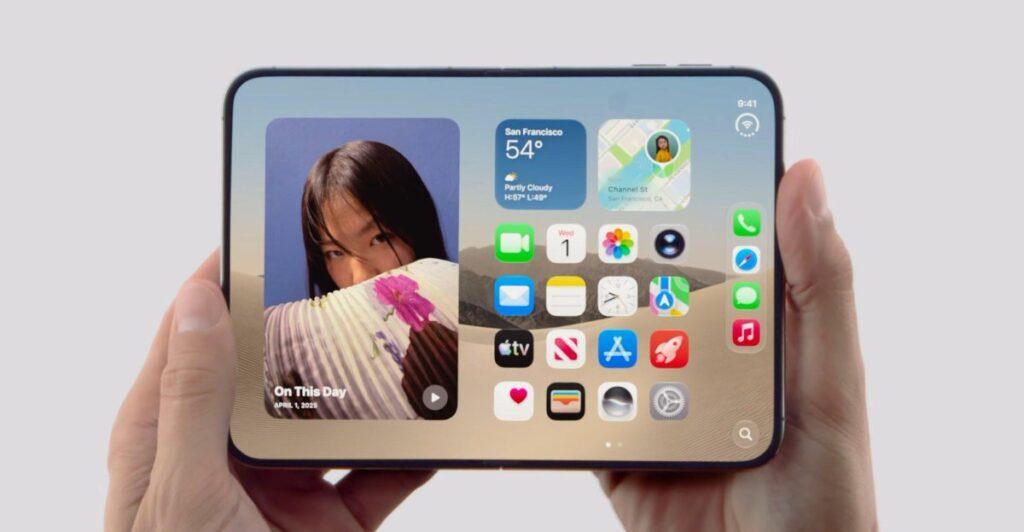

The iPhone Duo is Apple’s first foldable

News Room

Apple has announced its long-anticipated foldable iPhone, the iPhone Duo, which arrives more than seven years after the first Samsung Galaxy Fold hit the market.

The Duo will be available to preorder from October 16th, going on sale on October 23rd, a month later than the two 18 Pro models. It starts from $1,999 — $100 more than Samsung’s Galaxy Z Fold 8, but $100 less than its Z Fold 8 Ultra — for 256GB of storage, with the option to go up to 2TB total.

Much like Samsung’s recent Galaxy Z Fold 8, Apple says the Duo is a similar size to a passport when closed, with a 5.4-inch display, but opens to a 7.6-inch panel, the largest on any iPhone yet. Both screens use the exact same aspect ratio, and the large inner screen is 50 percent larger than the screen on the new iPhone 18 Pro Max, and 80 percent bigger than the iPhone Pro’s. Both screens support ProMotion, always-on displays, and up to 3,000 nits of peak brightness, and Apple says that Apple Pencil support is coming “later this year.”

Johny Srouji, Apple’s newly minted chief hardware officer, says the company didn’t want a crease or a plastic feel to the display, so used a custom nano-texture display material that is “perceptually flat.” It reduces glare and reflections, minimizing the visibility of the crease, and Apple says it also “feels great to touch.” Meanwhile the multilayer display stack used custom adhesives that Apple says allow the layers to “glide” over each other when folding, reducing how much the crease deepens and distorts over time. Oppo’s Find N6 from this spring is so far the foldable with the least noticeable crease, and I’m curious to see how the two compare.

The phone’s frame is primarily titanium, strengthened with internal ceramic fibers three times stronger than grade 5 titanium. There’s toughened Ceramic Shield glass on the rear, and Ceramic Shield 2 on the front. An IP68 rating should guarantee safety from both dust and water. It’s launching in two colors: star white, and a dark blue called night sky.

While you’ll see a selfie camera tucked into the rounded corner of the front screen, you won’t see the usual iPhone Dynamic Island or Face ID cameras. You won’t see any selfie cameras on the inner screen, but there is one there, with an under-display camera specifically for the foldable screen. Instead of Face ID, Touch ID is built into one of the side buttons.

Like the 18 Pro and Pro Max, the Duo is powered by Apple’s A20 Pro chip and C2 modem. The 2nm, six-core A20 Pro has two “desktop class” super cores, which Sribalan Santhanam, the VP of Apple’s silicon engineering group, says are “by far the fastest in any smartphone.” Four performance cores complete the CPU, which is joined by a seven-core GPU and two neural engines in the 32-core NPU. A new vapor chamber — three times the size of the previous generation’s — helps maintain thermal performance.

Rumors have swirled about a folding iPhone since at least 2017, when it was optimistically reported that production might begin in 2020. Since then, rivals including Samsung, Google, Huawei, Oppo, Honor, and more have released myriad foldable Android phones, including larger book-style models, smaller flip phones, and more recently trifolds. The market has remained relatively small, though — just 1.6 percent of all smartphone sales in 2025.

Different reports have claimed that Apple was developing variants of each of these form factors, plus larger foldable iPads, but over the last two years reporting has centered on a short, wide book-style foldable iPhone, about the size and shape of a passport when closed. That expectation is likely part of what prompted Huawei, Samsung, and Xiaomi to all release foldable phones in roughly that form factor this year, proving Apple’s industry influence remains outsize.

Developing… see our live blog for the latest details.

Follow topics and authors from this story to see more like this in your personalized homepage feed and to receive email updates.


Read the full article here

Share This Article
Leave a comment

Leave a Reply

Your email address will not be published. Required fields are marked *