

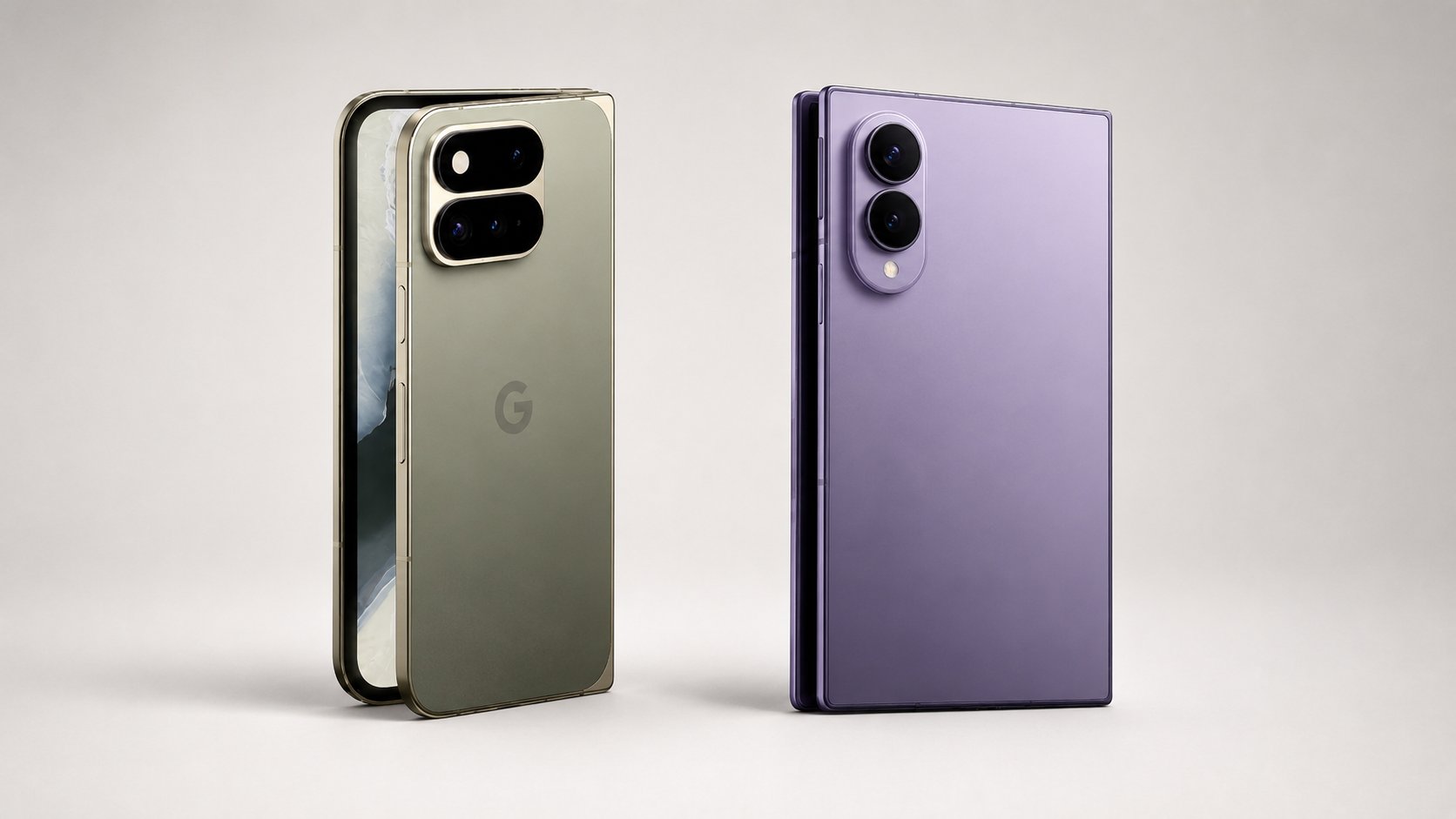

At roughly $1,900 apiece, Google’s Pixel 11 Pro Fold and Samsung’s Galaxy Z Fold8 make very different cases for a place in your work bag. Samsung emphasizes lighter hardware and stronger productivity tools, while Google offers more base RAM, better dust protection, built-in magnetic charging, and longer optical zoom.
For work, the Galaxy Z Fold8 has the stronger overall case, especially for users who want desktop-style flexibility from a phone. The Pixel remains competitive for everyday use, but independent testing shows its Tensor G6 processor still trails current Qualcomm flagship silicon in raw performance.
| Feature | Pixel 11 Pro Fold | Galaxy Z Fold8 |
|---|---|---|
| Starting price | About $1,900 | About $1,900 |
| Processor | Google Tensor G6 | Snapdragon 8 Elite Gen 5 for Galaxy |
| RAM | 16GB | 12GB or 16GB |
| Weight | 239g | 201g |
| Dust/water rating | IP68 | IP48 |
| Wired charging | 30W charger or higher for fast charging | Up to 45W |
| Magnetic wireless charging | Qi2.2, up to 25W | Requires magnetic case for alignment |
| Telephoto camera | Dedicated 5x optical zoom | No dedicated telephoto |
| Desktop mode | Standard Android multitasking | Samsung DeX |
| Best fit | Durability, charging, optical zoom | Productivity, portability, performance |
Samsung has the stronger productivity setup
The Fold8 runs Qualcomm’s Snapdragon 8 Elite Gen 5 for Galaxy, with Samsung listing 12GB or 16GB of memory depending on configuration. Google gives the Pixel 16GB across its storage options, while the broader Pixel 11 lineup varies by model and storage.
In Tom’s Guide testing of the Pixel, Tensor G6 lagged competing Qualcomm flagship processors in benchmarks, although everyday operation and split-screen multitasking remained smooth.
Samsung’s software gives it another productivity advantage. Multi Window supports split-screen and pop-up apps, while Samsung DeX turns the Fold8 into a desktop-style workspace on an external display. The broader shift toward using Android phones as desktop PCs makes that capability useful for mobile workers.
Both devices have lengthy support commitments. Google promises seven years of OS and security updates, while Samsung promises seven generations of OS upgrades and seven years of security updates. The Fold8 is also slated to gain tap-to-share Quick Share support.
Pixel has compelling everyday-use advantages
Google’s Pixel 11 Pro Fold specifications include IP68 dust and water resistance, 25W Qi2.2 magnetic wireless charging, and a dedicated 5x telephoto camera. Samsung’s Fold8 is rated IP48 and lacks a dedicated telephoto lens.
Samsung is considerably lighter. The Galaxy Z Fold8 weighs 201 grams, 38 grams less than the Pixel, and supports up to 45W wired charging versus the Pixel’s 30W.
The Pixel’s size and software behavior introduce some everyday trade-offs. The Verge’s review noted its bulkier design and more visible inner-display crease, while Tom’s Guide encountered app-scaling problems and measured 12 hours and 31 minutes of battery life.
Organizations considering either device for wider deployment should test their MDM platform, business apps, conferencing tools, and accessories first, since fleet compatibility and support costs can outweigh consumer-facing spec differences. Samsung’s lighter hardware, stronger processor performance, multitasking tools, and DeX support make the Galaxy Z Fold8 the better work-focused choice. The Pixel is more compelling for buyers prioritizing dust protection, magnetic charging, and optical zoom.
Read more: For another same-price flagship decision, see how the Pixel 11 Pro compares with the iPhone 17 Pro across cameras, AI features, video tools, and software support.
Read the full article here