




Google Maps Gets New Gemini Agent Features for Orders, Hotels, and Events

News Room

Google wants Maps to become less of a navigation app and more of a personal assistant.

New AI capabilities in Ask Maps can help users find restaurants, prepare food orders, compare hotels, discover events, and surface personalized recommendations using context from connected Google services. The experience can carry out several steps on a user’s behalf, but Google still requires people to approve purchases, reservations, and other final actions.

The move is also the latest sign of Google’s broader strategy to make Gemini the intelligence layer across its products rather than a standalone chatbot. 

After embedding its AI into services such as Search, Chrome, Android, and Workspace, Google is now giving Ask Maps — the Gemini version for Maps — more autonomy, gradually turning its geographical data into points of execution. 

Agentic, but with limits

Google is bringing more more features to Maps, but the company is stopping short of handing full control to Gemini. Instead of autonomously completing tasks end-to-end, Ask Maps acts more like a digital assistant, handling the preparation work before asking users to make the final decision.

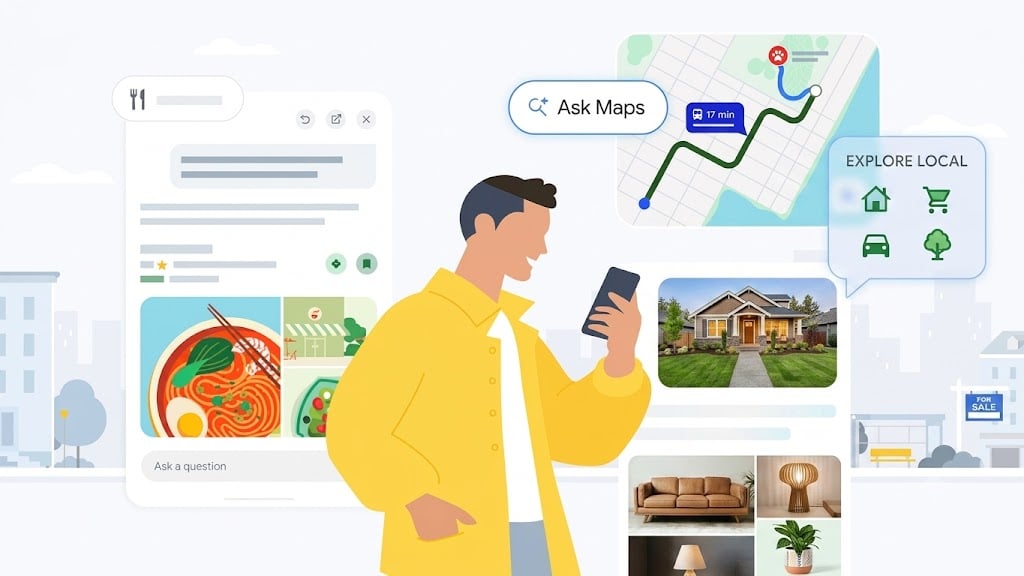
For example, when ordering food, the AI can understand a conversational request, find matching restaurants along a user’s route, add the selected meal to the cart, and present it for review and checkout.

Image: Google

The same pattern applies to hotel bookings and event discovery, where Ask Maps compares options and surfaces relevant results, but still redirects users to complete reservations or ticket purchases themselves.

That design appears intentional. Google handles discovery and preparation while requiring users to approve purchases and reservations.

The approach also reflects Google’s broader method to agentic AI so far: letting Gemini handle repetitive workflows while leaving high-impact decisions to people.

Personal Intelligence gives Maps memory

Google is also introducing Personal Intelligence for Maps, an opt-in capability that allows Ask Maps to tailor responses using information from other Google services. Rather than treating every request as a standalone prompt, the AI model can draw on context from connected apps — starting with Gmail and later Calendar — to better understand a user’s plans and preferences.

That means users can ask more naturally without having to repeat information they’ve already shared elsewhere. For instance, if a flight confirmation is sitting in Gmail, Ask Maps could recommend hotels near the destination or suggest places to eat after arrival.

Broader implications and availability

Google’s broader strategy is becoming clearer: Gemini is increasingly valuable not as a standalone chatbot, but as a layer connecting Search, Gmail, Calendar, Maps, Android, and other services.

For users, that could mean fewer steps between asking for something and getting it done. The tradeoff is that the most personalized version of that experience depends on giving Gemini access to more context across Google’s ecosystem.

That balance — how much autonomy and personal data users are willing to give an AI assistant in exchange for convenience — may become one of the defining questions as Google pushes Maps beyond navigation.

Related News: Google is phasing out Google Assistant on Android as it shifts users toward Gemini as its primary AI assistant.

Read the full article here

Share This Article
Leave a comment

Leave a Reply

Your email address will not be published. Required fields are marked *