


A smartwatch can cost hundreds of dollars and still reach the end of major software updates while the hardware works perfectly well.
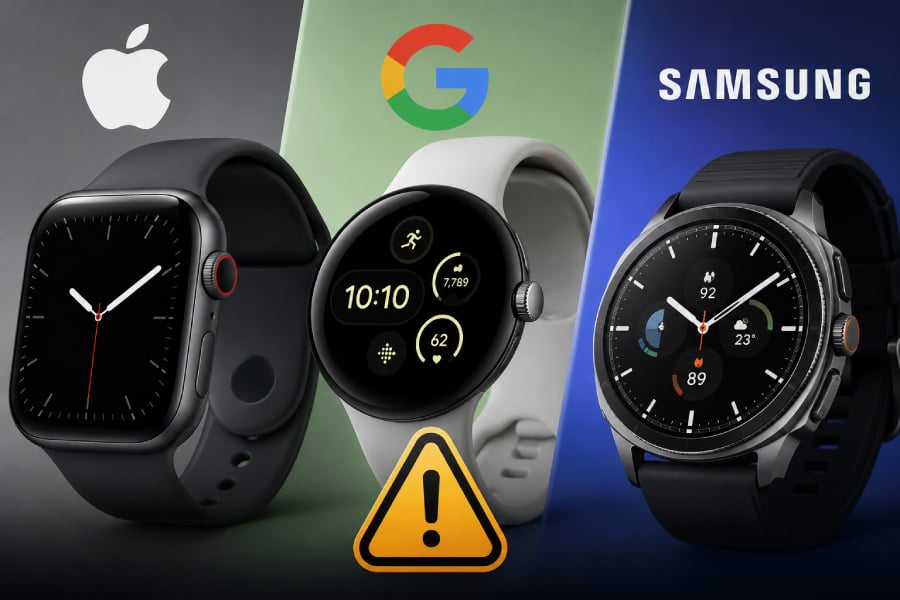
Several Apple, Google, and Samsung watches are approaching the end of their guaranteed software-update periods this year, giving owners a clear look at how quickly wearable hardware can fall behind even while it remains physically usable.
The deadlines do not all mean the same thing. Some watches are losing compatibility with the newest operating system, while others are reaching the end of guaranteed OS updates even though security fixes may continue.
Apple’s watchOS 27 leaves the Series 6, Series 7, Series 8, second-generation SE and first-generation Ultra behind. Google’s Pixel Watch 2 reaches its guaranteed software-support deadline in October, and Samsung’s Galaxy Watch 5 and Watch 5 Pro are nearing the end of their guaranteed major Wear OS upgrades.
The timing is especially interesting because manufacturers are simultaneously pushing newer watches toward more demanding capabilities.
Apple’s latest watchOS adds Apple Intelligence-powered Siri features, Google is pushing the Pixel Watch 5 toward proactive Gemini assistance and health tracking, while Samsung’s newest watches are getting newer hardware and longer update commitments.
Apple has a large and surprising cutoff
Just two weeks ago, Apple added two of its most iconic devices — the iPhone X and the 2018 15-inch MacBook Pro — to the obsolete category. And now, Apple Watch users would have to realize that time is almost up on several Apple Watches.
With watchOS 27, Apple is ending software support for the following:
- Apple Watch Series 6: The 2020 model introduced blood oxygen monitoring, an always-on display and the S6 chip.
- Apple Watch Series 7: Its standout upgrades included a larger display, thinner bezels, faster charging and improved durability.
- Apple Watch Series 8: Released in 2022, the Series 8 stands out because it is only about four years old. It is a more notable casualty, bringing temperature sensing and Crash Detection alongside ECG and blood oxygen monitoring.
- Apple Watch SE 2: Apple’s cheaper option offers Crash Detection, fall detection, and heart rate monitoring, but lacks some of the premium Series features.
- Apple Watch Ultra: Apple’s first rugged smartwatch brought a 49mm titanium case, Action button, dual-frequency GPS, depth sensing, and a larger battery.
Which newer models remain supported
Apple’s current supported lineup includes the Series 9, Series 10, Series 11, Ultra 2, Ultra 3, and SE 3.
Must-read Apple coverage
Google has one watch nearing the cutoff
Google’s list is much shorter, but its support timeline may be more surprising. Endgadget reports that the Pixel Watch 2, released in October 2023, is approaching the end of its guaranteed software support period.
When paired with the software lifecycle of its smartphones — which can be up to seven years — one begins to see just how short this software update limit really is.
- Pixel Watch 2: Google’s second-generation smartwatch brought the Snapdragon W5 Gen 1, 2GB of RAM, improved battery life, faster charging, continuous heart rate tracking, skin temperature sensing, and Fitbit integration.
Which newer models remain supported
Google has since moved through the Pixel Watch 3, Pixel Watch 4 and Pixel Watch 5, with the newer generations pushing further into Gemini-powered assistance, health monitoring and proactive features.
Samsung also has cutoff plans
Samsung’s affected list is also short, with the Galaxy Watch 5 and Watch 5 Pro approaching the end of their guaranteed Wear OS upgrade period.
- Galaxy Watch 5: The 2022 model introduced a BioActive Sensor, ECG, body composition analysis, sleep tracking, and temperature sensing, making it one of Samsung’s more health-focused watches.
- Galaxy Watch 5 Pro: Built for outdoor users, it stood out with a titanium case, GPS route tracking, and longer 590mAh battery life than the standard Watch 5.
Samsung guarantees Wear OS upgrades for the Watch 5 generation through December 31, 2026. However, that is not the same as the end of security support. Samsung’s update policy can keep security fixes coming after major OS upgrades stop.
Which newer models remain supported
Samsung has since moved to newer generations, including the Galaxy Watch 9 and Galaxy Watch Ultra 2, which add new health features and hardware and software capabilities.
After the end of support, what’s next?
The end of software support does not mean a smartwatch suddenly becomes useless. It can still handle its core functions, but the lack of updates means no new OS features, fewer bug fixes, and eventually weaker compatibility with newer apps and services.
Security is another consideration, even if smartwatch vulnerabilities rarely attract the same attention as smartphone flaws. As security fixes stop, known weaknesses can remain unpatched, increasing user risk.
Hardware limitations can also make the cutoff unavoidable. Newer features often require more capable processors, sensors, or other components, meaning an older watch may simply lack the necessary components to support the latest software.
Owners should therefore check the exact type of support their watch is losing before replacing it. The end of major feature updates is different from the end of security patches, and neither necessarily means the device has reached the end of its useful life.
Replacement becomes more worth considering when security updates stop, important apps no longer work, or a newer phone can no longer pair properly with the watch.
For owners of the models approaching their 2026 deadlines, the key is not to panic-upgrade, but to know which updates are ending and watch for the next support milestone.
Other smartwatch news: TechRepublic compared the Apple Watch Ultra 3 and Galaxy Watch Ultra2, finding Samsung offers longer advertised battery life for $99 less, while Apple has the edge in satellite communication features.
Read the full article here