


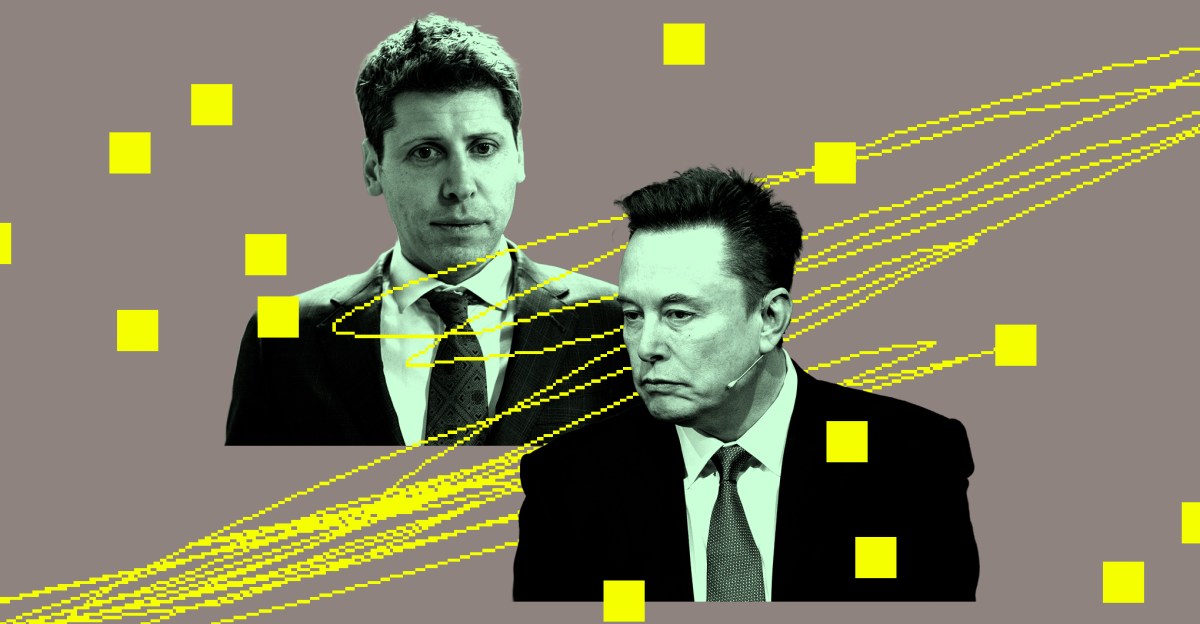

The Musk v. Altman trial is underway, and that means exhibits, or the evidence to be presented in court, are being revealed piece by piece. So far, email exchanges, photos, and corporate documents are circulating from the earliest days of OpenAI — and from before the AI lab even had a name. Some high-level takeaways: Nvidia CEO Jensen Huang gave OpenAI an in-demand supercomputer, Musk largely drafted OpenAI’s mission and heavily influenced its early structure, OpenAI CEO Sam Altman appeared to want to lean heavily on Y Combinator for early support for OpenAI, OpenAI president Greg Brockman and Ilya Sutskever worried about Musk’s level of control over the company, and Musk highlighted the importance of a nonprofit with a mission of broadly beneficial AI.
Musk’s buzzy lawsuit, which began its jury trial on Monday in a federal courtroom in California, names Altman, Brockman, and OpenAI investor Microsoft as defendants. It accuses them of breaching the company’s charitable trust, fraud, and unjust enrichment, but ultimately, Musk’s lawsuit boils down to whether or not OpenAI deviated from its founding mission of ensuring that artificial general intelligence — an often vaguely-defined term that denotes AI systems that equal or surpass human intelligence — benefits all of humanity. It’s the latest in a yearslong string of legal actions against OpenAI and its executives by Musk, who co-founded the AI lab alongside Altman and Brockman and was an early investor. (Musk also owns xAI, an AI lab that directly competes with OpenAI, and is owned by parent company SpaceX.)
Former OpenAI employees and people close to both companies have been watching this particular lawsuit with a close eye, since the outcome of a jury trial could have affected how OpenAI runs its business and controls its quickly-advancing technology. Plus, OpenAI and SpaceX are both reportedly racing to go public this year, so they’re more in the public eye than ever.
The lawsuit discovery process had already unearthed a lot of eyebrow-raising communications between AI industry executives, from emails between Altman and Sutskever to entries from Brockman’s own diary. Even texts between Meta CEO Mark Zuckerberg and Musk were made public. But that was all before the jury trial started — now, there’s even more set to be revealed.
Here’s an exhaustive list of all the exhibits that have been made public so far and the biggest takeaways from each one. Admittedly, not every item is necessarily interesting, so we’ve flagged the most important ones with an asterisk The Verge will keep updating the list as more are added.
A June 2015 email exchange between Altman and Musk. Altman lays out a five-part plan, involving an AI lab with a mission to “create the first general AI and use it for individual empowerment—ie, the distributed version of the future that seems the safest. More generally, safety should be a first-class requirement.”
He suggests that they start with seven to 10 people and expand from there, using an extra Y Combinator building located in Mountain View. Governance-wise, Altman names five people to start, proposing himself, Musk, Bill Gates, Pierre Omidyar, and Dustin Moskovitz. “The technology would be owned by the foundation and used ‘for the good of the world’, and in cases where it’s not obvious how that should be applied the 5 of us would decide,” Altman writes. He adds that the researchers working at the lab would have “significant financial upside … uncorrelated to what they build, which should eliminate some of the conflict,” and suggests paying them a “competitive salary” and awarding them equity in Y Combinator. He also says they should get someone to “run the team” but that that person “probably shouldn’t be on the governance board.”
Altman goes on to ask Musk whether he’ll be involved in the AI lab in addition to governance, potentially coming by once a month to talk about progress or at least being publicly supportive to help with recruiting. As a model, he names Peter Thiel’s “part-time partner” involvement at Y Combinator.
Finally, Altman mentions a “regulation letter,” seeming to imply that the AI lab was going to write a letter calling for AI regulation. He says he’s happy to leave Musk off as a public signatory.
Musk replies, “Agree on all.”
In an October 2015 email exchange between Altman and Musk, Altman suggests starting with a $100 million commitment by Musk and asks if he could donate an additional $30 million over the next five years.” He says Bill Gates isn’t yet committed to donating but that he hopes to “have him locked down next week,” adding that he believes Mark Zuckerberg likely won’t come through due to his own AI lab, Facebook AI Research (FAIR). He also suggests that he and Musk start as the first two members of the Safety Board with the potential to add three other members over the following year, calling it the “‘second key’ for releasing anything that could be dangerous.”
Musk responds, “Let’s discuss governance. This is critical. I don’t want to fund something that goes in what turns out to be the wrong direction.”
In a November 2015 email exchange between Musk and Altman, the two discuss plans for the forthcoming AI lab. Musk starts off by recounting a “great call with Greg [Brockman]” and saying he’s “super impressed with everyone so far,” calling it a “great team.” He suggests creating the lab as an “independent, pure play 501c3, but with a crystal clear focus on the positive advent of strong AI distributed widely to humanity.” He says the company would “still aim to bring in revenue in excess of costs at some point, but positive net revenue would just flow to cash reserves.”
With regards to compensation for employees, Musk suggests a cash salary and certain bonuses. He says that if Altman is amenable, employees could convert cash to stock in Y Combinator, adding that it’s fine if they’d rather convert some or all to SpaceX stock instead. (“I can pretty much do what I want on the SpaceX side, as it is private (thank goodness),” Musk writes.) He also offers “insane amounts of real world sensor data” from Tesla for the AI lab to use, mentioning that the amount of data is “several orders of magnitude greater than any other company.”
Musk’s first stab at a name for the AI lab is “Freemind,” as he says it “conveys the sense that we are trying to create digital intelligence that will be freely available to all — the opposite of Deepmind’s one-ring-to-rule-them-all approach.” He also says he’ll dedicate whatever amount of his time is useful, even though that could mean less time allocated to SpaceX and Tesla. “If I really believe that this is potentially the biggest near-term existential threat, then action should follow belief,” he writes. He adds later that, despite seemingly trying to be essentially a silent partner, he has to “bite the bullet on admitting real involvement. This will come as a shocker to many, but so be it. Can’t be lukewarm about this.”
Altman suggests the AI lab share a building with Y Combinator and use the incubator’s legal team to help get it started. He also suggests the names “Axon” or something related to famed computer scientist and mathematician Alan Turing.
Musk writes, “Something Turing-related that doesn’t sound too ominous might be good. Want to avoid the Turing Test association though, as that sounds too much like we are replacing humans.”
A December 2015 email exchange between Altman and Musk drafts the opening paragraphs of OpenAI’s mission and press release. Musk says the “whole point of this release is to attract top talent.” The two go back and forth on wording, and the final product ends up not straying too much from Musk’s original draft.
Musk writes in his draft that “the outcome of this venture is uncertain and the pay is low compared to what others will offer, but we believe the goal and the structure are right.” Altman writes in his draft that “because we don’t have any financial obligations, we can focus on the maximal positive human impact and disseminating AI technology as broadly as possible.”
OpenAI’s official articles of incorporation, filed December 8, 2015. The document states that OpenAI “shall be a nonprofit corporation organized exclusively for charitable purposes” and that its purpose is “to ensure that artificial general intelligence benefits all of humanity, including by conducting and/or funding artificial intelligence research. The corporation may also research and/or otherwise support efforts to safely develop and distribute such technology and its associated benefits, including analyzing the societal impacts of the technology and supporting related educational, economic, and safety policy research and initiatives.”
The document continues, “The resulting technology will benefit the public and the corporation will seek to distribute it for the public benefit when applicable. The corporation is not organized for the private gain of any person.”
An April 2016 email exchange between Musk and Nvidia CEO Jensen Huang. Musk asks Huang if the OpenAI team can buy an early unit of a supercomputer, making sure to highlight that “OpenAI is unaffiliated with Tesla. It is a non-profit funded by me and a few others with the goal of developing safe AGI (and hopefully not paving the road to hell with good intentions).”
Huang responds that he “will make sure OpenAI gets one of the first ones.”
A photo of Jensen Huang ostensibly dropping off said computer. Elon Musk stands nearby.
On the wall behind him is a lengthy quote sometimes attributed to U.S. Navy Admiral Hyman G. Rickover, which is echoed in a 2013 blog post by Altman. (The Verge couldn’t immediately confirm the whole quote was said by Rickover; in a US Navy post attributed to the admiral, only part of the quote appears: “Man has a large capacity for effort. But it is so much greater than we think it is, that few ever reach this capacity.”)
In an August 2017 email exchange between Musk and Shivon Zilis, Musk’s chief of staff who eventually sat on OpenAI’s board, and with whom Musk would eventually share multiple children. Zilis writes a recap of her meeting with Brockman and Sutskever, laying out seven unanswered questions. She says Brockman and Sutskever are fine with Musk spending less time on the company and having less control, or spending more time and having more control, but not less time and more control. They also hope to raise significantly more than $100 million to start, as they worry the data center they need alone would cost that much. She says Brockman is relatively set on an equal equity split. They also, she writes, worry about Musk’s control over the company. In her notes recapping their concerns, Zilis writes, “Is the requirement for absolute control? They wonder if there is a scenario where there could be some sort of creative overrule position if literally everyone else disagreed on direction.”
The biggest point of tension, Zilis writes, seems to be on Musk’s duration of control over the company, despite his 51% stake. “*The* non-negotiable seems to be an ironclad agreement to not have any one person have absolute control of AGI if it’s created. Satisfying this means a situation where, regardless of what happens to the three of them, [Greg, Ilya, and Sam] it’s guaranteed that power over the company is distributed after the 2-3 year initial period … An ironclad 2-3yr minority control agreement, regardless of the fates of Greg / Sam / Ilya.”
Musk responds, “This is very annoying. Please encourage them to go start a company. I’ve had enough.”
A September 2017 email to Musk from Jared Birchall, an adviser to Musk and manager of his family office. He attaches a “more user friendly version of the cap table that Ilya and Greg are proposing.”
In it, Musk is reflected as having 51.20% of equity, with Altman, Sutskever, and Brockman each having 11.01%, respectively. There’s also reserved equity for employees, and the cap table denotes each initial employee’s name or nickname followed by a proposed amount of equity.
Read the full article here