



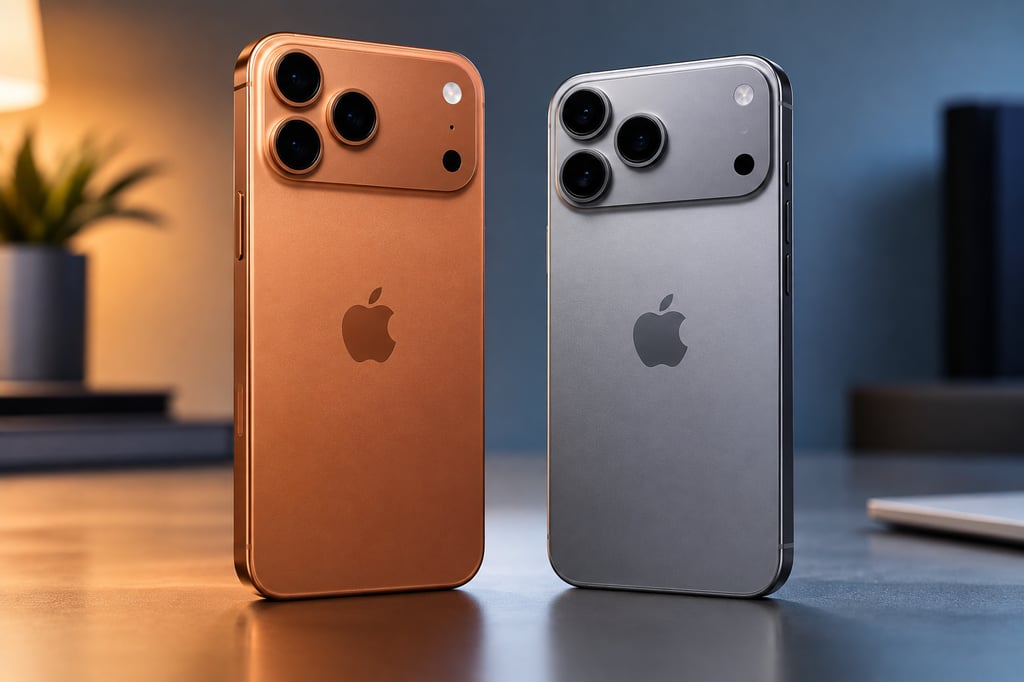

A year after the iPhone 17 Pro arrived, Apple is asking buyers to spend more for another round of upgrades. The iPhone 18 Pro brings a new A20 Pro chip, a variable-aperture camera, faster charging, slightly longer battery life, a smaller Dynamic Island, and up to 2TB of storage.
It also starts at $1,199, compared with the iPhone 17 Pro’s $1,099 launch price. For anyone who already owns last year’s Pro, that makes the decision less about which phone is better and more about whether the new features justify upgrading after just one generation.
| iPhone 18 Pro | iPhone 17 Pro | |
|---|---|---|
| US launch price, 256GB | $1,199 | $1,099 |
| 512GB launch price | $1,399 | $1,299 |
| 1TB launch price | $1,799 | $1,499 |
| Maximum storage | 2TB | 1TB |
| Chip | A20 Pro | A19 Pro |
| Display | 6.3-inch OLED, up to 120Hz | 6.3-inch OLED, up to 120Hz |
| Peak outdoor brightness | 3,000 nits | 3,000 nits |
| Main camera | 48MP, variable aperture | 48MP, fixed aperture |
| Telephoto | 4x optical, 8x optical-quality | 4x optical, 8x optical-quality |
| Video playback | Up to 36 hours | Up to 33 hours |
| 50% wired charge | Around 15 minutes | Around 20 minutes |
| Siri AI | ✔ | ✔ |
How we evaluated
For this comparison, we checked Apple’s official specifications and launch pricing for both generations, then considered early independent testing. We focused on the differences most likely to affect iPhone 17 Pro owners: price, cameras, performance, battery life, display, storage, and software.
How much more does the iPhone 18 Pro cost?
The 256GB iPhone 18 Pro launched at $1,199, compared with $1,099 for the 256GB iPhone 17 Pro. At 512GB, the difference is also $100: $1,399 for the 18 Pro versus $1,299 for the 17 Pro at launch.
At 1TB, the gap is much larger. The iPhone 18 Pro costs $1,799, compared with the iPhone 17 Pro’s $1,499 launch price. Apple has also added a 2TB option to the smaller Pro for the first time, priced at $2,399.
Apple has also raised prices on older iPhones following its latest product launch, so buyers comparing current models may find fewer discounted options than in previous years.
Pricing also differs by country. TechRepublic found that iPhone 18 Pro prices vary across Southeast Asia, so buyers outside the US should check local pricing before comparing the two generations.
For buyers looking at the standard 256GB model, the comparison is simple: the iPhone 18 Pro costs $100 more than the iPhone 17 Pro did at launch.
The camera is the biggest upgrade
The biggest hardware change is the iPhone 18 Pro’s new 48MP Fusion Main camera with variable aperture.
According to Apple, the camera can switch between ƒ/1.48, ƒ/1.8, ƒ/2.8, and ƒ/4.0. The Camera app also adds manual controls for aperture, shutter speed, white balance, and focus, along with a live histogram.
The iPhone 17 Pro already has three 48MP rear cameras, including 4x optical telephoto and an 8x optical-quality option. It also supports ProRes RAW, Apple Log 2, and genlock, which Apple introduced with the 17 Pro.
That means the 18 Pro is building on an already capable camera system rather than replacing it. The main difference is the extra control it gives photographers before they shoot.
Early testing supports that view. The Verge found the variable aperture useful for low-light photos, close subjects, and controlling depth of field, but said many of the image-quality differences were subtle. The feature is most useful for people who want to adjust camera settings themselves rather than rely entirely on automatic mode.
The 18 Pro also adds 4K Dolby Vision time-lapse recording, improved focus tracking, post-capture Cinematic effects, and Apple Reference Image for comparing an edited photo with signed sensor data captured alongside the original.
For photographers and video creators, these camera changes are the clearest reason to consider upgrading.
A20 Pro is faster, but battery gains are smaller
The iPhone 18 Pro replaces the A19 Pro with the new A20 Pro, built on a 2-nanometer process.
Apple says the seven-core GPU is up to 40% faster than the A19 Pro, while the dual 16-core Neural Engine doubles AI processing capacity. The redesigned vapor chamber also has three times the surface area of the cooling system used in the iPhone 17 Pro.
Those improvements should be most noticeable during gaming, video editing, and other demanding tasks. For messaging, browsing, streaming, and everyday apps, the A19 Pro remains more than capable.
Battery life improves, but not by a huge amount. Apple rates the US eSIM-only iPhone 18 Pro for up to 36 hours of video playback, compared with up to 33 hours for the iPhone 17 Pro.
Charging is also quicker. The iPhone 18 Pro can reach 50% in around 15 minutes with a compatible 60W or higher adapter. Apple rated the iPhone 17 Pro for around 20 minutes to reach the same level with a compatible adapter.
The extra battery life and faster charging are useful, especially for owners whose iPhone 17 Pro battery has already started to lose capacity, but they are unlikely to justify an upgrade on their own.
Display and Siri are mostly unchanged
The display is very similar across both generations.
Both phones have a 6.3-inch Super Retina XDR OLED display with ProMotion up to 120Hz, Always-On support, and up to 3,000 nits of peak outdoor brightness.
The iPhone 18 Pro has a smaller Dynamic Island that can show up to three Live Activities at once, but the overall display experience is largely unchanged.
Software is also similar.
Siri AI and Apple Intelligence run on both the iPhone 17 Pro and iPhone 18 Pro with iOS 27. Apple also lists both generations among the devices that can run its most powerful on-device AI model.
So iPhone 17 Pro owners don’t need to upgrade just to get Apple’s new Siri features.
Should you upgrade?
For most iPhone 17 Pro owners, upgrading after one year is difficult to justify.
The iPhone 18 Pro makes the most sense for people who want the variable aperture camera and manual photography controls. It may also appeal to buyers who need more than 1TB of storage, regularly use demanding games or creative apps, or want the modest battery and charging improvements.
For everyone else, the similarities between the two generations are substantial. The display is nearly unchanged, Siri AI works on both phones, and the A19 Pro still has plenty of performance for everyday use.
If your iPhone 17 Pro is working well, keeping it for another year is the more practical choice.
Buyers who are not committed to iOS can also compare the iPhone 18 Pro with the Pixel 11 Pro before spending more than $1,000 on a new flagship.
The iPhone 18 Pro is clearly the newer and more capable phone, but the biggest differences are concentrated in the camera, storage, and performance. For many iPhone 17 Pro owners, those upgrades will not change everyday use enough to make replacing a year-old phone worthwhile.
Also read: AirPods 5 and AirPods Pro 3 offer different trade-offs in noise cancellation, battery life, fit, and health features.
Read the full article here