



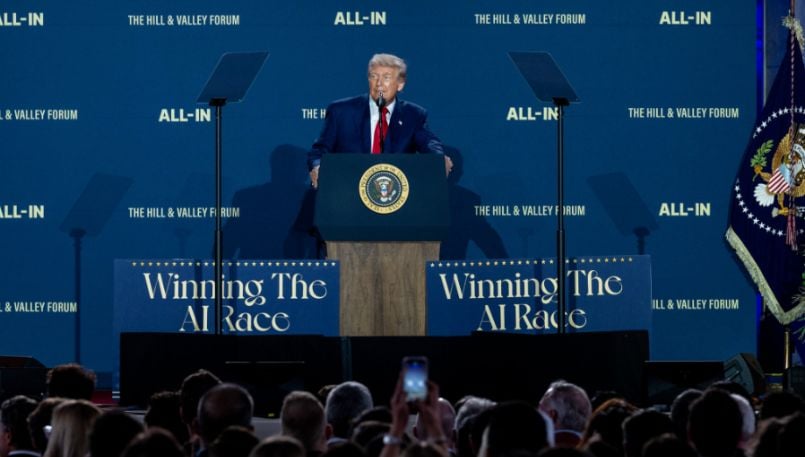

President Donald Trump interrupted Nvidia CEO Jensen Huang’s appearance at the All-In Summit in Los Angeles on Monday — by calling Huang’s cellphone while he was onstage.
Huang put the president on speaker, turning the unexpected call into a public exchange about AI development and the data centers needed to support it. Trump dismissed fears of an AI takeover while arguing that the U.S. should continue expanding the industry rather than slow development.
“The robots will not be taking over,” Trump said, according to a video posted on X by an attendee. “The AI will not be taking over the rest of the world. The whole thing is a hoax.”
Trump was referring to growing warnings about the risks of increasingly capable AI systems. He also criticized opposition to new AI data centers, saying, “The data centers are great, and they make people wealthy, and they make states wealthy.”
He called data centers “the oil of the next 20, 25 years,” while saying the country should proceed carefully.
“We have to be a little bit careful,” Trump said. “We have to do things and we have to do them prudently, but that doesn’t mean we’re going to stop an industry.”
Huang backs continued AI development
Huang did not challenge Trump’s position during the call. Instead, he told the president, “We’re going to make sure that everybody wins in the AI race in America. Every industry, every company, every state, every people.”
Huang has also questioned the predictions of catastrophic AI outcomes, while drawing a distinction between safety concerns inside AI companies and forecasts about the technology’s future.
“The whistleblowing is fine,” Huang said. “I think the scientific prediction about the future is less fine because it’s not grounded on science, obviously.” That position puts Huang closer to Trump than to some AI executives calling for stronger safeguards.
The debate behind the call
Anthropic CEO Dario Amodei published an essay over the weekend arguing that frontier AI development should be slowed and that companies should strengthen safety measures. OpenAI CEO Sam Altman and SpaceX CEO Elon Musk publicly backed the call, although the executives have differed on how such measures should work.
The debate intensified after former Anthropic researcher Jacob Coxon resigned and raised concerns about how quickly leading AI companies are developing their systems. Huang praised Coxon for speaking out but rejected predictions that AI could eventually destroy humanity.
Meanwhile, Microsoft released a draft code of conduct for its own AI work on Monday, calling for limits on the technology without advocating an industrywide halt.
More must-read AI coverage
What it means for AI infrastructure
The phone call puts two connected issues — AI safety and the enormous expansion of data centers needed to run AI systems — directly in the political spotlight.
For Nvidia, the stakes are especially high. Its chips are central to the AI infrastructure boom, and Trump has repeatedly backed data center construction.
But the disagreement over infrastructure is not simply a debate between AI acceleration and AI skepticism. TechCrunch reported that recent Gallup polling found 7 in 10 Americans oppose data center construction in their area, with environmental resources, living costs, and quality of life among the concerns cited.
For businesses planning AI infrastructure, that gap between national ambitions and local acceptance may become increasingly important. Access to chips is only one part of scaling AI; developers also need power, water, land, permits, and communities willing to host the facilities.
Even if Washington pushes for faster AI development, those constraints could still shape where projects get built, how quickly they come online, and what they ultimately cost.
Other news: King Charles III will host AI leaders from OpenAI, Google DeepMind, Anthropic, Nvidia, government, and nonprofits in Scotland to discuss voluntary principles for responsible AI development, testing, transparency, and human oversight.
Read the full article here