



Singapore is moving beyond soft recommendations on employee rights, making workplace fairness a matter of legal enforcement. In fact, the Singapore Parliament passed Singapore’s workplace fairness legislation in two stages. First, the Workplace Fairness Bill in January 2025 and, second, the Workplace Fairness (Dispute Resolution) Bill on November 4, 2025.
Together, the laws transform long-standing fair employment guidelines into enforceable legislation while giving companies a transition period to prepare. When the framework takes effect by the end of 2027, employers will not only need to follow fair workplace practices but also demonstrate compliance through clear and objective employment processes.
The Act is especially important for Human Resources (HR) teams. Routine decisions like hiring, appraisals, and even dismissals will need to be backed by clear, properly documented, and objective criteria. Non-compliance with this Act may result in legal actions against employers.
From guidelines to law: what HR teams should know
Currently, the Tripartite Guidelines for Fair Employment Practices (TGFEP) is the guiding framework that employers and employees rely on for fair workplace practices. However, it currently functions only as a guideline, with limited enforcement mechanisms.
Here comes the WFA. It draws from guidelines within the TGFEP and turns them into enforceable law. That means that adherence to the framework is no longer optional, but a must.
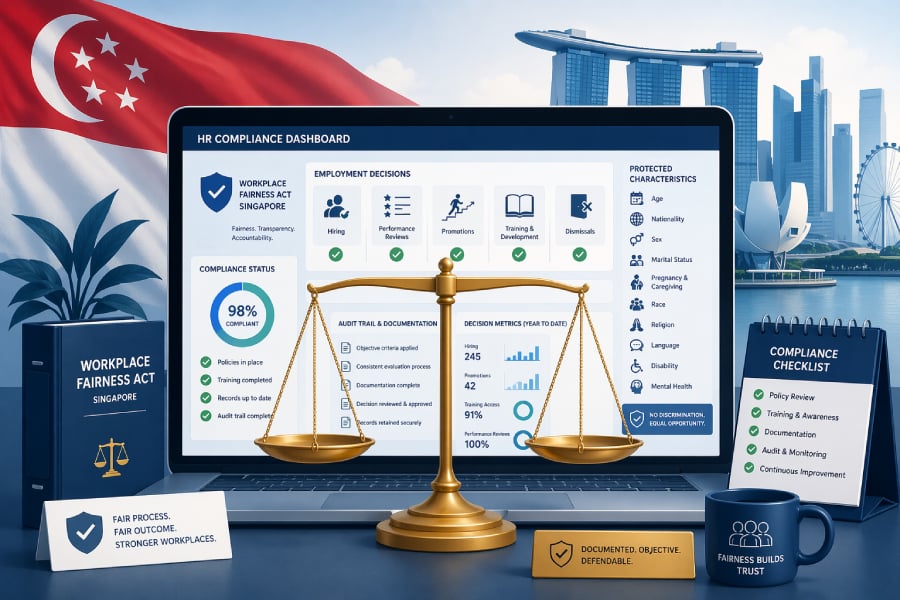
Under the WFA, employers, through their HR teams, must show that no employment decisions were biased. Employment decision here refers to any activity involving:
- Hiring and onboarding
- Performance reviews and appraisals
- Promotions and demotions
- Opportunity for career growth, including training or access to materials needed for work.
- Dismissals
Qualifying characteristics for bias, also known as protected characteristics, under the WFA include:
- Age
- Nationality
- Sex
- Marital status
- Pregnancy and caregiving responsibilities
- Race
- Religion
- Language abilities
- Disability
- Mental health conditions
However, there are flexible exceptions to this law. Employers with fewer than 25 employees at the time of implementation will be exempt from WFA, according to a report from The Straits Times.
The law permits certain distinctions when they are based on legitimate job requirements. For instance, hiring preferences for a specific sex are permitted when that sex is proven to be essential to the role’s performance.
The law isn’t a blanket dictate; it requires any difference in employee treatment to be clearly explainable and objective. This is especially important for companies that outsource HR responsibilities or use AI during employment decisions. HR systems and employment practices will need to comply with the WFA once it comes into force.
The three steps of dispute resolution, and what HR must prepare for
To enforce the WFA, the Parliament paired it with a Dispute Resolution bill. The bill outlines a guided process for individuals to file workplace discrimination claims against employers. For HR teams, understanding this part of the WFA means they are better positioned for compliance and can easily remediate any dispute before it costs the business settlement claims.
In order, the bill lists three steps to be followed:
- The internal remediation process: Employees are first mandated to seek resolution within the company. This stage falls directly on the shoulders of HR, and how well it is handled at this stage will determine whether the next sequence, if any, will be in HR’s favor or not.
- An external mediator: If the matter isn’t resolved internally, it is referred to a formal third party, such as the Tripartite Alliance for Dispute Management (TADM). The goal here is to mediate between both parties, and if it can’t be resolved at this stage, the dispute moves to legal proceedings.
- The Employment Claims Tribunal and High Court: This is the last stage of the three-step process. The Employment Claims Tribunal (ECT) will handle claims up to and including S$250,000, while the High Court handles claims above that amount. Disputes at the ECT will permit no lawyers, while the High Court allows lawyers for representation.
What’s hot at TechRepublic
What HR must keep in mind going forward
Documentation is key
It is not enough to make an employer’s action with vague justifications such as “this person deserves it more than the others.” HR must now show all the elements that were factored in before a decision was reached, and it must be objective.
Even with internal dispute resolution, the entire process must be documented and handled with objectivity, while protecting employees from future bias due to the complaint.
Clarity must be present in all HR processes
Employees must be educated on how decisions affecting them are made. Proper enlightenment of employees can significantly reduce the number of discrimination disputes made by employees against their employers. And the payoff goes beyond the settlement claims companies may pay.
Businesses dealing with zero or no disputes will ultimately have more time to focus on scaling business operations than those having to deal with disputes all the time.
Frivolous claims get dismissed in your favor
If an employee makes a frivolous claim, during internal investigation and resolution, communicate with them about it. If they still proceed through the next steps of the Dispute Resolution bill with the frivolous claim, come prepared with your findings. If found to be flimsy, the law now permits that it be dismissed, often with a fine attached to it.
Consistency is equally important
It’s not enough for HR teams to document all decisions; all decisions must follow a consistent standard across the organization. If two employees in a similar situation receive different outcomes, without an objective reason behind that, that can be seen as discrimination.
Under WFA, patterns matter just as much as individual cases. A single well-documented decision may hold up. But multiple inconsistent ones? That can quickly undermine your entire compliance position. To avoid this dilemma, HR teams must standardize criteria for all employer decisions, and as noted above, educate all regarding this standard criteria.
When put together, this puts HR teams at an advantageous position, giving them the knowledge to have a head start in compliance.
What the WFA means for HR teams across APAC companies
What WFA did is simple: it simplified and enforced the entire guidelines companies followed when creating their own internal policies. Its simplicity now makes compliance easier, ensuring that companies that might be operating with discriminatory practices understand where they stand and make adjustments.
Its 2027 enforcement timelines give HR teams more than enough room to transition and make changes that reflect the new law. Businesses that start now in implementing this new law will stand a better chance of being compliant, as the new change would have become a cultural norm by then.
For companies within APAC, Singapore is a regulatory signal. Other countries may follow soon. Hence, fair adjustments must be made before then.
Read the full article here