



If success is measured by commitment, then Samsung’s foldable business is now more successful than ever.
With the addition of the quirkily sized Galaxy Z Fold 8, introduced here at Samsung Galaxy Unpacked on July 22, there are now three Samsung Galaxy Z smartphone options to choose from. Sure, foldables account for perhaps a single percentage point of the overall smartphone market, but Samsung is now more committed to the category than ever. So, success, right?
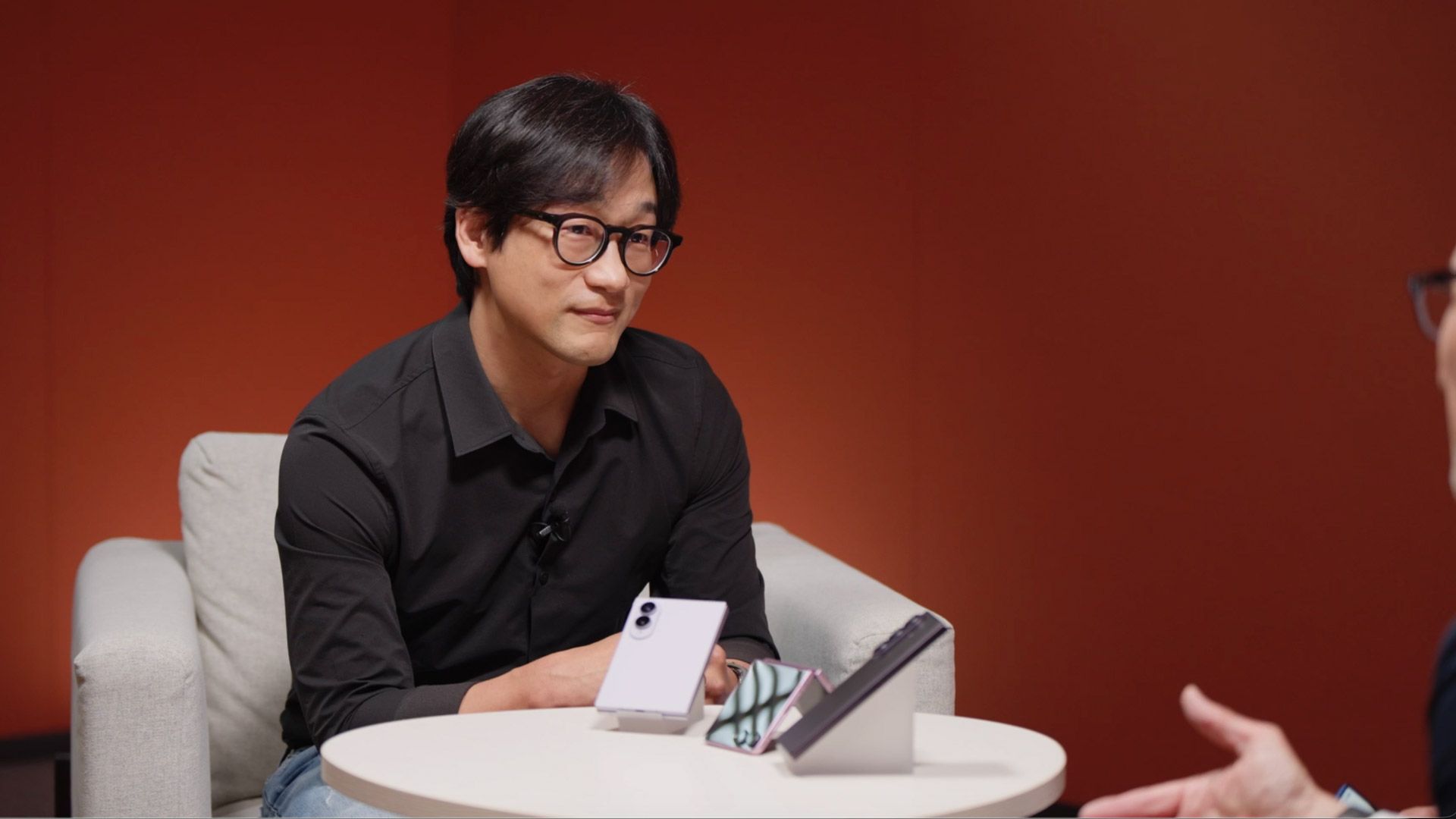
To understand that commitment, I, along with Tom’s Guide Global Editor in Chief Mark Spoonauer, sat down in Samsung’s South Korea headquarters a few weeks before the Galaxy Unpacked with Jay Kim, Samsung’s EVP and Head of CX Office, to talk about the newest foldables, how Samsung measures success, and the pesky new folding phone competitor that might be waiting in the wings.


Watch On
Getting to the Fold 8
Kim acknowledged the journey over now eight generations of foldable devices and told us that when the exquisite Galaxy Z Fold 7 arrived (it remains my favorite foldable but might be supplanted by the Z Fold 8 Ultra), something shifted.
Consumers stopped nitpicking core stumbling blocks of foldable phones like thickness or thinness. Instead, they were celebrating the core benefit, saying, in Kim’s words, “I have a phone that actually can be a tablet, and then that full capability of a phone is not compromising anything. So, we felt,” continued Kim, “like, ‘okay, now… consumers are really understanding why we’re pushing the boundary for such a long time.’”
So instead of bystanders watching a man balance a chair on his chin for no reason, they were on the journey with Samsung and getting excited about a device that could slip into a pocket as effortlessly as your classic flagship phone but also double as a productivity powerhouse.
So, we felt like, okay, now… consumers are really understanding why we’re pushing the boundary for such a long time.”
Samsung EVP Jay Kim
Sitting before us as we talked were all three of the latest Samsung Galaxy Z devices, but only one is a head-scratcher: the 4:3-ratio Galaxy Z Fold 8. Sure, its size makes it the lightest Fold ever, but the question remains: why? From the outside, it’s hard to understand how Samsung came to this design conclusion, let alone how consumers would react.
Samsung, though, tracks the demands and behaviours of its consumers, and Kim told us that the company saw signals that there was a market for this device, and it came to what sounds like a very scientific conclusion.
“When we looked at our consumer… insight on how people react to the products, almost over 50% are focused on media; they consume media, whether on the outside cover screen or the inside, the main screen; they engage in content, and we thought, ‘Why not?’”
That’s right, why not? It’s not necessarily a market research-tested conclusion, though Kim admitted that Samsung threw out a lot of designs before arriving on this content-friendly and still pocketable display size.
“We put together the form factor where the media makes most sense, the content native [form factor], but in terms of, like, how do you engage with the device? So basically, we looked at when you engage with content, what is the best form factor [that doesn’t] compromise anything on the full bar type,” recalled Kim. And by “bar type,” Kim is referring to slab phones like its Samsung Galaxy S26 Ultra.
How does Samsung know it’s on to a winning design with the Galaxy Z Fold 8? Well, it did test it, at least internally, and the feedback appears to have been positive.
“I’m really happy how our hardware and the design team came out with the product, because it’s beautiful, and when we test[ed] it with the market for the preview, everybody’s asking about when it’s coming,” said Kim.
Samsung may not have been excessively focused on the thinness of the Galaxy Z Fold 8 line, but it was, in one instance, acting on feedback about how hard it can be to open the Z Fold 7. “Folding and unfolding was some of the most important feedback we got [with last year’s phones].” The result in the Z Fold 8 Ultra is a chamfered frame that’s easier to pry open with a fingertip. “[They] spent days and nights changing the angles,” recalled Kim.
There will be thoughts
It’s also fair to say, though, that everyone will have an opinion about the Z Fold 8, which is arguably a confusing name because the follow-up to the Z Fold 7 is not the 8, but the Galaxy Z Fold 8 Ultra. The Z Fold 8 is, essentially, a totally new animal. And that size — the wide and squat cover screen, and the internal display that essentially unfolds to a screen quite similar in size and shape to your average Kindle ereader — is not going to be everyone’s cup of tea.
Yes, content like ebooks, comics, and video look great with smaller black bezels around them, but does the Galaxy Z Fold 8’s new aspect ratio help with things other than content consumption? Kim sees benefits there, too.
“How do people use a cover screen? Most of the time [what] they do is communication. So, you text a lot, and… [the cover display on the Galaxy Z Fold 8] is actually a pretty good size for texting.”
Kim told us he also thinks the cover screen is an optimal size for flicking through all that scrollable video content, too.
Since he has responsibility for not just these new foldables but for standard Galaxy phones (and XR glasses) too, I wondered how Kim (and therefore Samsung) explains to consumers that there might be value in a foldable device over a standard S26. After all, these flexi phones are priced at a considerable premium over standard smartphones.
Kim knows that most consumers are satisfied with standard phones: “At the same time, bar type is very confined to the screen size, so everything must be squeezed into the size, but I think there’s a consumer who would love to leverage different sizes of the display. You know, you have a size, but you can actually expand it to the bigger screen, or you can actually engage with content better, or you could be more productive. You can actually play a game on a bigger screen.”
No compromises
So, yes, there’s a market for those who feel constrained by the single screen size idea, but — and this is an early lesson Samsung learned —it’s not enough to just give a second screen size option on a single device. Samsung has arguably been doing that since the first Fold, but it was a terrible device.
“I think the only condition is you can’t compromise anything that you have on the bar type. So, on top of not compromising from bar type, if you can actually provide additional screen experience, I think there’s a need for the consumers,” added Kim.
It’s probably the reason why the Galaxy Z Fold 7 has been so well-reviewed. It is a no-compromise dual-screen device.
While the new Galaxy Z Fold 8 is by no means a compromise, it is a complication. We wondered how consumers might decide or be guided when they walk into, say, a Verizon store and consider the Z Fold 8, Z Flip 8, and Z Fold 8 Ultra.
“We’re happy for the consumer to make a choice,” said Kim, adding that the choice may boil down to where you spend most of your time on the phone.
People who like split screens and productivity — maybe they even set two phones side-by-side for double the productivity — they’ll gravitate toward the Galaxy Z 8 Ultra.
I think the only condition is you can’t compromise anything.
Jay Kim
“If you use a lot of media, you read books, or you play games, you know, if that’s like your focus area, then you take the Fold 8. And then if you are more, you know, very expressive, and you feel like you want to have a small phone in the pocket, and you want it to be glanceable, and then you want to have more of a native type of AI, a native type of experience, then you go with the Flip.”
There’s bound to be some market confusion as consumers adjust to the “Fold 8” being not the standard fold but the unusually shaped one, but Kim told us that Samsung spent a lot of time working on the names, and one thing was clear: “We weren’t trying to create a new category,” he said. This was still a Fold just in a different form factor and aspect ratio. “We went back to basics, saying it’s a Fold 8,” said Kim.
And while Samsung wondered how the market would react, Kim says the company is pleased with the level of attention. “Whether it’s a form factor, whether it’s a name, or anything, it’s a good sign [and] we were very happy that consumers and the market are very interested to get their hands on it.”
Kim, by the way, wouldn’t talk pricing for any of the new folds, but he did reveal that, like the rest of the industry, Samsung is grappling with RAM crisis challenges. “The costs of components going up is not just our problem; it’s an industry-wide problem… We take it pretty seriously, looking at [the] balance and [seeing] how to adjust based on the market situation. We’re not free from that and [are] addressing it very actively,” he told us.
What’s coming next and the Apple threat
While the Z Fold 8 is the exciting new look, the Z Fold 8 Ultra is now, at 4.1mm, essentially the same thickness as a USB-C port. It’s unlikely that the foldable could get any thinner without Samsung removing that port. I asked Kim if the company is considering doing so for future generations.
“Definitely, we look at all the options, but I think the most important thing is: do you need to make it thinner? That question is the most important. We made it thinner and lighter because that was the biggest sort of feedback we got for many, many years […] So, I think now consumers are asking for different things.”
We made it thinner and lighter because that was the biggest sort of feedback we got for many, many years […] So, I think now consumers are asking for different things.”
Samsung EVP Jay Kim
We also talked, naturally, about Apple. Most rumors point to a foldable iPhone Ultra possibly arriving in September, and it might even match the Galaxy Z Fold 8’s unusual aspect ratio.
Kim, though, doesn’t appear nervous about the industry’s most-watched company entering a market Samsung created.
“If our big sort of market player is coming into the market and bringing the fold type, then it proves that what I have been thinking and what I’ve been envisioning, and how much of the effort that we put in is actually the right direction. If not, they wouldn’t really come into the market,” said Kim diplomatically.
Apple’s anticipated entry will surely change the folding market, but only as a follow-up to the transformation Samsung has already wrought. “I think it’s important that we pushed the industry. [But] it’s a collaborative effort. I don’t think we could’ve done it just ourselves.”
If you believe Kim, Apple’s folding entry, if it arrives, could be seen as a major validation of Samsung’s years-long efforts. And, unless we are very mistaken, Apple will have one folding phone, while Samsung now has three. With that number of flexible devices and screen size and shape choices available on store shelves, that may be all the validation this still relatively young market needs.
We could even be approaching a foldables breakout moment. “I think we’re on the verge where [foldables] could actually become mainstream going forward. It has the potential,” Kim told us, “Because we had these two form factors for a very long time. Introducing another one is a bold move, actually, because that shows that we’re confident in the category and we’re confident in how the market is reacting to it. So I’m more excited about what’s to come than what we have achieved.”
Follow TechRadar on Google News and add us as a preferred source to get our expert news, reviews, and opinion in your feeds.
Read the full article here