



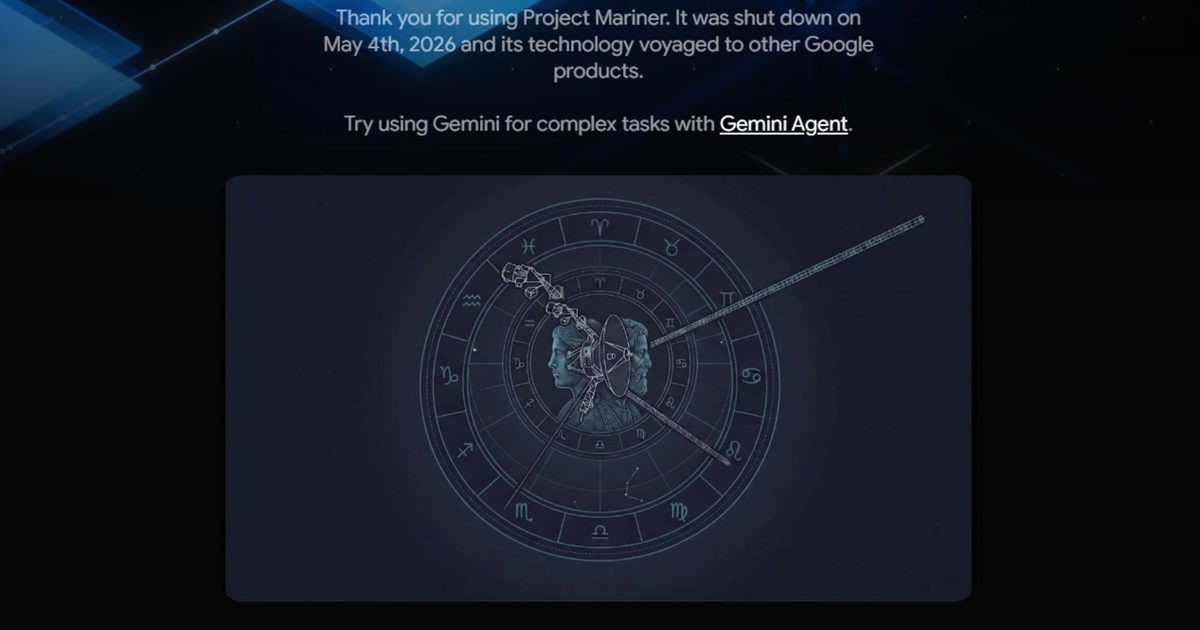

Google has shut down Project Mariner, the autonomous web browsing agent it debuted at I/O last year. The tool, which could navigate Chrome, fill out forms, search listings, and book travel by taking screenshots and visually recognizing page elements, is no longer available. Its landing page now shows a notice with the shutdown date listed as May 4, 2026.
A browser agent that saw what you saw
Project Mariner was Google DeepMind’s attempt to build an AI agent that interacted with websites the way a person would. Rather than reading page data directly, it processed screenshots in real time to identify buttons, text fields, and links, then clicked and typed on a user’s behalf. That approach lets it handle multi-step tasks across sites without requiring any special integration from the website.
The tradeoff was performance. Visual processing at that scale demands significant compute, and the method was prone to errors, such as selecting the wrong option on a page. The agent also raised privacy concerns, since it required continuous access to whatever was visible in a user’s browser at any given moment.
Signs of trouble first surfaced in March, when Wired reported Google had begun reassigning staffers away from the Project Mariner team, a signal the project was losing internal support months before the shutdown became public.
Mariner’s tech isn’t going away
Google says Mariner’s technology “voyaged to other Google products.” Its core features will reportedly be absorbed into the Gemini API and the new Gemini Agent rather than being discontinued outright.
The shutdown tracks with a wider shift in how the industry is building agentic AI. Tools that operate at the file and code level, rather than the visual browser level, have become the dominant model. They are faster, cheaper to run, and more capable of handling complex, multi-step tasks. Mariner’s screenshot-based approach, while novel at launch, was competing against an architecture that had effectively moved past it.
Read the full article here