





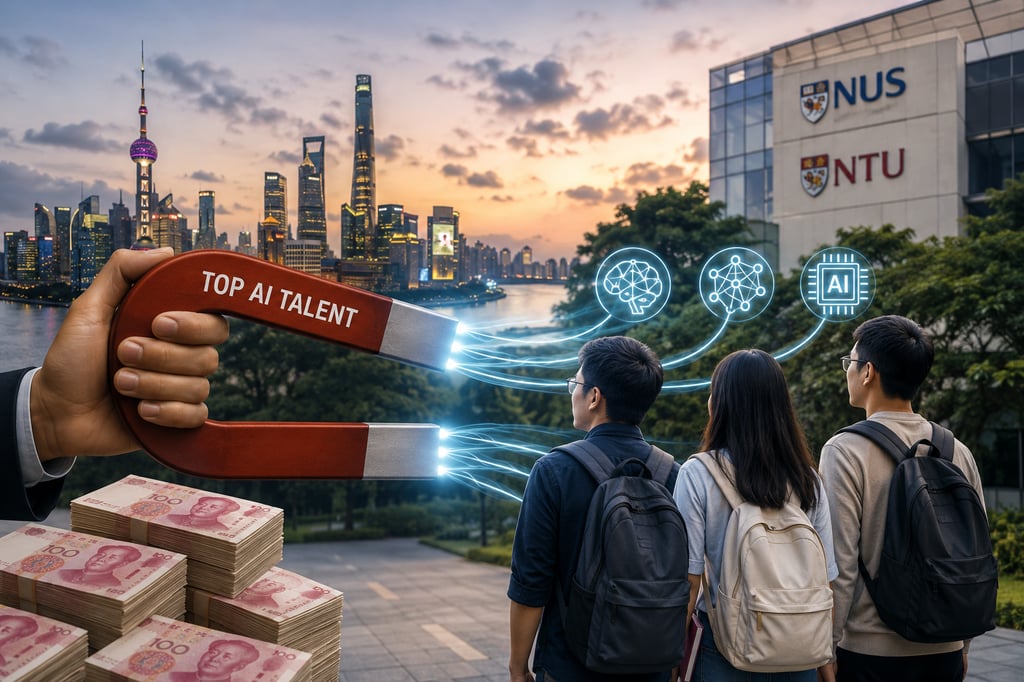

Chinese tech firms are turning Singaporean universities into hunting grounds for AI talent, paying record-high salaries to attract them.
Firms including Alibaba, MiniMax, ByteDance, and Huawei are now turning to the National University of Singapore (NUS) and Nanyang Technological University (NTU) as overseas recruiting centers for their AI talent.
Behind this push is a talent shortage that is growing too large to ignore: China faces a predicted deficit of 4 million AI professionals by 2030. Companies are now competing for the same limited pool of AI professionals rather than waiting for domestic pipelines to catch up.
Candidates are screened for their ability to connect AI across industries, with pay packages starting at around S$200,000. The strongest candidates are evaluated on the quality of their research papers and citation scores and can command twice as much, The Business Times reports.
Heavyweights behind the talent search
According to The Business Times, the talent hunt features some of China’s biggest technology players. Companies including Alibaba, ByteDance, MiniMax, and Huawei have shown interest in recruiting AI talent from both NUS and NTU.
The publication notes that Huawei has even gone so far as to organize conversations with engineers while pitching its open roles to students. Reported roles include AI algorithms, large language models (LLMs), and cybersecurity, all of which are critical to the development and deployment of AI systems.
The outlet also noted that these companies aren’t merely browsing for talent — they are offering record-high compensation packages.
While outstanding master’s and PhD-level hires commanded about 1 million yuan last year, this year’s figure has risen to around 1.5 million yuan, or about US$220,000. Citing Yuan Yijia, the report also suggested that these companies might offer stock options that could drive compensation well beyond the stated S$200,000-S$350,000 range.
PhD-level hires with excellent performance could command way more than that, according to Jason Yang. Yang, a China-based recruiter, says these PhD hires can command between 3 million and 5 million yuan, or around US$441,000 and US$735,000 per annum.
What’s behind the recruitment push
Although two-thirds of students at both universities are international, with Chinese students making up 50% of that group, the actual reason for the aggressive recruitment is beyond demographic favoritism.
China is facing a major AI talent shortage, and that gap could complicate its ambitions in the global AI race.
According to a McKinsey report cited by The Straits Times, China’s AI talent shortage could reach 4 million workers by 2030. That leaves the country’s rising AI sector in a double-edged dilemma, where the growth of AI firms is driving huge demand for AI expertise that is increasingly unavailable.
That talent shortage is now prompting companies like Huawei to cast a wider net, and Singapore-based talent appears to be a good fit. Huawei has confirmed that it “plans to increase its campus recruitment in Singapore this year,” but declined to provide specific numbers.
Whether overseas recruiting can meaningfully shrink China’s AI talent gap remains to be seen.
Also read: The 10 tech jobs growing fastest in 2026 include AI engineer and AI consultant roles, reflecting the same demand for specialized AI skills driving aggressive recruitment in Singapore.
Read the full article here