



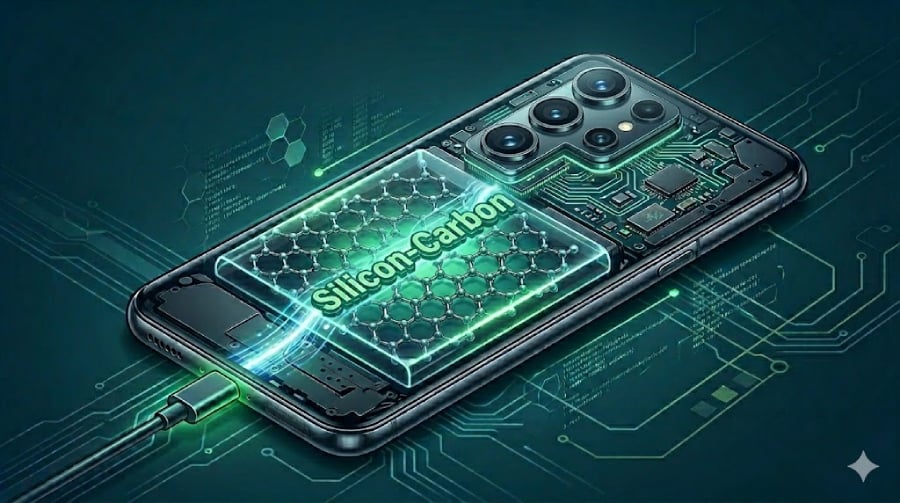

Samsung may finally be ready to fix its biggest phone weakness: battery life.
A new leak suggests the company is testing silicon-carbon batteries, which can deliver more capacity without adding bulk. Samsung reportedly hoped to bring the tech to the Galaxy S26, but durability issues may have pushed the upgrade to 2027. If that timeline holds, the Galaxy S27 could become one of Samsung’s biggest hardware jumps in years.
If Samsung gets this right, the Galaxy S27 may be the phone that finally makes battery anxiety feel outdated.
A tipster’s report
The tipster known as Schrödinger, in its report, seemed pretty confident about the claim. Citing leaked internal SDI files from Samsung, it claims that new battery capacities ranging from 12,000 to 20,000 mAh are being cell tested by Samsung engineers.
The claim also indicates that the initial planned launch of this battery was with the Galaxy S26 lineup. Still, hiccups experienced during testing have now pushed it to 2027, ideally falling with the debut of the S27.
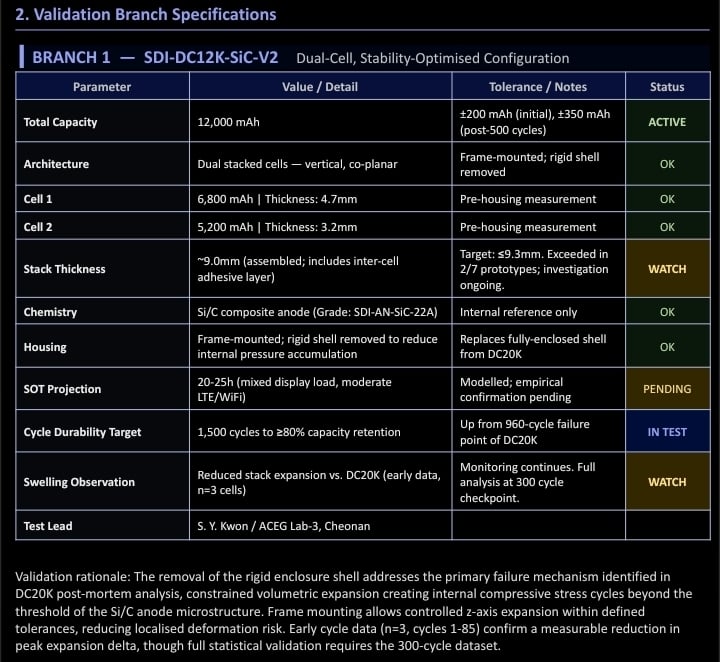
The report also confirmed that the silicon-carbon battery worked during Samsung’s testing. But it notes that it didn’t meet the company’s expected charge cycles, breaking at 960 cycles, which, while on the upside of battery cycles, isn’t the 1,500 cycles Samsung wants for its phones since they get years of software support.
The race for silicon-carbon batteries
Most smartphones and computers today use lithium batteries because of their balance of energy density, safety, and cost. But recently, many manufacturers have been shifting toward a different battery material: silicon-carbon. Manufacturers like Xiaomi, OnePlus, and Vivo are already deploying this material on some of their phones.
For example, Xiaomi, in its Redmi 15 Pro announcement, notes that the device has a high silicon carbon battery content, boosting its capacity to 6,500 mAh. While 6,500 mAh may look large, silicon-carbon batteries offer greater capacity. And Samsung may be about to demonstrate that.
One of the company’s leaked documents shows that it’s been working on a massive 12,000 mAh battery with two cells, each rated at 6,800 and 5,200 mAh. On top of that, these battery cells will occupy just the same amount of space as lithium batteries, ensuring slimmer devices.
What it could mean for Samsung
Samsung is a leading phone manufacturer, and if it succeeds with this, it could cause significant disruptions in the smartphone manufacturing industry. Already, flagship models often come with processors tuned to save battery; adding such a processor to this kind of battery capacity will take things to a whole new level.
The company is already playing catch-up. One leaker, yeux1122, cited by Schrödinger claims that Samsung’s Executive VP and Head of Smartphone R&D, Sung-Hoon Moon, acknowledged that the company is already behind with silicon-carbon battery phones.
Despite being behind, other big players like Apple and Pixel are apparently yet to make any moves regarding this battery innovation trend popular with South Asian phone manufacturers.
If Samsung releases a battery this big while retaining its overall phone dimensions, these competitors may be pressured to join the train — that is, if they’re not already on board.
Also read: Samsung’s latest budget 5G phone shows how the company is still expanding AI features beyond its flagship lineup.
Read the full article here