




Cisco’s new Antares models aim to shorten one of application security’s slowest jobs: finding where a known weakness may exist inside a large code repository. Released July 21, 2026, the two open-weight models narrow that search before a human analyst verifies the flaw.
Antares-350M and Antares-1B can run locally, allowing organizations to examine proprietary code without sending it to an outside AI service. They do not confirm vulnerabilities, assign severity, or generate fixes, so their output remains a starting point for investigation rather than a security verdict.
Antares searches before analysts verify
Antares works as a terminal-based code-search agent, not a stand-alone vulnerability scanner. Given a Common Weakness Enumeration, or CWE, identifier and a generic description, it uses commands such as grep, find, and cat to inspect a read-only repository copy and identify files that may contain the weakness.
Cisco’s Antares-1B documentation says the command-line tool can run targeted CWE investigations or repository-wide sweeps. It returns candidate files in human-readable, JSON, or SARIF format for use in existing review workflows. Similar AI-assisted vulnerability research shows how automation can narrow a large search area while analysts handle validation and reporting.
The models target different environments. Antares-350M has a 32,000-token context window for constrained deployments, while Antares-1B has a 128,000-token window and is designed for a single GPU.
Cisco says the models did not receive additional stand-alone safety alignment for conversational use. Teams should isolate the code-analysis environment, limit access, and verify model files and inference dependencies, especially as AI model supply-chain risks become part of enterprise deployment planning.
Local operation is a central selling point. Cisco says in its release announcement that Antares can localize potentially vulnerable files without relying on a cloud AI service, but air-gapped and locally hosted AI still requires controls for administrator access, updates, logging, model provenance, and data handling.
Benchmarks show promise and major limits
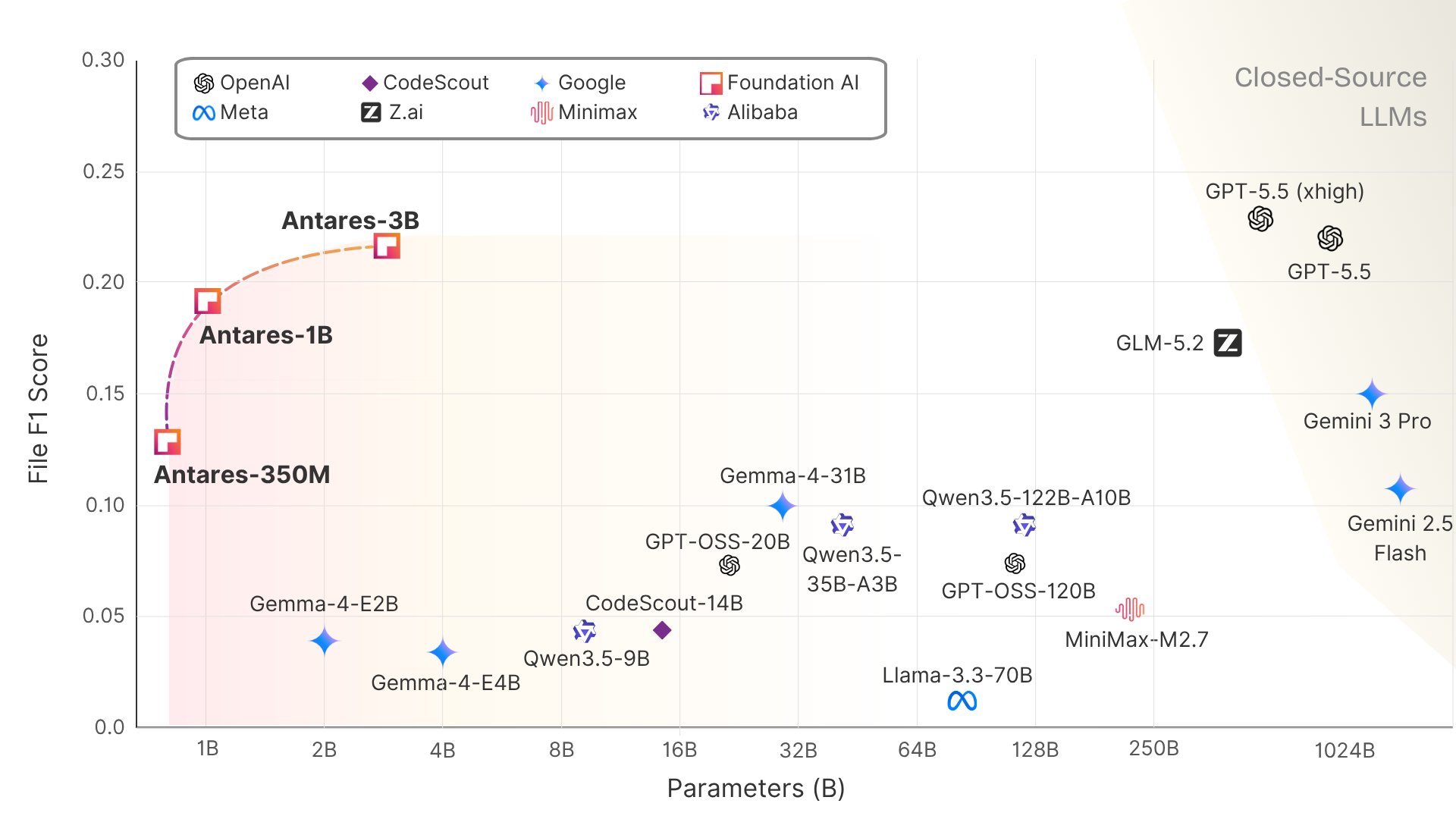
Cisco evaluated Antares on VLoc Bench, a benchmark it created from 500 tasks involving 290 repositories, six software ecosystems, and 147 CWE categories. Models receive a repository containing a known vulnerability and must identify the implementation files later changed by the security patch.
Antares-1B recorded a File F1 score of 0.209. Cisco’s unreleased Antares-3B reached 0.223, close to the leading GPT-5.5 configuration at 0.229, but even the highest score remained below 0.23.
Cisco also found that 190 of the 500 tasks were unsolved by every evaluated model. Performance fell as repositories grew, and vulnerabilities spanning at least five files were more difficult under the benchmark’s 15-command limit.
Antares-1B completed the full test in about 13 minutes on one Nvidia H100 GPU using 16 parallel workers. That result reflects Cisco’s evaluation environment and should not be treated as a guaranteed production runtime.
A pilot should measure false negatives, irrelevant file suggestions, analyst time saved, and performance across the organization’s own languages and repository structures. Antares should provide advisory leads rather than block builds, approve fixes, or replace static analysis and software composition analysis.
The Hugging Face repositories are public, but downloading the models requires contact information and manual approval. Antares may reduce code-triage time, but its findings still need human verification before they influence remediation decisions.
Read more: Local execution addresses only part of the risk; organizations also need runtime visibility and least-privilege access as AI systems gain tools, repository access, and authority to act.
Read the full article here