




Crypto payment gateways let businesses accept cryptocurrency without relying only on direct wallet-to-wallet transfers. Depending on the provider, merchants can accept crypto payments through a website checkout, invoice, QR code, payment link, ecommerce plugin, API, or POS workflow.
The best crypto payment gateway for your business depends on how much control you want over settlement, whether you want to hold crypto or convert it to fiat, which coins your customers use, and how much setup work your team can handle.
| NOWPayments | Overall flexibility | 0.5% transaction fee |
| BitPay | Multi-user access | 2% + 25 cents |
| Coinbase Commerce | Simple settlement | 1% transaction fee |
| OpenNode | Bitcoin payments | 1% transaction fee |
| Crypto.com Pay | Zero merchant transaction fees | 0% transaction fee; payout fees apply |
Top crypto payment gateways comparison
The best crypto payment gateway providers should support the payment methods, settlement model, ecommerce tools, and security controls your business needs. I compared each provider across fees, settlement, custody model, and Lightning support. All have API and ecommerce plugin integrations, too.
| NOWPayments | |||||
| BitPay | |||||
| Coinbase Commerce | |||||
| OpenNode | |||||
| Crypto.com Pay | |||||
| *Crypto transactions always incur a network or gas fee for executing operations on the blockchain. The transaction fee charged by the payment gateway is a separate fee. | |||||
What is a crypto payment gateway?
A crypto payment gateway is a payment tool that lets a business accept cryptocurrency from customers through a structured checkout flow. Instead of manually sharing a wallet address, a business can use hosted checkout pages, invoices, payment links, QR codes, ecommerce plugins, or APIs to collect crypto payments.
Some gateways convert payments into fiat currency, some send funds to a crypto wallet, and others let merchants choose between custody, crypto payout, or bank settlement.
Custodial vs non-custodial crypto payment gateways
| Custodial gateway | Provider holds funds before settlement or payout | Businesses that want easier setup and fiat conversion | Requires trust in the provider |
| Non-custodial gateway | Payments go directly to the merchant wallet | Businesses that want more control | More wallet and key management responsibility |
| Self-hosted gateway | Merchant runs the payment server | Technical teams and crypto-native businesses | Requires setup, hosting, maintenance, and security oversight |
NOWPayments: Best overall
Our rating: 4.54 out of 5
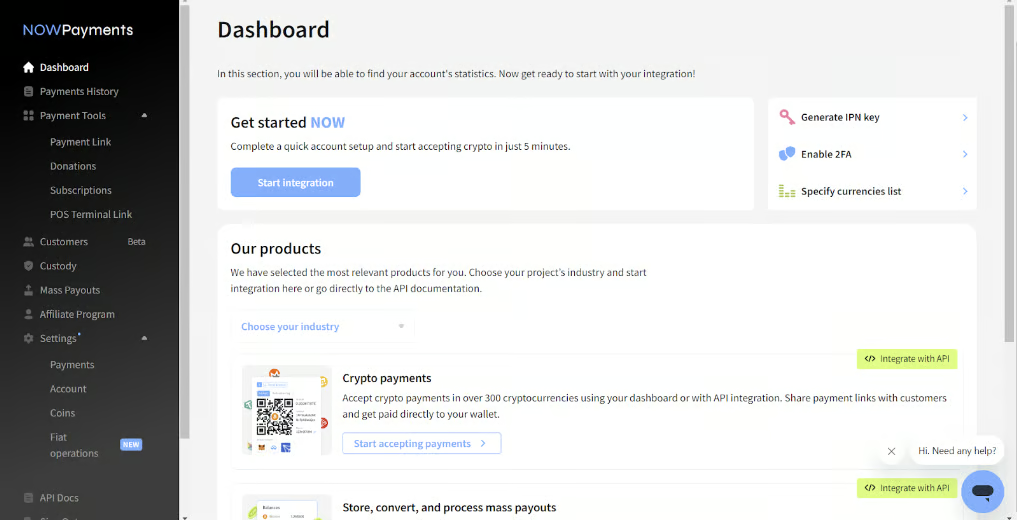
NOWPayments is a flexible cryptocurrency payment gateway that allows businesses to accept both crypto and fiat payments. It offers a range of integration options and settlement methods, giving merchants control over how they manage their funds.
Why I chose NOWPayments
NOWPayments’ biggest strength is the complete flexibility it provides to merchants when it comes to accepting payments. It allows merchants to receive both fiat and cryptocurrencies. Upon receiving the payment, the merchant has continued flexibility on what to do with it (keep it in the same currency or convert it to a different currency) and where to put it (keep the payment in custody or withdraw it to a crypto wallet or bank account).
Aside from the settlement flexibility, NOWPayments offers all the possible ways to accept crypto payments. Its Custody feature allows merchants to accept cryptocurrency payments without a crypto wallet and make currency exchanges without paying network fees. It also has a network fee optimization that can help minimize blockchain fees when converting or transferring cryptocurrencies.
NOWPayments offers a more comprehensive set of features than other crypto payment gateways on this list. This makes it an excellent fit for businesses seeking full control and flexibility in managing their crypto payments.
Who should use NOWPayments
- Businesses that want broad cryptocurrency support and flexible settlement options.
- Ecommerce sellers that need plugins for Shopify, WooCommerce, Magento, OpenCart, PrestaShop, or similar platforms.
- Merchants that want invoices, payment links, subscriptions, donation buttons, API access, custody, and wallet payouts.
When not to use NOWPayments
NOWPayments may not be the best fit if you want the simplest possible crypto checkout or a provider with stronger built-in reporting. Its flexibility is useful, but it can add setup and reconciliation work.
NOWPayments pricing
- Transaction fee: 0.5% for payments without exchange.
- Conversion fee: 0.5%.
Visit NOWPayments
Features
- Instant account registration.
- Accepts over 100 cryptocurrencies as payments.
- Settles in more than 20 fiat currencies.
- Custody feature.
- Ways to accept crypto payments:
- API integration.
- Invoices or payment links.
- Ecommerce plugins: PrestaShop, Magento 2, OpenCart, Zen Cart, Shopware, WooCommerce, WHMCS, Ecwid, Shopify.
- QR code.
- Subscription.
- Donation button.
- Payment flow:
- Accept crypto > keep in custody
- Accept crypto > convert to other cryptocurrency > keep in custody
- Accept fiat > convert to cryptocurrency > keep in custody
- Accept crypto > withdraw to your crypto wallet
- Accept crypto > convert to other cryptocurrency > withdraw to your crypto wallet
- Accept crypto > convert to fiat > withdraw to your bank account
- Custody balance > withdraw to your crypto wallet
- Custody balance > convert to fiat > withdraw to your bank account/
- Fixed-rate exchange option.
- Crypto-to-fiat withdrawal: 1 business day.
- Mass payouts.
- Network fee optimization.
- API to integrate with any mobile POS terminal.
- Sandbox environment for testing.
- 24/7 customer support.
Pros and cons
| Pros | Cons |
|---|---|
| Settlement flexibility. | Complex refund process. |
| Custody feature to save on network. fees for currency exchanges. | Limited reporting tools. |
| Accepts both crypto and fiat payments. | Minimum payment fluctuates. |
| API integration with any mobile POS terminal. |
BitPay: Best for multi-user access

Our rating: 4.30 out of 5
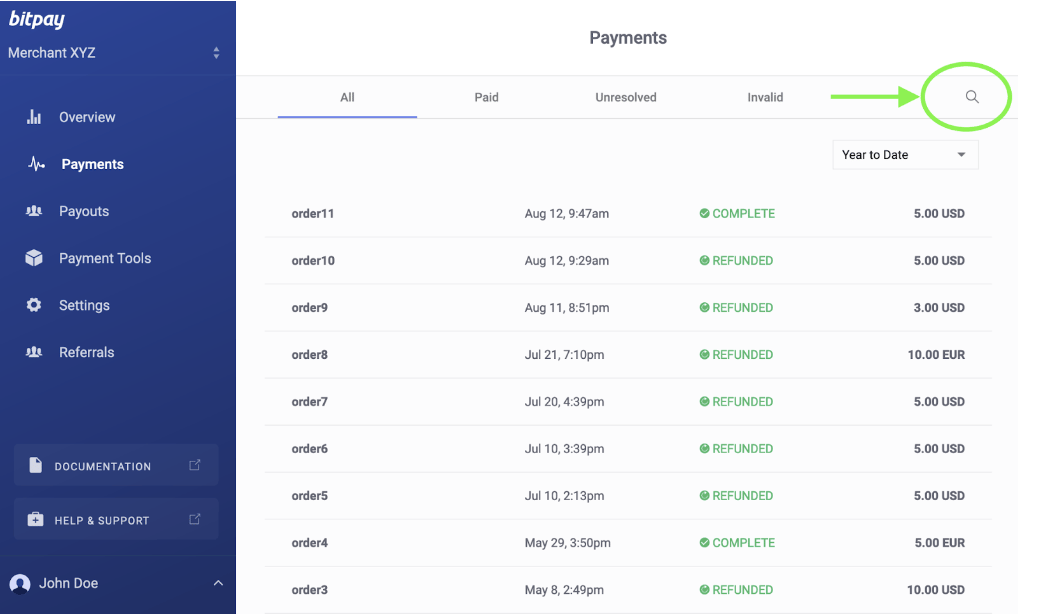
BitPay is a cryptocurrency payment gateway known for its user-friendly interface and multi-user account capabilities. It offers tiered transaction fees that decrease with higher monthly volumes. However, it provides limited flexibility to merchants as payments are automatically converted and settled into the merchant’s bank account or cryptocurrency wallet.
Why I chose BitPay
BitPay is the only crypto payment gateway on this list that allows multi-user access. This makes it a great choice for businesses that require multiple team members to manage payments. It also locks in exchange rates at the time of purchase, which helps protect merchants from crypto price fluctuations.
While its transaction fees may be higher than others on this list, BitPay is a reliable and well-known provider, and its mobile POS app makes it easy to accept crypto payments in-store.
Who should use BitPay
- Businesses that need multi-user payment management.
- Merchants that want a mobile POS app for in-person crypto payments.
- Established businesses that prefer a well-known crypto payment provider.
When not to use BitPay
BitPay may not be the best fit if you want the lowest possible transaction fee or the broadest ecommerce plugin coverage. Its fees can be higher than some alternatives.
BitPay pricing
- Transaction fee (based on monthly volume):
- < $500,000: 2% + 25 cents
- $500,000–$999,999: 1.5% + 25 cents
- $1,000,000 and above: 1% + 25 cents
- Application fee: $75
- Minimum withdrawal amount: depends on currency; $20 for USD
Visit BitPay
Features
- Instant account registration.
- Accepts 15 cryptocurrencies as payments.
- Settles in 9 fiat currencies.
- Automatic volume discounts.
- Daily settlement.
- Ways to accept crypto payments:
- API integration.
- Invoices or payment links.
- Subscription.
- E-commerce plugins: Magento 2, Shopify, WHMCS, Wix, WooCommerce, BigCommerce.
- Easy to embed payment button.
- Donation button.
- Mobile POS app.
- Payment flow:
- Accept crypto > converted to your chosen currency > daily settlement to your chosen bank account or cryptocurrency wallet.
- Multi-user login access.
- Locks in rate at the time of purchase.
- Lightning network support.
- Customer support via email within 1 business day.
Pros and cons
| Pros | Cons |
|---|---|
| Multi-user capability. | Fewer e-commerce plugins. |
| Mobile POS app for accepting payments in-store. | Application fee. |
| Locks in rate at time of purchase. | Higher transaction fees, even with the automatic volume discounts. |
| Low minimum withdrawal amount. |
Coinbase Commerce: Best for instant settlement

Our rating: 4.25 out of 5
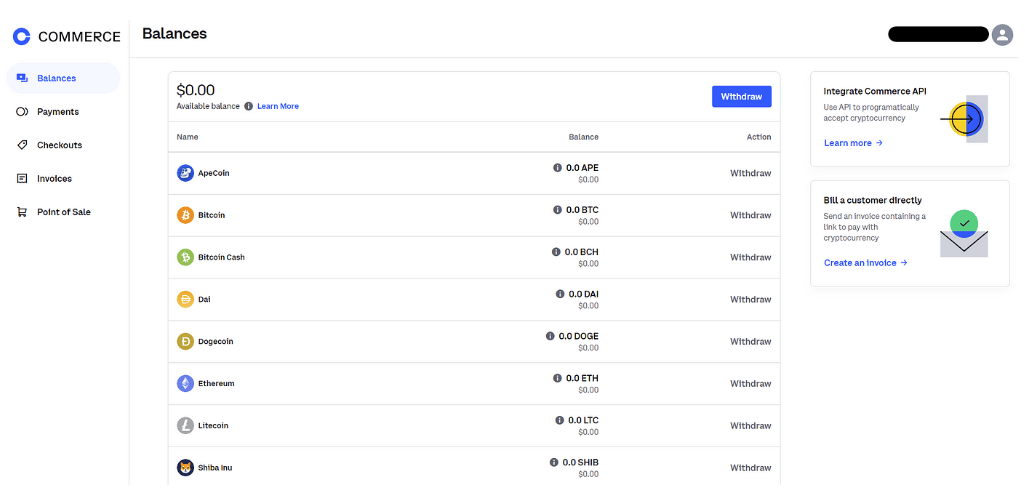
Coinbase Commerce is a cryptocurrency payment gateway that makes it simple and straightforward for businesses to accept cryptocurrency payments. It automatically converts incoming crypto payments into USD or USDC and offers instant settlement to the deposit address provided by the merchant.
Why I chose Coinbase Commerce
Businesses that are just exploring crypto payments and would like to start small will find Coinbase Commerce simple and easy to use. Unlike other gateways on this list, Coinbase Commerce does not provide the option to keep other currencies except USD and USDC. Instead, it locks in exchange rates at the time of purchase and transfers funds directly to the merchant’s chosen deposit address.
While it lacks currency exchange options and is limited to website payments, its ease of use and support for popular e-commerce platforms like Shopify and WooCommerce make it an ideal choice for businesses prioritizing straightforward, hassle-free transactions.
Who should use Coinbase Commerce
- Businesses that want a simple crypto checkout.
- Merchants that want settlement in USD or USDC.
- Shopify or WooCommerce sellers that want basic crypto payment acceptance.
When not to use Coinbase Commerce
Coinbase Commerce may not be the best fit if you want to keep payments in many cryptocurrencies, test in a sandbox, or accept crypto outside website-based workflows.
Coinbase Commerce pricing
Visit Coinbase Commerce
Features
- Accepts 13 cryptocurrencies as payments.
- Settles in 1 fiat currency only.
- Daily settlement.
- Ways to accept crypto payments:
- API integration.
- E-commerce plugins: Jumpseller, Primer, Shopify, WooCommerce.
- Payment flow: Instant settlement to deposit address indicated.
- Locks in rate at the time of purchase.
- Lightning network support.
- Customer support via account dashboard only.
Pros and cons
| Pros | Cons |
|---|---|
| Simple and straightforward. | No currency exchange. |
| Instant settlement eliminates rate volatility. | No sandbox environment for testing. |
| All incoming payments are converted to USD or USDC. | |
| Only for accepting payments on a website. |
OpenNode: Best for Bitcoin-only payments

Our rating: 3.98 out of 5
A cryptocurrency payment gateway focused exclusively on Bitcoin, OpenNode offers features such as split settlement and scheduled payouts. Its Lightning network support makes it highly efficient for Bitcoin transactions.
Why I chose OpenNode
OpenNode stands out as the best option for businesses that want to accept Bitcoin and nothing else. Its features, like custom automatic settlement schedules, multiple ways to accept crypto payments, and limited settlement currencies, make it an ideal option for businesses that want to limit their crypto payment acceptance but would like to accept it in various payment channels.
Although limited to Bitcoin, OpenNode’s simplicity, combined with strong e-commerce integrations, makes it a great fit for businesses focused on Bitcoin payments.
Who should use OpenNode
- Merchants that only want to accept Bitcoin.
- Businesses that need Lightning Network support.
- Ecommerce sellers that want Bitcoin checkout through plugins or payment links.
When not to use OpenNode
OpenNode may not be the best fit if customers want to pay with Ethereum, stablecoins, or a wider range of cryptocurrencies. It is intentionally Bitcoin-focused.
OpenNode pricing
- Transaction fee: 1%.
- Withdrawal fee: 1% for on-demand bitcoin payout.
Visit OpenNode
Features
- Accepts 1 cryptocurrency only (Bitcoin).
- Settles in 8 fiat currencies.
- Ways to accept crypto payments:
- API integration.
- Payment button.
- Invoices or payment links.
- E-commerce plugins: Shopify, Magento, BigCommerce, Prestashop, WooCommerce, OpenCart.
- QR code.
- Payment flow: Accept bitcoin > keep as bitcoin or convert to local currency > transfer to bank account or bitcoin wallet.
- Merchant may choose to initiate payouts or to set them on a schedule.
- Split settlement.
- Lightning network.
- KYC compliant.
- 24/7 customer support.
Pros and cons
| Pros | Cons |
|---|---|
| Merchants may set a custom automatic settlement schedule. | Bitcoin only. |
| Lightning network support. | Withdrawal fee for on-demand bitcoin payout. |
| Split settlement. |
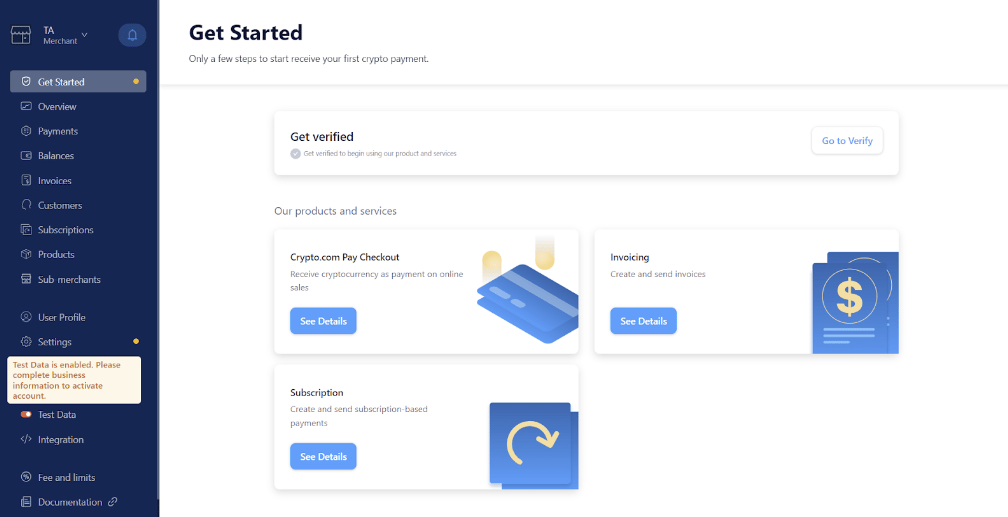
Features
- Instant account registration.
- Accepts over 30 cryptocurrencies as payments.
- Settles in 4 fiat currencies.
- Ways to accept crypto payments:
- API integration.
- Invoices or payment links.
- Ecommerce plugins: Shopify, WooCommerce, OpenCart, Ecwid, NopCommerce, PrestaShop.
- Subscription.
- Payment flow:
- Accept crypto > convert to your chosen currency.
- Account balance > withdraw to bank account or cryptocurrency wallet.
- Any conversion and transfer fees are charged to the customer.
- Customer can pay using a QR code or by linking to Crypto.com, Metamask, WalletConnect, or other cryptocurrency wallets.
- The merchant receives the exact pricing amount.
- Lightning network support.
- 24/7 customer support.
Pros and cons
| Pros | Cons |
|---|---|
| Merchants receive the exact price of the goods/services. | Limited fiat and cryptocurrencies for settlement. |
| Allows merchants to choose pricing currency in fiat or crypto. | No POS option for in-person payments. |
| Merchant is not subjected to exchange rate volatility. | No advanced reporting tools. |
Fees to watch
Crypto payment gateway costs go beyond the advertised transaction fee. Before choosing a provider, compare network fees, conversion costs, payout fees, minimum payout requirements, and refund costs because these can change your true cost per transaction.
| Gateway transaction fee | Fee charged by the payment gateway. |
| Network or gas fee | Blockchain fee required to process the transaction. |
| Conversion fee | Cost to convert crypto to another crypto or fiat. |
| Payout fee | Fee to withdraw to a bank account or crypto wallet. |
| Minimum payout | Minimum balance required before withdrawal. |
| Refund cost | Fees and workflow limits for returning crypto payments. |
Compliance and risk considerations
Crypto payment gateways can reduce card chargeback exposure, but they also introduce compliance, custody, accounting, and volatility risks. Before choosing a gateway, review KYC requirements, supported countries, sanctions screening, AML controls, wallet custody model, refund process, tax reporting exports, stablecoin support, data security, and whether funds settle to fiat, crypto, or both.
Merchants should also decide how much crypto risk they are willing to hold. If you do not want price volatility, choose a gateway with fiat or stablecoin settlement. If you want more control over funds, consider a non-custodial or self-hosted setup.
TechRepublic Academy
Benefits of using a crypto payment gateway
Using a crypto payment gateway offers some advantages for businesses, including:
- Lower transaction fees compared to traditional payment processors.
- Instant payments and quicker settlements.
- Global reach.
- No chargebacks or payment reversals.
- Enhanced security with the blockchain technology.
- For some gateways, flexibility to convert crypto into fiat or keep as digital currency.
How do I choose the best crypto payment gateway for my business?
Choose the best crypto payment gateway by starting with settlement. If you want to avoid holding crypto, prioritize providers that convert payments to fiat or stablecoins. If you want to keep funds in crypto, look for wallet payout, custody, or non-custodial options.
Next, compare supported coins, stablecoins, transaction fees, conversion fees, payout fees, ecommerce plugins, API access, Lightning support, refund tools, and reporting. Businesses that want a simple checkout should consider Coinbase Commerce or BitPay. Businesses that want maximum flexibility should consider NOWPayments. Bitcoin-only merchants should compare OpenNode and BTCPay Server.
When choosing a cryptocurrency payment gateway for your business, consider these key factors:
- Transaction fees: To maximize your profits, look for a gateway with low fees, especially if you process a high volume of transactions.
- Supported cryptocurrencies: Make sure the platform supports popular cryptocurrencies or those most relevant to your customer base.
- Fiat conversion options: If you don’t want to hold crypto, choose a gateway that offers easy conversion to fiat currencies.
- Ease of integration: Ensure the platform integrates smoothly with your website, POS, or e-commerce platforms.
- Settlement times: Consider how fast the gateway settles payments into your bank or crypto wallet to maintain your cash flow.
Methodology
For this list of the best crypto payment gateways, I focused on solutions that offer flexibility, security, and ease of use for businesses looking to accept cryptocurrency payments. I evaluated each gateway based on specific criteria: integration, developer tools, and user experience (25%); supported cryptocurrencies and payment options (25%); security, compliance, and privacy (20%); pricing and transaction fees (15%); and customer support and resources (15%).
My research included a thorough review of product documentation, pricing pages, customer feedback, and hands-on testing or demo environments where available. The goal was to recommend gateways that offer a strong balance of features, ease of use, and security for businesses across different industries.
This article and methodology were reviewed by our retail expert, Meaghan Brophy
Read the full article here