




“The GX1 is one of the easiest $50 gaming headsets that I can recommend”
Pros
- Great value-for-money gaming headset
- Great positional audio
- Comfortable for long sessions
- Solid battery life
- Reliable 2.4GHz wireless connectivity
Cons
- Software is pretty barebones
- Virtual 7.1 isn’t very ideal for competitive games
- Bass could hit harder
Cheap gaming headsets have gotten considerably better over the years. Even then, the compromises usually aren’t difficult to find. Maybe the sound is muddy, the microphone sounds like you’re talking through a walkie-talkie, or the entire thing starts becoming uncomfortable halfway through a long Discord call.
That’s roughly what I expected when I started using the Epomaker GX1. It costs $49.99, and Epomaker currently sells it for $44.99. But after using it for around two weeks, primarily for gaming and Discord on my PC, I’m now using it every day.
Sure, the GX1 has its shortcomings. Some aspects, like its software and virtual 7.1 mode, could use a little work, but the rest of it is genuinely solid.
It gets almost all of the basics right and is an easy recommendation for its price.

Epomaker GX1 specs
| Epomaker GX1 | Specifications |
| Drivers | 50mm dynamic |
| Frequency response | 20Hz–20kHz |
| Design | Open-back |
| Connectivity | 2.4GHz, Bluetooth, USB/wired |
| 2.4GHz latency | 25ms |
| Microphones | Built-in + detachable ENC boom mic |
| Battery | 2,000mAh |
| Battery life | 30 hours RGB on / 70 hours RGB off |
| Weight | Approx. 320g |
| Headband | 7-level adjustable |
| Price | $49.99 MSRP |
Epomaker officially supports 2.4GHz, Bluetooth, and wired operation, while the 2.4GHz dongle also works with the PS4, PS5, PC, Mac, and Nintendo Switch. Xbox Series consoles require a wired connection.
Design: Better built than I expected
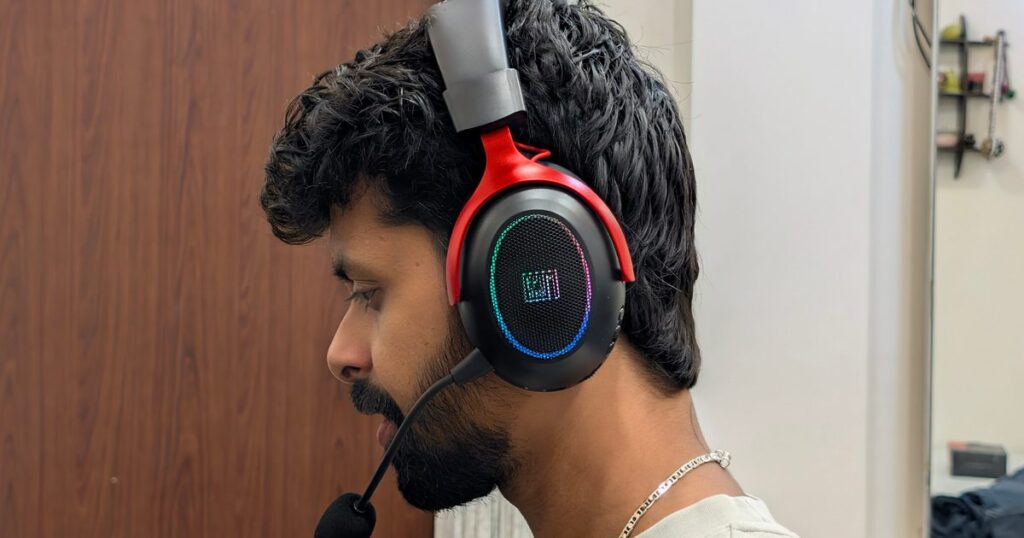
The GX1 definitely looks like a gaming headset. Black remains the dominant color on my unit, with a bright red metal frame wrapping around each earcup and an RGB ring behind the mesh on either side.

Those metal sections give the headset considerably more rigidity than I expected at this price. The headband is sturdy, adjustment only produces the normal clicks between positions, and I never heard the cheap creaking that still shows up on plenty of affordable gaming headsets. Once adjusted, it also stays securely in place.
The RGB lighting is fairly restrained as well. It isn’t bright enough to become distracting and suits the rest of the design. I initially left it enabled all the time before eventually switching it off to preserve battery life. Comfort was a slightly different story during my first few days. The earcups are smaller than those on my previous headset, and the headband initially clamped a little harder than I preferred. Both became much easier to live with once I got used to the GX1.

The thick earpads completely surround my ears, and even my glasses slide between them without creating uncomfortable pressure against the frames. At 320 grams, the headset is neither lightweight nor too heavy to become a problem after full workdays consisting of writing, Discord chatter, meetings, and a gaming session afterwards. The pads can get sweaty on particularly hot days, but I could comfortably keep the GX1 on for hours.
Gaming is where the GX1 shines
I spent most of my gaming time with Rainbow Six Siege X, Overwatch, and Arc Raiders, which ended up being an excellent mix for testing positional audio. Siege remains one of my favorite tests for any gaming headset because knowing where a sound came from can matter just as much as actually hearing it.
If I did have any issues with audio, that’s mostly about how weird the game audio behaves sometimes in R6S. But for the most part, footsteps were pretty clear and distinct. Front-to-back positioning worked properly, and I could judge distance without the audio throwing me off.

Arc Raiders showcased the headset differently. Its environmental audio gets considerably more room to breathe, and the GX1’s open-back design creates a reasonably spacious soundstage. It doesn’t come close to some considerably more expensive headphones I’ve used, but we’re also talking about a headset that costs less than $50.
Epomaker claims the open-back construction is designed to widen the soundstage and improve positional awareness. It also advertises just 25ms of latency over its 2.4GHz connection. My experience backs up the practical part of those claims. I couldn’t notice any meaningful latency while gaming, and I never experienced dropouts, crackling, or desync over 2.4GHz.
I did spend a little time with the GX1’s virtual 7.1 surround mode in Cyberpunk 2077. It can make single-player games sound more expansive, and I can see the appeal for something atmospheric. For competitive gaming, I preferred regular stereo, even if Epomaker advertises it as the mode that gives you a competitive edge. Directional cues sounded cleaner and more precise without the additional processing.
Sound quality is good, with one obvious weakness
The GX1 uses large 50mm dynamic drivers, and its overall tuning ended up being surprisingly balanced for a budget gaming headset. Bass is the area where I wanted a little more. The lows remain distinct and controlled, so explosions and gunshots still carry enough weight during games. There just isn’t enough bass to really give music or action movies that deep physical impact.
In the midrange, Vocals and dialogue are clear, while the GX1 generally comes across as neutral rather than aggressively tuned toward bass or treble. The top end could use some additional detail, but it never became particularly harsh.

It can also get pretty loud. I wouldn’t recommend pushing it anywhere near maximum volume. Slight distortion starts creeping in at higher levels, and I rarely found a reason to go beyond around 70%.
I was perfectly happy using the GX1 for Spotify while sitting at my PC. My old Sony WH-1000XM4 remains better overall for the music experience, as you’d expect, but the GX1 performs well enough that I never felt compelled to swap headphones just because I stopped playing a game.
Its open-back design also means you retain some awareness of the room around you. I could still hear PC fans, the air conditioner, conversations, or someone knocking at the door. Interestingly, sound leakage wasn’t particularly troublesome during my use, so I would still be comfortable using it in a shared room.
The microphone might be the biggest surprise
The one area where budget gaming headsets often disappoint is with the microphones. I’ve heard some considerably more expensive models butcher voices badly enough that I’d rather use a cheap standalone microphone.

Epomaker, somehow, made the mic one of the strongest parts of this review. There are actually two microphones. Removing the detachable boom mic automatically switches the headset over to its built-in microphone. That internal mic is perfectly usable for calls, but it makes my voice sound more distant. The detachable one is substantially better.
My voice remained clear and reasonably close to its natural character. There’s some compression, but my Discord pals found it clear and were particularly surprised when I told them I was using a wireless headset. The ENC isn’t miraculous. Keyboard strokes remain audible, mouse clicks aren’t completely eliminated, and I got better results once Discord’s Krisp processing was involved. Fan and AC noise were handled considerably better.
Wireless and seamless

The GX1 spent almost all of my testing connected through its 2.4GHz dongle. Connection stability was always reliable, reconnecting happened almost immediately after turning the headset on, and Bluetooth pairing with my phone was equally painless. I managed roughly six meters in a straight line before encountering problems. Walls and closed doors reduce that usable range considerably, so I wouldn’t expect to wander around the entire house while staying connected.

Bluetooth and 2.4GHz can’t play simultaneously. A physical switch changes between them, which I actually prefer over dealing with confusing automatic source switching. Wired operation also works while charging, with the GX1 automatically moving into USB mode.
All of the basic controls are right on the headsets. There’s a tactile volume wheel alongside buttons for lighting, microphone control, and power. The three buttons are difficult to distinguish from one another purely by touch, but you get audible prompts for power, pairing, connection mode, low battery, and microphone muting, which make operation easier.

The weakest part of the whole experience might actually be the software. The GX1 uses Xear ONE, powered by C-Media. You get EQ controls, virtual 7.1, multiple additional audio effects, microphone controls, and noise reduction. It works, and settings can be saved, but the interface is pretty barebones.
You also get no obvious battery percentage readout or RGB control either. But for something this inexpensive, I’m not losing much sleep over an average companion software.

Battery life absolutely seals the deal
Epomaker rates the GX1 for 30 hours with RGB enabled and up to 70 hours with it switched off. The headset houses a 2,000mAh battery and takes roughly three hours and 20 minutes to charge, according to the company. I didn’t sit there with a stopwatch until the headset died, but my real-world experience was excellent.
I could comfortably get through roughly a week between charges, using it throughout work, Discord calls, and gaming. I initially ran the RGB for about four days before turning it off and stretching the battery considerably further. Endurance is key for any wireless headset. The entire point of losing a wire is to make sure it stays that way for as long as possible.
Should you buy the Epomaker GX1?
The Epomaker GX1 is a well-rounded gaming headset for $50. Its bass could use more authority, virtual 7.1 wouldn’t be my choice for competitive gaming, and the software needs improvement. None of those problems seriously changed my experience.
Everything else about it remained top-tier (for its class). I experienced accurate positional audio, a rock-solid 2.4GHz connection, and comfort for long gaming sessions. The detachable microphone also sounded better than I expected, with the excellent battery life and robust construction rounding it all off.
Before testing it, I probably would have guessed the GX1 cost somewhere around $70 to $80. At $49.99, it’s already easy to recommend. Though it is currently listed for $44.99 on the official website.
Audiophiles will want something considerably more refined, especially for music. For everyone else looking for an inexpensive wireless gaming headset that gets the fundamentals right, the GX1 is pretty sweet.
FAQ
Is the Epomaker GX1 good for competitive gaming?
Yes. The GX1 performed particularly well in games such as Rainbow Six Siege X, Overwatch, and Arc Raiders. Footsteps were easy to distinguish, directional audio was accurate, and busy fights never became overly muddy. I also couldn’t notice any meaningful latency over the 2.4GHz connection.
Does the Epomaker GX1 have good microphone quality?
Surprisingly, yes. The detachable boom microphone was one of the strongest parts of the headset, with clear voice reproduction and good results in Discord. The built-in microphone is usable too, but it makes your voice sound more distant. ENC helps with background noise, although keyboard strokes and mouse clicks can still come through.
How long does the Epomaker GX1 battery last?
Epomaker claims up to 70 hours with RGB turned off and 30 hours with RGB enabled. In my testing, I could comfortably use the headset for roughly a week between charges, depending on how much I used the lighting. It can also continue working while charging over USB.
Does the Epomaker GX1 support Bluetooth and 2.4GHz wireless?
Yes. The GX1 supports Bluetooth, low-latency 2.4GHz wireless, and wired USB operation. Switching between Bluetooth and 2.4GHz is handled through a physical control on the headset, although it cannot play audio from both sources simultaneously.
Is the Epomaker GX1 comfortable for long gaming sessions?
It was for me. The headset initially clamped a little tighter than I preferred, but became much more comfortable with use. The thick pads completely surround my ears, glasses don’t create noticeable pressure, and the 320g weight wasn’t particularly noticeable even after several hours.
Is the Epomaker GX1 worth $50?
Absolutely! For around $50, the GX1 delivers solid positional audio, stable wireless connectivity, a surprisingly good microphone, strong battery life, and better build quality than its price suggests. Its biggest weaknesses are the fairly basic software and restrained bass response, neither of which seriously hurts the overall value.
Read the full article here