




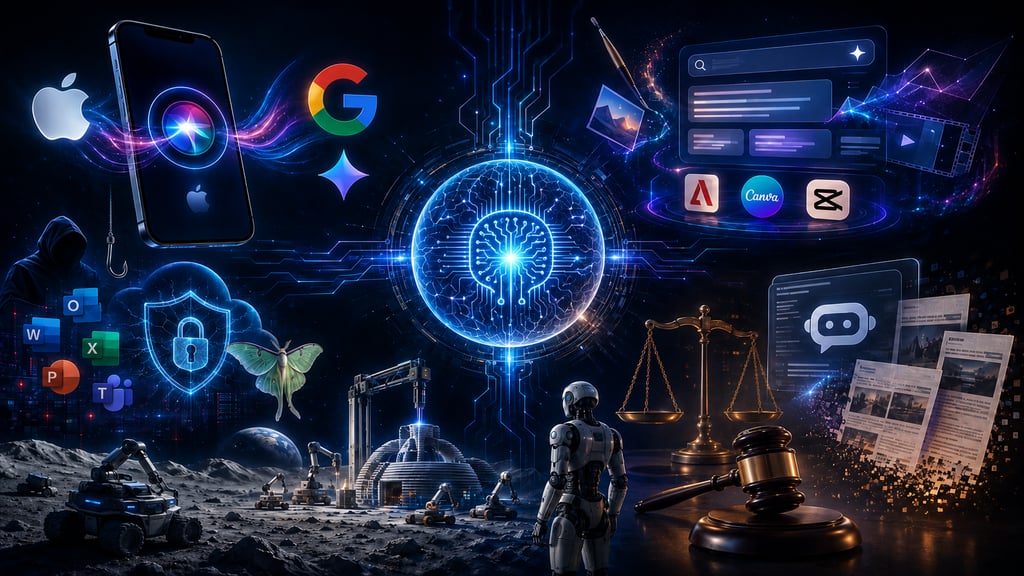

From Apple and Google weaving AI deeper into everyday tools to fresh cyber warnings, data leaks, robot ambitions, and legal fights over AI content, this week showed how quickly tech’s biggest bets are becoming real-world headaches — and business opportunities.
Top news
Apple and Google double down on AI integration
Apple is preparing a major Siri overhaul for iOS 27, powered by Google Gemini. The update will enable on-device AI processing for faster, privacy-focused responses and introduce new features like a Siri capture mode in the Camera app and enhanced AI tools in Photos.
Meanwhile, Google unveiled its biggest search revamp in 25 years, integrating Gemini 3.5 Flash to deliver AI summaries and interactive prompts directly in search results. Publishers are reporting steep traffic declines as zero-click searches rise, sparking new debates over visibility and misinformation risks.
In another move, Google’s Gemini now integrates directly with Adobe, Canva, and CapCut, turning the chatbot into a full creative workspace for multimedia editing and design. Pricing for premium integrations remains unclear.
AI and automation reshape business and space
Meta has begun testing new subscription tiers under the Meta One brand for Instagram, Facebook, and WhatsApp. The tiers range from low-cost user plans to premium creator options offering verification, analytics, and AI compute boosts — part of Meta’s broader $145 billion AI investment strategy.
OpenAI CEO Sam Altman downplayed fears of mass job losses due to AI, arguing that automation has not displaced workers as quickly as expected. His comments come as OpenAI eyes a potential IPO and industry leaders debate AI’s real impact on employment.
Robinhood launched Agentic Trading and an Agentic Credit Card, enabling AI agents like ChatGPT or Claude to autonomously trade stocks and make purchases. The beta includes spending limits and manual approval options, though the company warns of significant investment risks.
SK Hynix reached a $1 trillion valuation amid soaring demand for high-bandwidth memory chips. The company now controls over half of the HBM market, with analysts predicting shortages through 2028.
NASA revealed plans for a robot swarm to construct lunar infrastructure ahead of human missions. Up to 30 robotic landings are planned starting in 2027, supported by a streamlined leadership structure to manage budget constraints and competition from China.
Insider Intel
AI and automation transform creative and industrial frontiers
ByteDance’s Seedance 2.0 platform powered the AI-generated film “Hell Grind,” produced for under $500K and screened at Cannes’ Marché du Film. The project reignited debate over AI in filmmaking, dividing directors between embracing generative tools and defending traditional production methods.
China is projected to deploy up to 24 million humanoid robots by 2035 to offset labor shortages, potentially replacing 60% of its expected workforce gap. The move signals a national shift toward “physical AI” as automation becomes essential to sustaining manufacturing output.
Cloud complexity and responsibility
Experts warn that interconnected cloud environments — spanning Microsoft 365, Entra ID, Salesforce, and Azure — can amplify risk exposure. Attackers increasingly exploit shared credentials and persistent data retention that preserve compromised states.
Readers are also reminded of the shared responsibility model in cloud security: while providers secure the platform, organizations must protect their own data through proactive management and recovery strategies.
Security alerts
Cyberthreats and exploits
The FBI warned that the Silent Ransom Group, also known as Luna Moth, is impersonating IT staff to infiltrate US law firms and other sectors. Attackers use USB drives and remote-access tools to steal data and extort victims, prompting calls for stronger access controls and multi-factor authentication.
Kali365, a phishing-as-a-service kit, is exploiting Microsoft 365’s device-code login to bypass MFA and hijack accounts. Sold for as little as $250, the tool enables large-scale credential theft. The FBI urges organizations to block device-code flows and tighten conditional access policies.
Researchers also revealed that a free GitHub tool called Heretic can strip safety guardrails from open AI models like Google’s Gemma and Meta’s Llama in minutes, enabling unsafe content generation. Experts urge developers to conduct rigorous safety audits and isolate open-weight models.
Data breaches and privacy risks
7-Eleven suffered a breach exposing data from 185,000 franchise applicants after hackers linked to ShinyHunters compromised a Salesforce-connected server. The company declined ransom demands and is offering free identity monitoring to affected individuals.
A massive 340 million-record database marketed as an OnlyFans leak was found to be compiled from older breaches and public data. While not a new hack, the dataset still poses phishing and blackmail risks. Experts recommend using unique emails and enabling two-factor authentication.
Trump Mobile confirmed a data leak exposing customer names, addresses, and phone numbers due to a flaw in a third-party platform. The issue, discovered by a researcher and publicized by YouTubers, affected around 10,000 customers and has since been patched.
Security innovations
Apple is testing an anti-snatching feature that automatically locks an iPhone when sensors detect a sudden grab, preventing thieves from accessing data. The system builds on Stolen Device Protection and mirrors similar Android theft detection tools.
Microsoft addressed a critical flaw in Edge that stored saved passwords in plaintext memory. The latest Edge 148 build encrypts credentials, reducing exposure to malware and insider threats across all channels.
Industry shakeups
Legal and workforce turmoil
CNN has filed a federal lawsuit against AI startup Perplexity, accusing it of copying and redistributing over 17,000 pieces of content to train its chatbot. The suit also alleges trademark infringement after Perplexity’s system falsely claimed a partnership with CNN.
ClickUp laid off 22% of its workforce as it pivots toward an AI-first model. The company is deploying thousands of internal AI agents and offering top performers salaries up to $1 million. While ClickUp claims the move boosts productivity, analysts caution that most AI-driven restructures ultimately lead to job cuts.
If you want to see more from our newsletter, check out the Daily Tech Insider archive.
Read the full article here