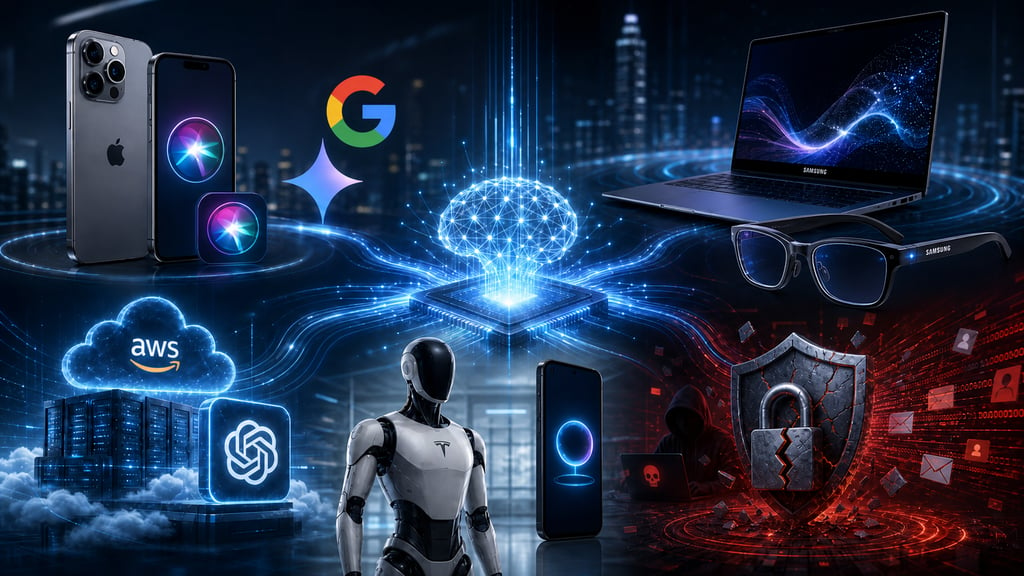

From Apple/Google’s tighter AI alliance to AWS’s OpenAI power play, this week’s tech news showed the industry’s biggest players racing to put artificial intelligence everywhere: phones, laptops, glasses, clouds, robots, and even government systems. But as AI gets more capable, the questions around trust, security, ethics, and control are getting harder to ignore.
Top news
Apple and Google deepen AI collaboration
Apple is bringing its Visual Intelligence system to the iOS 27 Camera app and also introducing AI-driven photo-editing tools like Extend, Enhance, and Reframe. The update, expected at WWDC 2026, will also feature a new Siri mode powered by Google’s Gemini, signaling a deeper partnership between the two tech giants.
That collaboration continues with Apple’s upcoming Siri overhaul, which will run on Gemini AI models hosted via Google Cloud. The upgrade will enable Siri to perform complex, multistep tasks and integrate more deeply across apps.
Meanwhile, Apple’s “Ultra” line is rumored to include a foldable iPhone and a touchscreen MacBook, expanding the company’s premium device portfolio.
Samsung bets on Android laptops and AR glasses
Samsung is preparing to replace Windows with Android 17 and One UI 9 on its upcoming Galaxy Book laptops, creating a unified ecosystem across its devices and challenging Microsoft’s dominance in the laptop market.
Leaked documents also reveal the company’s next big hardware play: Galaxy Glasses — AI-powered, screenless eyewear built in collaboration with Warby Parker and Gentle Monster. The glasses will use Snapdragon AR1 chips and bone-conduction audio, with a premium micro-LED version expected in 2027.
AI expands across cloud, defense, and devices
Amazon Web Services has added OpenAI’s GPT-5.4 and Codex models to its Bedrock platform, following Microsoft’s loss of exclusive reselling rights. The $50 billion AWS investment and $100 billion compute commitment from OpenAI position AWS as a top AI cloud provider.
In a more controversial move, Google amended a $200 million contract with the Pentagon to allow Gemini AI models on classified networks for mission planning and targeting — prompting internal protests over military AI use.
Meanwhile, OpenAI is reportedly developing an “agent-first” smartphone that replaces traditional apps with AI-driven assistants, with production planned for 2028 in partnership with Qualcomm, MediaTek, and Luxshare.
AI ethics and legal battles
Taylor Swift has filed trademarks for her voice and likeness to combat AI-generated deepfakes, setting a potential precedent for celebrity protection in the age of synthetic media.
The Vatican also weighed in, introducing a new AI ethics framework banning manipulative systems and rejecting proposals for an AI “virtual pope.”
And in Oakland, the Musk vs. Altman trial began, with Elon Musk accusing Sam Altman of betraying OpenAI’s nonprofit mission. The $134 billion case could reshape AI governance and the future of the company.
Robotics and language tech
Tesla announced plans to begin production of its Optimus humanoid robots in July at its Fremont facility, with mass production targeted for 2027 and prices between $20,000 and $30,000.
Meanwhile, Google Translate added an AI pronunciation coach for English, Spanish, and Hindi, expanding its role from translation to interactive language learning.
Insider intel
China has paused new Level-4 robotaxi licenses following a Baidu Apollo Go glitch that stranded riders and caused a collision. Regulators are mandating safety audits before expansion, while US surveys show growing expectations but declining trust in autonomous vehicles.
Security alerts
Critical vulnerabilities and exploits
Google Chrome patched 30 vulnerabilities, including four critical flaws that could allow remote code execution. Users are urged to update immediately as attackers are already reverse-engineering the fixes.
Microsoft confirmed active exploitation of a Windows Shell spoofing bug (CVE-2026-32202) that leaks password hashes via malicious shortcut files. Federal agencies must patch by May 12.
Data breaches and leaks
ClickUp exposed nearly 900 corporate and government emails due to a hard-coded API key, a flaw ignored for over a year. The leak raises phishing concerns for affected users.
Vimeo confirmed that hackers accessed user metadata via a supply-chain breach at analytics vendor Anodot. The ShinyHunters group demanded ransom and used stolen tokens to target other firms.
ADT suffered a breach exposing data from 5.5 million users after hackers compromised its Salesforce cloud via Okta SSO credentials. The ShinyHunters group claimed responsibility.
Itron and Medtronic also reported separate breaches tied to ShinyHunters, highlighting vulnerabilities between IT and operational networks.
Phishing and fraud campaigns
North Korea’s Lazarus Group is using fake Zoom and Teams invites to target crypto executives, stealing wallet keys and Telegram sessions within minutes.
Robinhood patched a flaw that allowed attackers to send phishing emails from legitimate company addresses, urging users to enable two-factor authentication.
Fake CAPTCHA pages are being used to trigger costly international SMS fraud, sending dozens of premium-rate texts per attempt.
Global surveillance concerns
Citizen Lab researchers discovered that surveillance vendors are exploiting SS7 and Diameter protocol flaws to track mobile phones globally, with VPNs offering no protection.
Industry shakeups
Microsoft is offering voluntary retirement packages to US employees whose age and tenure total 70, affecting about 7% of its workforce. The move reallocates funds toward AI infrastructure while avoiding layoffs — contrasting with Meta’s recent 10% staff cuts.
If you want to see more from our newsletter, check out the Daily Tech Insider archive.
Read the full article here