
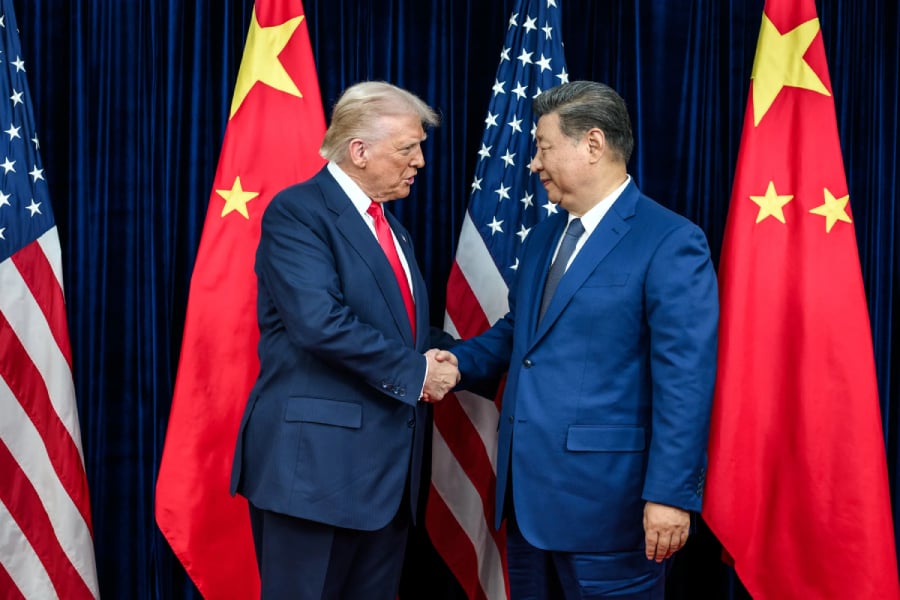

President Donald Trump’s China summit arrived with a Silicon Valley entourage.
The US president landed in Beijing this week with Nvidia’s Jensen Huang, Apple’s Tim Cook, and Tesla’s Elon Musk, among others. Their presence turns a diplomatic meeting with Chinese President Xi Jinping into a high-stakes negotiation over market access, AI chips, and global tech influence.
Trump said he planned to ask Jinping to “open up China” so American firms could expand business opportunities in the country. Trump described the executives traveling with him as “brilliant people” who could “work their magic.”
The trip marks the first visit by a sitting US president to China in nearly a decade, and it comes at a tense moment in relations between the world’s two largest economies. Trade disputes, export controls, artificial intelligence competition, and the wars in Iran and Gaza all hang over the summit.
Chinese state broadcaster CCTV reported that Xi told the visiting executives that “China’s door will only open wider,” while adding that U.S. firms would enjoy “broader prospects in China.”
The importance of Jensen Huang’s presence
Among the executives in Beijing, Huang has drawn particular attention.
Reuters report said Trump invited Huang onto the trip at the last minute, with the Nvidia CEO reportedly boarding Air Force One during a refueling stop in Alaska. The move underscores how central AI and semiconductors have become to US-China relations.
Nvidia has spent years trying to maintain access to China’s massive AI market while navigating increasingly strict US export controls. The company previously dominated China’s advanced AI chip market, but restrictions introduced under both the Biden and Trump administrations limited sales of its most powerful processors.
Huang has pushed for broader access to China because he sees the country as a major long-term AI market. But Chinese firms such as Huawei, Alibaba, and ByteDance are increasingly developing domestic alternatives.
An Nvidia spokesperson told Euronews Next: “Jensen is attending the summit at the invitation of President Trump to support America and the administration’s goals.”
Investors appeared to welcome the diplomatic outreach. Investopedia reported that shares of Nvidia, Qualcomm, and Micron rose during the summit as traders bet the talks could ease pressure on semiconductor companies.
AI rivalry overshadows the summit
While tariffs and trade remain central issues, analysts increasingly see AI as the real battleground.
Euronews reported that AI-enabled warfare, cybersecurity, and semiconductor restrictions are expected to dominate discussions between Washington and Beijing. David Leslie of The Alan Turing Institute told the outlet that “AI-supported warfare” has rapidly become a defining geopolitical issue after its expanded use in conflicts tied to Iran, Gaza, and Venezuela.
The report also highlighted growing concern over advanced AI systems capable of exposing vulnerabilities in national cybersecurity infrastructure.
At the same time, the summit reflects how closely major US tech firms are tied to Washington’s foreign policy agenda. Leslie told Euronews that “one of the defining features of the way tech policy has evolved from the Trump administration side is that it has all been largely dictated by the interests of Silicon Valley.”
Washington continues to restrict exports of advanced chips to China, while American tech companies still depend heavily on Chinese manufacturing, supply chains, and consumers.
More must-read AI coverage
China holds key leverage
Beijing enters the talks with important economic advantages.
China remains dominant in the processing of rare earth minerals used in everything from smartphones and electric vehicles to fighter jets and AI hardware. Reuters noted that the current US-China trade truce includes agreements tied to rare earth exports, an issue closely watched by technology companies.
Meanwhile, China’s domestic AI sector continues to grow rapidly. The United States still leads in capital and advanced chips, while China now leads in areas such as patents, research publications, and robotics.
Chinese officials used the summit to reinforce a more cooperative tone. CCTV quoted Xi as saying: “Trade wars have no winner,” while urging both countries to maintain dialogue through “equal-footed consultation.”
Trump seeks economic wins ahead of midterms
For Trump, the business-heavy delegation is also political theater. Reuters reported that the president entered the summit under pressure from inflation concerns and political fallout linked to the Iran conflict. Analysts noted that Trump needs visible economic victories ahead of November’s midterm elections.
Independent China strategist Andrew Leung told Al Jazeera that the presence of major executives “signals what [Trump] needs to take home: market access and investment commitments that he can present to his political base.”
Executives traveling with Trump appear eager to secure those gains for themselves as well. Apple continues to rely heavily on Chinese manufacturing, while Tesla depends on its Shanghai Gigafactory as a major export hub. Boeing is reportedly pursuing a large aircraft sale to China, and Nvidia is still trying to regain ground in the country’s AI chip market.
As Trump and Xi continue talks in Beijing, the summit is increasingly looking less like a traditional diplomatic meeting and more like a negotiation over who will shape the next era of global technology.
Related reading: For more on how AI deals are becoming geopolitical test cases, read TechRepublic’s coverage of China blocking Meta’s $2.5 billion Manus AI acquisition.
Read the full article here