



Textbooks demand focus; the internet rewards swiping. ScrollEd is betting the same habit that keeps people scrolling can also be used to help them learn.
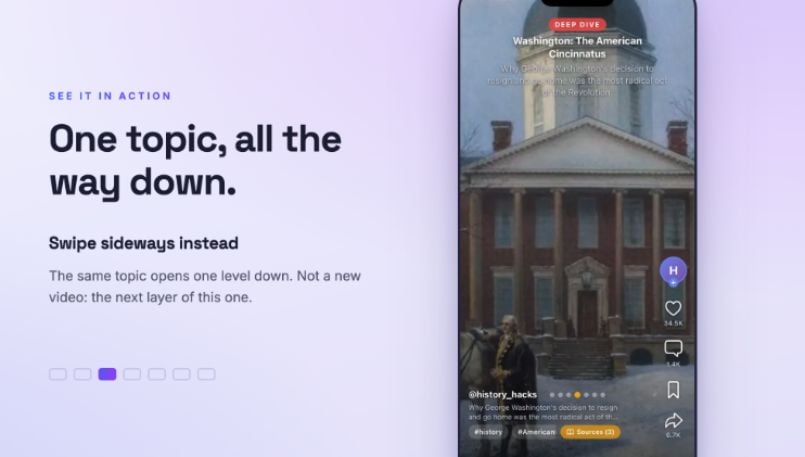
The Palo Alto startup uses AI to turn long-form material such as PDFs and textbooks into a vertical learning feed that serves up short videos, audio, text explanations, and interactive quizzes. A swipe up moves the learner to another topic, while a sideways swipe opens a deeper path through the subject already on screen.
The bet is that the format itself can change how people engage with educational material. Instead of treating scrolling as the obstacle to studying, ScrollEd treats the feed as the delivery mechanism and adds depth, source grounding, and retrieval practice around it.
How ScrollEd turns textbooks into a feed
ScrollEd’s idea started with a problem its founders experienced: scrolling before bed.
Utsav Gupta, who studies AI and human purpose at Stanford, and Rebecca Neff, a computer science student at the University of Pennsylvania, built the startup around a different interpretation of that behavior. Their bet is that the problem is not necessarily scrolling itself, but what people are given to scroll through.
That makes ScrollEd’s approach more interesting than simply putting textbooks on a phone.
ScrollEd keeps the quick interactions and familiar gestures of short-form feeds but replaces the stream of unrelated content with lessons designed to build toward understanding.
Its key interface idea is what the company calls “depth scrolling.” Swiping up moves to a new topic, similar to conventional short-form feeds, while a sideways swipe keeps the learner on the same subject and opens a deeper sequence of material.
That distinction matters because learning and scrolling normally optimize for different outcomes. A social feed wants users to keep moving; ScrollEd has to prove that the same behavior can also encourage people to stop, think, recall information, and go deeper.
Although ScrollEd’s website says the technology behind the system is patent-pending, the startup is already putting the idea in front of users. TechCrunch reports that the company will pitch at Disrupt, and ScrollEd already has a working demo that lets users see the depth-scrolling experience.
The company is also building out a business around the product rather than treating it solely as a consumer learning app. TechCrunch reports that ScrollEd plans to offer free and Pro subscriptions, alongside an institutional package that would let schools and other organizations upload their own material and access data on learner engagement and progress.
ScrollEd is entering the market as governments and school systems take a harder look at children’s relationships with social media, screen time, addictive feed designs, and AI.
That puts ScrollEd’s pitch in an unusual position. While much of the current response to problematic digital habits is to reduce access, limit screen time, or remove the features that encourage prolonged use, ScrollEd is taking the opposite route: it wants to retain the swipe-based format and redirect it toward education.
That raises a more interesting question than whether scrolling itself is good or bad. Social platforms typically optimize feeds around engagement and retention, while an educational product has to optimize for comprehension and memory.
ScrollEd’s challenge will be proving that the same interface associated with rapid consumption can produce a fundamentally different result when its incentives and content are changed.
More must-read AI coverage
What does this mean for users?
For students and other learners, ScrollEd could make educational material feel far less demanding to pick up. A textbook that once required sitting down and committing to a chapter could instead become something a user can open for five minutes, learn one concept, test themselves, and decide whether they want to go deeper.
But the real test is whether changing the format changes the outcome. Making lessons easier to consume does not automatically make them easier to remember, and turning education into a feed could just as easily encourage users to skim from one concept to another.
That is the experiment at the heart of ScrollEd. The startup is betting that habits built around short-form content can be redirected toward deeper learning. Its success will ultimately depend not on how long people scroll, but on what they still know after they stop.
Let us teach you How to Talk to AI for free! Try our six-minute course at The Neuron Academy and learn a few simple ways to write better prompts and get more useful results from AI, or browse our other AI course for free for seven days. Check out all the lessons here →
Read the full article here