




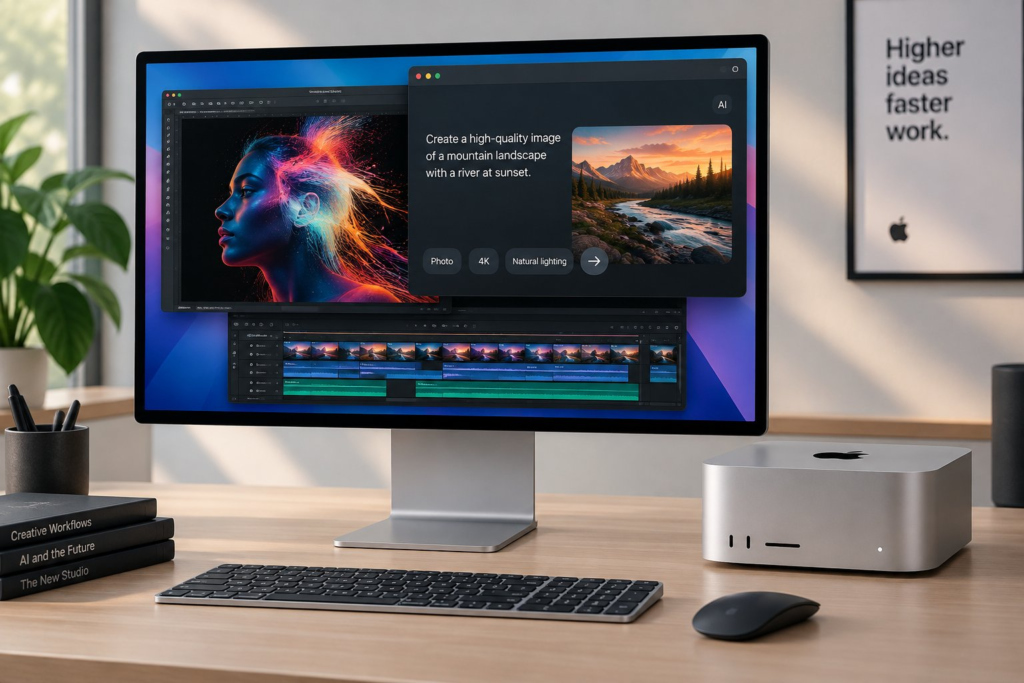

Same compact aluminum box, very different bill.
Apple’s 2026 Mac Studio starts at $2,499 with M5 Max and $5,499 with M5 Ultra, leaving buyers to decide whether another $3,000 buys useful performance or capacity they’ll rarely touch.
For most professional workflows, the M5 Max is already a powerful workstation. The M5 Ultra earns its premium when 128GB of unified memory becomes a ceiling, sustained GPU performance affects production time, or demanding AI, VFX, and multi-stream video workloads can actually use the extra hardware.
Mac Studio M5 Max vs M5 Ultra at a glance
| Mac Studio M5 Max | Mac Studio M5 Ultra | |
|---|---|---|
| Starting price | $2,499 | $5,499 |
| Base CPU/GPU | 18-core CPU, 32-core GPU | 30-core CPU, 64-core GPU |
| Maximum CPU/GPU | 18-core CPU, 40-core GPU | 36-core CPU, 80-core GPU |
| Starting memory | 36GB | 96GB |
| Maximum memory | 128GB | 512GB |
| Memory bandwidth | 460GB/s base; up to 614GB/s | 1.2TB/s |
| Starting storage | 512GB | 1TB |
| Maximum storage | 8TB | 16TB |
| Front ports | 2x USB-C | 2x Thunderbolt 5 |
| Best fit | Most professional creative and development work | Extreme AI, VFX, rendering, and memory-heavy workloads |
We compared Apple’s current US specifications and configurations with independent testing, focusing on CPU and GPU performance, unified memory, storage, connectivity, media workloads, local AI, and upgrade limits.
Because reviewers tested different configurations, benchmark results are used as directional evidence rather than a direct base-model comparison.
Apple’s current Mac Studio specifications show several major upgrades with M5 Ultra:
- Much more memory: M5 Max starts at 36GB and can reach 128GB. M5 Ultra starts at 96GB and scales to 512GB, although Apple says the 512GB configuration won’t arrive until late October. That capacity gap is especially relevant for local AI workloads and large datasets that need to stay in unified memory.
- Higher memory bandwidth: The base M5 Max provides 460GB/s, rising to 614GB/s with the 40-core GPU configuration. M5 Ultra provides 1.2TB/s, giving memory-heavy CPU and GPU workloads considerably more bandwidth.
- More CPU and GPU cores: M5 Ultra starts with a 30-core CPU and 64-core GPU, compared with an 18-core CPU and 32-core GPU on the base M5 Max. In The Verge’s testing, a high-end M5 Ultra was about 30% faster than M3 Ultra in CPU benchmarks, while one GPU test improved by 63%. Those are generational comparisons, not a direct M5 Max versus M5 Ultra test.
- More storage: M5 Max ranges from 512GB to 8TB, while M5 Ultra starts at 1TB and reaches 16TB. The extra ceiling is most useful for large media libraries, local datasets, and scratch storage that teams want to keep inside the machine.
- Faster front ports: Both versions have four Thunderbolt 5 ports on the back, but the Ultra adds two more Thunderbolt 5 ports up front. The Max instead uses two 10Gb/s USB-C ports.
- More media hardware: M5 Ultra doubles the Max’s video encode and decode engines. Apple says it can play as many as 33 simultaneous 8K ProRes 422 streams, making that hardware most relevant to demanding multi-stream production rather than ordinary editing.
Testing also suggests you shouldn’t assume the Ultra simply doubles real-world performance. The Verge’s M5 Ultra rendered one Blender scene in 11 seconds versus 15 seconds on M3 Ultra, while its other graphics tests produced different-sized gains. Extra cores create substantially more headroom, but the payoff changes with the workload.
That distinction is important for teams considering the Mac Studio with M5 Ultra primarily for AI. A workload that fits comfortably within the M5 Max’s 128GB ceiling may not need the Ultra for memory capacity alone.
Neither unified memory nor internal storage can be upgraded after purchase. That makes configuration especially important for organizations already using Mac minis and Mac Studios for AI agents, where model sizes and memory requirements can grow quickly.
Which Mac Studio should you buy?
The workload provides a cleaner dividing line than the benchmark charts:
- Choose M5 Max for professional photo and video editing, software development, music production, most 3D work, and local AI workloads that fit comfortably within 128GB.
- Choose M5 Ultra when projects regularly exceed 128GB, GPU rendering time directly affects production throughput, very large datasets need to stay in memory, or multiple high-resolution video streams are part of the workflow.
- Don’t buy Ultra just for occasional peak performance. The $3,000 base premium grows much larger once you add high-end memory and storage options.
- Configure for the machine’s lifetime. Unified memory and internal storage aren’t user-upgradeable, so buying too little at the start can’t be corrected later.
- Wait if you need 512GB. Apple’s top memory configuration isn’t due until late October.
For many professional buyers, M5 Max is already the workstation tier. M5 Ultra becomes easier to justify when its extra memory or parallel performance removes a measurable bottleneck rather than simply shortening occasional jobs.
Also read: Our guide to Mac Studio alternatives compares five Windows systems for buyers who need workstation-class performance outside Apple’s ecosystem.
Read the full article here