





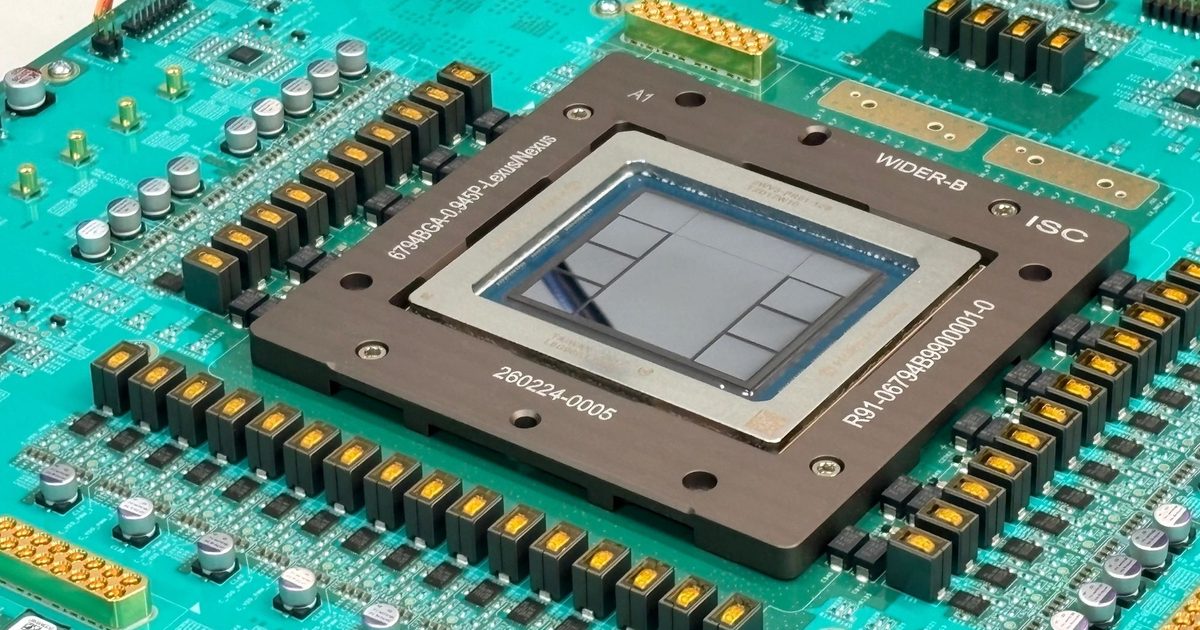

Every time you ask ChatGPT a question, a chip somewhere is racing to send back an answer. OpenAI just shared fresh benchmark results claiming its custom Jalapeño chip, co-developed with Broadcom, does that job significantly faster and more efficiently than rival chips in the market right now.
How much faster is Jalapeno, exactly?
OpenAI tested Jalapeno using InferenceX, an independent benchmark from SemiAnalysis that measures how well a chip handles inference, which is the process of running a trained AI model to generate responses.
Across three different AI models, Jalapeno delivered 1.5 to 1.9 times more AI work per watt of power, along with 1.7 to 3.6 times lower latency, meaning noticeably faster response times. For highly interactive tasks like AI agents, that advantage climbed even higher, reaching up to 4.1 times better performance.
Most chips force a tradeoff between speed and efficiency, but OpenAI says Jalapeno manages both simultaneously by minimizing how much data needs to move between different parts of the system during processing.
Why did OpenAI decide to build its own chip?
OpenAI has relied heavily on Nvidia GPUs since its inception, and Jalapeno marks its first real step toward designing hardware in-house. Interestingly, OpenAI’s own AI models helped design portions of the chip itself, and that same approach let a small team bring three additional AI models up to full performance within just two months.
Despite the strong results, OpenAI isn’t abandoning Nvidia anytime soon, since Jalapeno only handles inference, not the separate, compute-heavy process of training new models. The company plans to deploy the Jalapeno chip in small volumes by the end of 2026, scaling up meaningfully in 2027, with a second and third generation chip already taking shape behind the scenes.
OpenAI joins a growing list of AI companies building their own chips. Google has its TPU line, Amazon is pushing into custom silicon, and Anthropic recently confirmed similar plans of its own. Interestingly, Samsung has reportedly used Anthropic’s Claude to speed up its own chip design work, suggesting AI assisting hardware development is quickly becoming an industry norm, not just an OpenAI experiment.
Read the full article here