




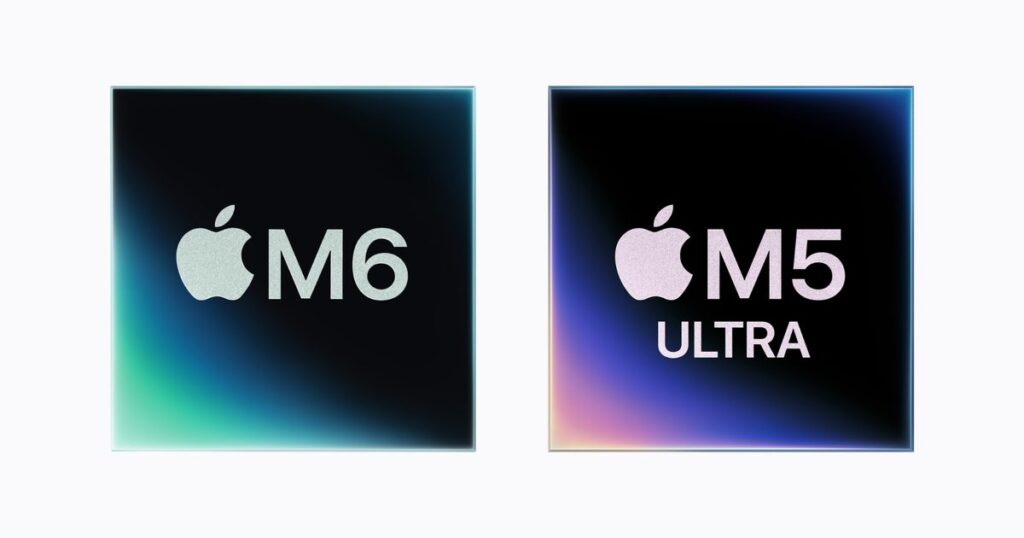

Apple is giving its Mac lineup a split personality: one chip built to make everyday computing and on-device AI faster, and another designed for workloads most people will never come close to exhausting.
The company has announced the M6 and M5 Ultra, alongside new versions of the Mac mini and Mac Studio. M6 becomes Apple’s first 2nm chip and powers the new Mac mini, while the M5 Ultra takes over the high-performance end of the lineup inside the new Mac Studio. Both machines open for preorder Tuesday and arrive on September 22.
Apple’s first 2nm Mac chip brings more power to the mini
The M6 represents a meaningful step forward from the M5. Apple has expanded the CPU from 10 cores to 12, including two super cores, four performance cores, and six efficiency cores. Apple claims the chip delivers up to 1.2 times faster multithreaded performance than M5, alongside what it calls the world’s fastest single-threaded performance.
Graphics also get a boost. M6 features a 12-core GPU, two more cores than M5, with a Neural Accelerator integrated into every GPU core. Apple says peak GPU compute for AI workloads is 30% higher than M5 and more than eight times faster than M1. The chip also supports up to 32GB of unified memory and delivers up to 170GB/s of memory bandwidth.
On-device AI is clearly a major part of Apple’s pitch. A new Dual 16-core Neural Engine can provide up to twice the peak compute performance of previous generations, while system frameworks can automatically distribute workloads across both engines. Apple says the design should help speed up local AI tasks, including image generation, coding, and interactions with large language models.
M5 Ultra is built for people who measure workloads differently
The M5 Ultra takes a far more extreme approach. Apple combines two dual-die M5 Max chips through its UltraFusion interconnect, creating a quad-die architecture that behaves as a single processor. The result is an up-to-36-core CPU, an up-to-80-core GPU, and a 32-core Neural Engine.

Memory capacity reaches 512GB, paired with up to 1.2TB/s of unified memory bandwidth. Apple says that opens the door to running large AI models with hundreds of billions of parameters locally, alongside demanding 3D rendering, scientific analysis, visual effects, and professional video production.
M5 Ultra also includes hardware acceleration for H.264, HEVC, ProRes, ProRes RAW, and AV1, while adding Apple’s latest graphics architecture, including Dynamic Caching, mesh shading, and ray tracing.
Apple’s strategy is becoming increasingly clear. M6 brings more AI and performance into a compact desktop, while M5 Ultra pushes the Mac Studio further into workstation territory. September 22 will reveal how much that extra power costs – and whether Apple’s biggest gains matter outside the most demanding creative and AI workloads.
Read the full article here