


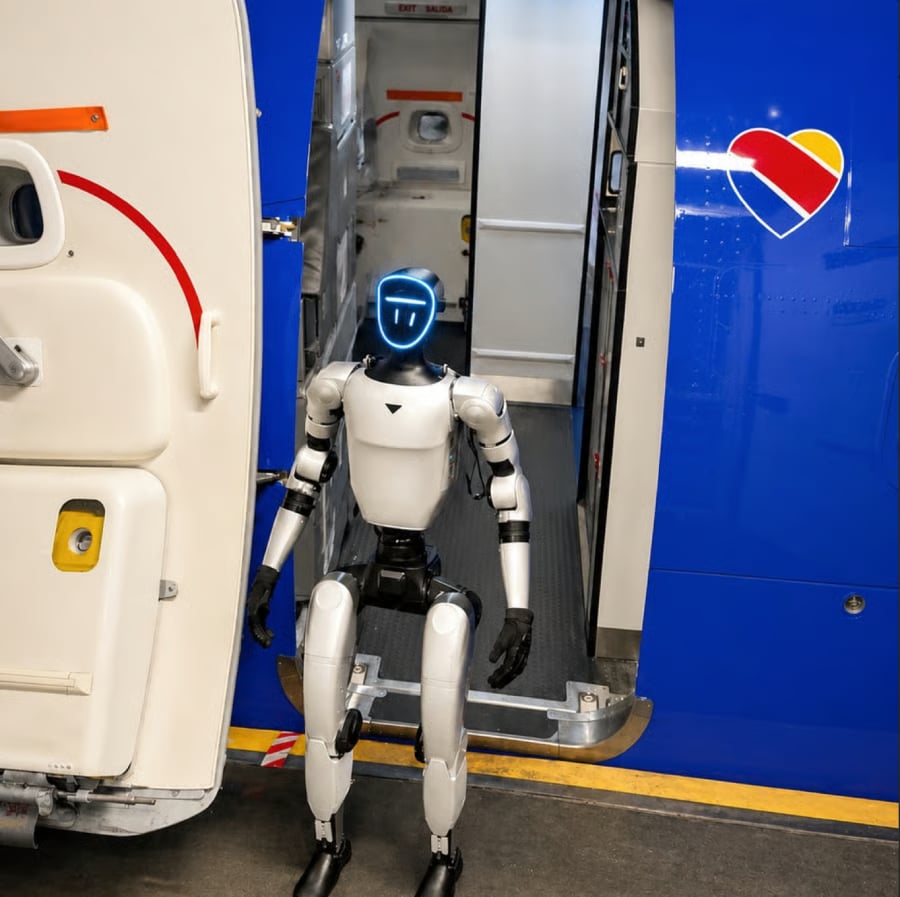

A humanoid robot made it to Dallas. Its fellow robots may not get the same boarding pass.
Southwest Airlines has banned “human-like or animal-like robots” from passenger cabins and checked luggage, citing concerns about the lithium-ion batteries used to power them. The rule follows viral flights in which travelers bought seats for event robots, creating confusion for crews over whether the machines counted as passengers, carry-ons, or something stranger in between.
The ban turns a quirky travel story into a sharper industry question: Will other airlines follow Southwest’s lead as lifelike robots become more common in public spaces?
The viral flights that triggered the ban
The policy shift follows a high-profile flight involving Aaron Mehdizadeh, founder of The Robot Studio in North Dallas. Mehdizadeh purchased a standard passenger seat on a flight from Las Vegas to Dallas Love Field for Stewie, a 3.5-foot humanoid robot typically rented out for events.
To clear TSA security, Mehdizadeh equipped Stewie with a smaller battery. The robot then walked through the terminal and boarded the plane under its own power, drawing stares and photos from stunned onlookers.
“Most people were very excited to see a robot flying and provided so much entertainment, and it was great,” Mehdizadeh said, according to CBS News Texas.
However, the mid-flight reality created an unexpected logistical puzzle for the flight crew. Because Stewie was technically classified as a carry-on item, it was not supposed to occupy a seat. Crew members ultimately disconnected the robot’s battery and relocated it to a window position to allow the flight to proceed.
Stewie’s flight wasn’t an isolated case. On April 30, Eily Ben-Abraham of Elite Event Robotics brought a robot named Bebop on a Southwest flight from Oakland to San Diego. That flight was delayed for nearly an hour when the crew noticed the robot was seated next to an aisle, violating airline policy for large carry-on items, and raised concerns about its power source.
More must-read AI coverage
The battle over batteries
Southwest frames the policy change as a critical safety measure, citing the fire risks posed by the high-capacity lithium-ion batteries that power sophisticated robotics. In a statement shared with PEOPLE, Southwest explained that its primary concern is “the size of lithium-ion batteries used to power [robots] and the risk they pose during flight.”
Mehdizadeh, however, publicly disputed the airline’s safety rationale, arguing that the modified power source he used was entirely standard. “It’s not a battery policy because the battery we used is essentially a laptop battery,” Mehdizadeh told CBS News Texas.
Stewie, using its programmed voice, offered a more colorful interpretation: “It’s a total conspiracy, I swear they don’t want us robots peeking at the clouds, seeing what’s really up there, my dreams got clipped faster than a bad haircut.”
To prevent any future confusion at the gate, Southwest has established clear, strict definitions for what is no longer allowed on board.
The airline defines a “human‑like robot” as “a robot designed to resemble or imitate a human in its appearance, movement, or behavior.” Similarly, an “animal-like robot” is defined as “a robot designed to resemble or imitate an animal in its appearance, movement, or behavior.”
Editor’s note: This article originally appeared on our sister publication, eWeek.
Read the full article here