

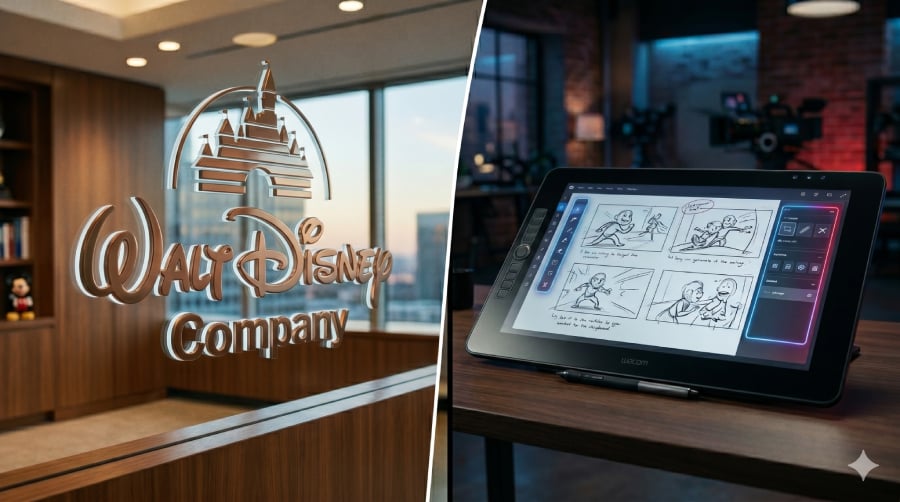

Recent Marvel layoffs have renewed concerns that major studios are moving away from in-house artists and toward leaner freelance and AI-assisted production models. While Disney did not explicitly say the layoffs were due to AI, new CEO Josh D’Amaro wrote in an April 14 memo that the company is looking for ways to “streamline our operations” and build a “more agile and technologically-enabled workforce” to meet future demands.
Former Disney animator Tom Bancroft, who worked on The Lion King, Aladdin, and Beauty and the Beast, spoke with TechRepublic about how the Marvel layoffs reflect a broader shift that could change how animated and effects-heavy stories are made.
Are studios replacing human creativity with AI?
Bancroft says the artists he spoke with described the layoffs as part of a larger move away from permanent in-house creative teams.
“It wasn’t necessarily because of AI,” Bancroft continued. “I do think that’s part of it. But most studios don’t want in-house employees anymore. They want freelancers they can hire as needed.”
Still, AI remains part of the conversation. Bancroft pointed to ongoing reports that Disney has been training its internal AI models on decades of studio content, potentially laying the groundwork for future productions that require fewer artists.
“We already know the rumors are out there that Disney has been training internal models on their films,” he said. “That does sound like something Marvel could eventually do, too.”
The fear among many artists is not just automation itself, but the possibility that studios could use AI systems trained on creative work while gradually reducing the number of creatives involved in making future projects.
What happens when long-term creative teams disappear?
AI-assisted tools could also help studios work faster and give artists more room to experiment during early development.
When used responsibly, they may reduce repetitive production tasks, speed up visual exploration, and make certain kinds of animation less expensive to produce. That could open the door for smaller teams, independent studios, or even hand-drawn projects that might otherwise struggle to compete with blockbuster budgets.
That upside could depend on whether studios use AI to strengthen creative teams or replace the conditions that make those teams effective.
Bancroft compared Marvel’s situation to Disney Animation Florida, where he worked for more than a decade before the studio was shut down despite producing successful films like Mulan and Lilo & Stitch. When studios dismantle established teams, Bancroft says they also lose years of collaborative chemistry and institutional knowledge.
“That team knew who was good at what,” he said. “They were probably working at a very efficient, higher artistic level.”
Freelance-heavy production models may offer flexibility and access to global talent, but Bancroft says they also tighten timelines and reduce opportunities for creative refinement throughout the production process.
More must-read AI coverage
Could a moment like Mufasa’s death still happen today?
Bancroft believes scenes like Mufasa’s death in The Lion King benefited from a production environment that allowed artists to continuously refine emotional and visual details throughout development.
With project-based staffing, that flexibility becomes harder to maintain.
“You’re suddenly on a tighter timeline,” Bancroft explained. “You might only have a few weeks to develop the look and feel of a major scene.”
Traditional studio systems allowed departments to overlap, collaborate, and evolve scenes organically as production progressed — something Bancroft worries could become increasingly rare.
Bancroft: AI is ‘not inherently bad’
Bancroft doesn’t believe AI itself is inherently bad. Like many artists, he already uses AI-powered tools in certain parts of his workflow. His concern is specifically with generative AI trained directly on artists’ previous work.
“It’s hard to think of a positive scenario where artists help train an AI and then aren’t needed anymore,” he said.
At the same time, Bancroft argues that artists cannot afford to completely reject the technology.
“AI is not going away,” he said. “Artists need to get involved in shaping how it’s used.”
He even sees potential for AI-assisted tools to reduce production costs enough to help revive hand-drawn 2D animation — a format that has largely disappeared from major US studios.
Should young artists still pursue animation?
Despite the uncertainty, Bancroft says yes.
He remembers when computer animation first emerged, and many traditional animators feared hand-drawn animation would disappear entirely. While CG animation dramatically changed the industry, he believes there is still room for traditional artistry to evolve alongside new tools.
“The tools change, but storytelling still matters,” Bancroft said.
The bigger question is how studios will use AI as creative workflows evolve. For artists, the hope is that the technology supports long-term creative teams, preserves institutional knowledge, and still leaves room for the slow collaboration behind memorable storytelling.
Related reading: Amazon is facing its own workforce reset, with layoffs across several states as Fresh closures, AI investments, and post-pandemic restructuring reshape the company.
Read the full article here