



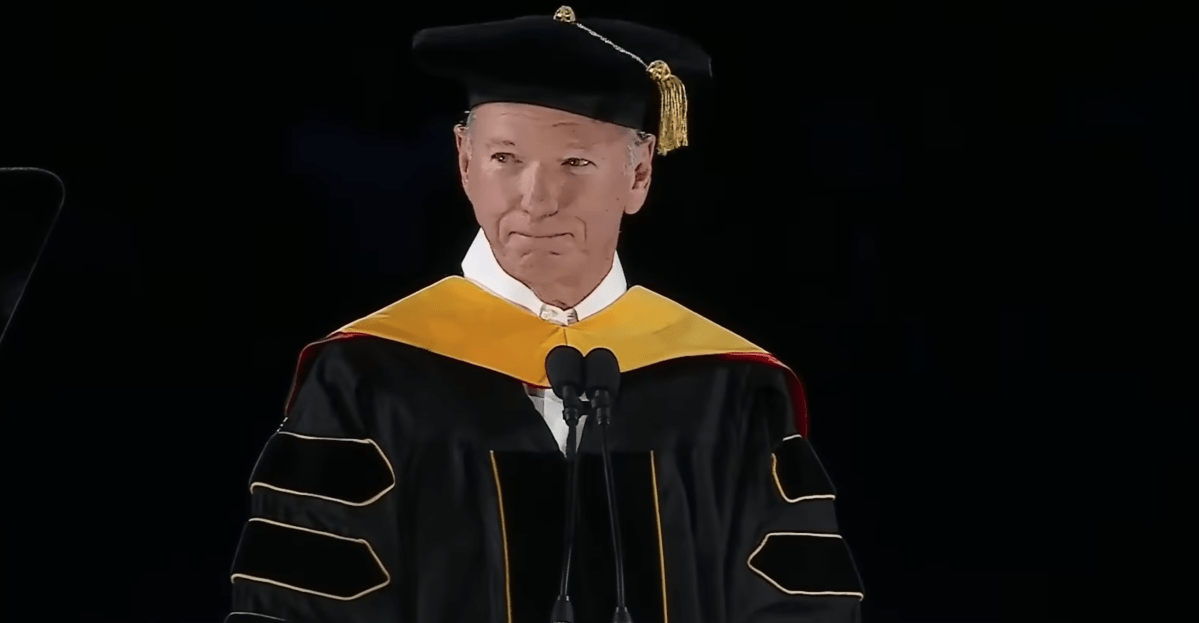

University graduates are booing and heckling corporate executives who praise AI during their commencement ceremonies, and the only people who seem to be genuinely surprised by this are the executives themselves.
In a procession of viral videos, 2026 commencement speakers like former Google CEO Eric Schmidt face loud and sustained jeers from students after praising AI and describing the technology as both inevitable and mandatory. The videos have clearly struck a chord among young people entering a bleak job market in an increasingly unstable world.
“They deserve everything they’re getting,” Penny Oliver, who recently graduated with a political science degree from George Mason University, told The Verge. “Some would argue they’re getting off kind of lightly. I’m not saying they deserve to get hurt, but it just shows a level of arrogance and a disconnect when you see that.”
Schmidt was met with a chorus of boos at the University of Arizona last week while lecturing graduates to accept the technology as part of their futures. “When someone offers you a seat on a rocket ship, you don’t ask which seat. You just get on,” Schmidt told the room of angry graduates. The reason for the outrage should have been obvious. As journalist Marisa Kabas put it, “these young people have already been forced onto the ship and there aren’t enough seats.”
The week before, Gloria Caulfield, an executive at a property development company, expressed shock after receiving a similarly icy reception from arts and humanities students at the University of Central Florida, where she described AI as “the next industrial revolution.” At Middle Tennessee State University, Scott Borchetta, a music industry CEO known for helping launch Taylor Swift’s career, gave a boisterous and patronizing speech mocking AI hecklers and telling students critical of AI to simply “deal with it.” And with graduation season ongoing and the online videos bringing anti-AI sentiment to a boiling point, it’s likely these incidents won’t be the last.
“Of course people are going to be mad and of course they’re going to boo. Why shouldn’t they?” said Oliver. “They just spent tens of thousands of dollars on an education that is supposed to get them more opportunities, and here comes this guy [Schmidt] who could never work another day in his life and still be very comfortable and well-off saying ‘Hey, you should really get on the bandwagon of this technology that’s going to replace you.’”
For many graduates, the surprised and contentious reactions of the speakers reveal a massive disconnect between the tech evangelists aggressively pushing AI and the young people being left to deal with its many well-documented consequences, which threaten everything from the environment to our critical thinking skills. Young people seem to particularly despise the attitude on display: Not only do you have to accept this technology we created that is the cause of your existential dread and rapidly evaporating job prospects, the speakers seem to say, but you also have to like it.
“It demonstrates a complete lack of being in touch with real people, and also it does not surprise me,” Austin Burkett, a game designer who recently graduated with an MFA at the NYU Game Center, told The Verge.
Burkett is one of the lucky ones. Before graduation, he found a job working on Pocket Bard, a mobile app used by tabletop roleplaying gamers, who tend to be staunchly anti-AI. But he says that some of his former classmates have been forced to take on fleeting gig work training the AI models that are replacing them, and that graduates are right to be incensed at corporate executives with a smirking “adopt-or-die” attitude on the technology.
“These are not the people who have to worry about rent, and they’re not the people who have to worry about their job being replaced,” Burkett added. “The people who are saying ‘it’s just a tool’ are the ones who can afford to say that. It puts the blame on the individual, and puts forth this myth that these institutions and systems and companies have no ulterior motive and no reasons to make a profit.”
To be fair, student receptions to commencement speakers promoting AI often vary depending on the majors of those in the audience. The strongest reactions seen in viral videos have come mainly from liberal arts and humanities students.
Many of those graduates include students hoping to enter creative professions that are facing existential threats thanks to generative AI tools. At CalArts, President Ravi Rajan was booed off stage by graduates of the legendary California art school, which is well known as an incubator for talent in the animation industry. Rajan has faced heavy criticism after eliminating creative programs and pushing AI adoption at the university through corporate partnerships with tech companies.
The student anger is coming to a head at a time when young people in most fields face intense pressure from the tech and business world to adopt generative AI tools — even as employers use those same tools to justify hiring freezes and mass layoffs. While polling shows that students and Gen Z are some of the most frequent users of AI tools, they are also extremely skeptical of Silicon Valley and have become some of the technology’s biggest critics.
That’s not a surprise considering that young people are regularly witnessing the technology’s failure to deliver on its most basic promises. At a commencement ceremony for Glendale Community College in Arizona, the room swelled with angry boos after the college president revealed that the school’s new AI system had failed to read out more than half the students’ names as they walked onstage to receive their diplomas. And earlier this week, The New York Times reported that a major nonfiction book by author Steven Rosenbaum about truth in the age of AI contained numerous fake or misattributed quotes hallucinated by AI tools.
“Society is in the process of restructuring itself around a tool that simply doesn’t work,” writer Margaret Killjoy wrote this week in response to the incidents. “If you needed to build a bridge, you wouldn’t hire a structural engineer who gets it right about 70% of the time. You wouldn’t read a history book that is 30% fiction but doesn’t tell you what 30%.”
It would be a mistake to ignore that much of the anger young people are expressing against AI is flowing through tech platforms that incentivize engagement metrics and short-lived cycles of paralyzing rage. Viral videos may be cathartic and a great way to unite lots of people, but graduates like Oliver seem to be well aware that doesn’t translate to material change unless people step up and take action.
“I definitely think there’s a catharsis in it, especially at a time where it feels like there are never any consequences for rich people, ever,” said Oliver about the much-talked-about viral videos. “I think it’s possible to take this outrage and channel it toward something impactful, but it doesn’t just spring up. People have to get together and say ‘let’s do something.’”
One tangible example is the massive movement that has sprung up around the country to oppose the construction of AI data centers. According to a recent Gallup poll, seven out of 10 Americans now say they oppose building these facilities in their local area, and nearly half of all proposed data center projects have either been scrapped or delayed this year. The unprecedented energy demands and environmental threats imposed by data centers have created a network of physical rallying points for those opposing the tech world’s multitrillion-dollar AI excess, and some graduates are encouraged by the role young people have played in the fight.
“I think despite the urge to feel nihilistic about it, I do have a decent glimmer of hope, inspired by people my age and younger,” said Burkett, mentioning a theater production written by high school students who were motivated by the environmental problems caused by AI. “It’s inspiring to see that it’s not just people who have had this privilege to go through an undergraduate or graduate degree, but the youth who are coming up and feel very strongly about this.”
Read the full article here