



For nearly 80 years, Ferrari occupied a unique cultural space where its cars were aspirational, even for people who resented those who could afford them. The price, the exclusivity, and the opacity of the buying process allowed Ferrari to sail above ordinary criticism. You might not be able to afford one, but you still wanted one.
With the launch of the all-electric Luce this week, however, the company fell down to earth, drawing the ire of the internet in the form of derision, mocking memes, and AI slop. People compared it to a vacuum, a Magic Mouse, and, most insultingly, a Nissan Leaf.
The Luce has arrived in a moment where wealth inequality and corporate excess have rarely been this visible or this resented. In that environment, a car that costs more than most people earn in a decade, yet looks like something bland and mass market, was always going to land hard. Ferrari has always sold desire across class lines. The $640,000-plus Luce homogenizes the aesthetic while keeping the Ferrari price, enraging loyalists and fans alike.
“The reaction illustrates how intrinsically the brand identity, expectations, and design are tied together,” Derek Jenkins, the SVP of Design and Brand at Lucid, told The Verge. “I can see a couple of things in the exterior design that still reference the brand. The taillights for one, the red color option, and finally, the logo. Everything else — proportions, lack of visual agility, even the expression of performance — is missing from the exterior. The face of the car isn’t identifiable… It’s a mismatch with the brand.”
“The face of the car isn’t identifiable… It’s a mismatch with the brand.”
— Derek Jenkins, SVP of Design and Brand at Lucid
The vehicle was designed in partnership with famed Apple designers Jony Ive and Marc Newson, through their firm LoveFrom, and boasts four motors, 1,035 horsepower, and around 500 km of electric range. Ive has been notoriously critical of car designers in the past, saying that he found some modern looks “shocking,” but recently admitted that he was surprised by how difficult it was to design a car.
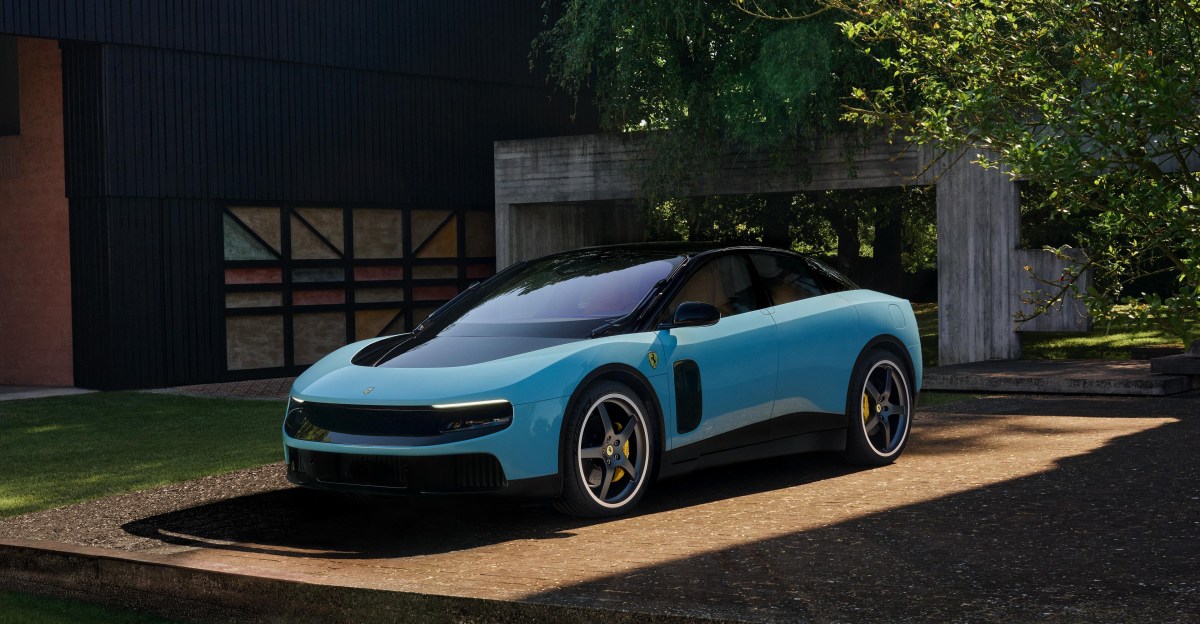
The Luce is the longest Ferrari ever built, eschewing the brand’s traditional sharp, aggressive lines for a more sweeping, aerodynamic profile. It’s also Ferrari’s first five-seater, with a low stance that almost makes it seem like a hatchback. It looks as though its sleek, dark “glass house” cabin is nested inside a separate, chunkier aluminum shell. And instead of a traditional grille, it features an S-duct swoop that drops down. It’s baffling to look at.
As Raphael Zammit, chair of transportation design at the College for Creative Studies in Michigan, explained, industrial design and automotive design are two very different disciplines, and the skills from one do not consistently translate to the other. Ive’s Apple iPhone design made the physical phone disappear, Zammit said, and was “100 percent appropriate for a digital communication device that you hold in your hand.” But a Ferrari is not an iPhone.
Ferrari’s decision to hire LoveFrom was a choice with a built-in logic, Zammit argued. “Ive is a brand,” he said. “When you hire Brad Pitt, you expect to get Brad Pitt.” The interior of the Luce has been praised for its blend of analog and digital touchpoints. But the interior language would likely be much more at home in a small premium city car, he added, such as a Fiat 500 or a Cinquecento, not a supercar that retails for half a million dollars.
Ferrari shares fell about 8 percent in Milan and 5.3 percent in New York the day after the unveiling, and hovered around that level through Wednesday, with analysts citing a mix of “design hate” and investor concerns about R&D costs and return on investment. Despite the public blowback, Ferrari CEO Benedetto Vigna said on Thursday that “interest was strong” in the Luce, especially with new customers, and the stock has since risen back to the prelaunch levels.
Stephanie Brinley, automotive analyst at S&P Global Mobility, said that the blowback has intensified as a direct result of the economic and political moment we’re living through. “It might end up being a blip on Ferrari’s overall history,” she continued, “I don’t see why this particular vehicle needs to destroy the Ferrari legacy.”
Image: Ferrari
A moment of collective trolling
The design criticism has come from far and wide, including harsh words from Italian officials and even the former president and chairman of Ferrari. It’s even spread beyond automotive media and Wall Street, landing on general culture sites, political accounts, and feeds with no particular interest in cars.
Competitors in the supercar world were also watching. Lamborghini CEO Stephan Winkelmann, without commenting directly on the Luce, said his company’s decision to cancel its EV plans and focus on plug-in hybrids was “the right way to go,” adding that innovation should not be made for its own sake or forced on customers.
Among automotive designers, the criticism is no less blunt. “It is brutally bland, actually. It really does look as if it was designed by AI. It’s like a mathematical averaging of many different themes,” Zammit said, adding that, “it’s almost alarmingly vacant of identity.”
There’s a lot that critics hate about the Luce. The stance and proportions, for example, are all wrong for Ferrari, which is known for its lithe and aggressive lines. The front end of the vehicle is generic, even with the air vent over the front glass (a video of executives showing the car to Pope Leo demonstrates that you can pass your entire arm through it).
“It’s not a sports car, it’s not a city electric, and it’s not really luxury,” Zammit said. “It seems like they might have gotten a little bit snowed or oversold by LoveFrom… The strategy is very muddy, because of what they’re doing versus what they’re saying on different parts of the vehicle.”
Ferrari may have an ulterior motive in its design choices. The company has been open about wanting to expand its presence in China, where electric vehicles are mainstream, large gasoline-powered cars face significant taxation, and many Chinese vehicles look a lot like Ferraris.
Chinese buyers have typically accounted for around 10 percent of Ferrari’s overall sales, but that share has declined in recent years. The Luce, with its large glassy surfaces, minimal/maximal interior, and polarizing exterior, reads less like a Ferrari and more like something designed to compete in a market where China’s domestic brands are launching ultraluxury EVs at volume.
If that calculation sounds familiar, it should. BMW spent the better part of a decade enlarging its kidney grilles to proportions that drew near-universal mockery in Western markets. BMW’s design chief, Adrian van Hooydonk, eventually acknowledged plainly: “In certain areas in the world, like China, it is good; people are still asking for big grilles.”
BMW has since moved on with its Neue Klasse design language, a global reset intended to resonate everywhere rather than optimize for one market. The lesson most automakers learned from BMW’s move was that when a brand built on a specific emotional identity makes an abrupt pivot toward a different buyer, the original audience notices immediately and tends to take it personally.
Benedetto Vigna, a former semiconductor industry executive, took over Ferrari in 2021, and has described the Luce as a “Leapfrog moment” in the company’s history, saying he considers himself fortunate to be leading through it. That conviction may be well-placed on the engineering side, but whether the physical design lives up to the Ferrari badge is another question.
Ferrari’s whole cultural function, as a signal, a provocation, an investment, depends on being unmistakably true to itself, its heritage, and, most importantly, its design.
When you remove the engine, the most emotionally resonant element in Ferrari’s history, you have to replace it with something compelling, Zammit points out, and the Luce’s design doesn’t do that.
Despite the design flop, Zammit was careful to separate it from the brand’s long-term health, calling it “a bit of a stumble, both in concept and in execution,” but said Ferrari had too strong a record to be permanently damaged.
One thing is clear in the face of all the negative coverage: In trying to signal a new era for Ferrari, the Luce has made everyone suddenly more interested in the old one.
Read the full article here