



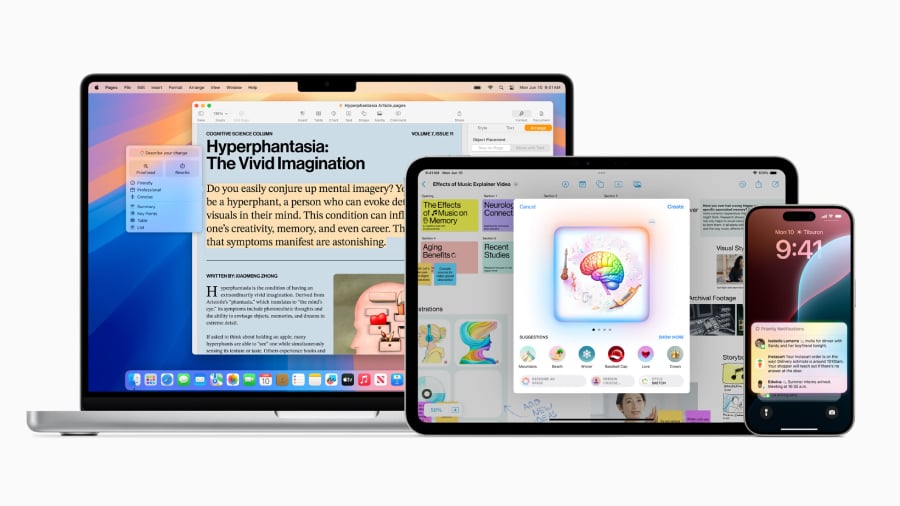

Apple Intelligence is Apple’s suite of generative AI features available on certain iPhones, iPads, Macs, Apple Vision Pro, and Apple Watch models.
These tools aim to deliver on Siri’s original promise of a more helpful assistant that makes device interactions more intuitive. They also introduce generative AI functions, such as on-device image generation, writing assistance, visual search, and automatic summarization, enhancing the capabilities of Apple’s ecosystem for a more dynamic user experience.
What does Apple Intelligence do?
Apple Intelligence is an umbrella term for various generative AI features that can operate on Apple devices. It includes:
- Generative writing tools.
- Automatic summarization.
- Smart prioritization of notifications and emails.
- Photo editing.
- Automatic photo sorting.
- Genmoji and Image Playground.
- Visual Intelligence for analyzing real-world objects, camera input, and on-screen content.
- The ability to control device settings and take actions across supported apps with voice commands.
- A more conversational and context-aware Siri.
- Live translation.
- Personalized workouts.
How does Apple Intelligence work?
Apple Intelligence is enabled by Apple’s chips, which include neural processing hardware that can run many AI tasks on-device. This means personal data used in many AI-augmented tasks can stay on the device instead of being sent to a data center or third party.
Some more processing-intensive generative AI tasks can be handled through Private Cloud Compute, Apple’s cloud-based system for more complex AI requests. Apple says data is used only for the task at hand and is not stored or shared with Apple.
Independent experts can inspect the code that runs on Apple servers to help verify that privacy is maintained.
Which devices have Apple Intelligence?
Apple Intelligence is compatible with newer iPhone, iPad, Mac, Apple Vision Pro, and Apple Watch models running supported software. The full list of supported devices includes:
| iPhone | iPad | Mac | Other Apple Devices |
|---|---|---|---|
| iPhone 15 Pro | iPad mini with A17 Pro | MacBook Air with M1 and later | Apple Vision Pro |
| iPhone 15 Pro Max | iPad Pro with M1 and later | MacBook Pro with M1 and later | Some Apple Watch features when paired with a nearby Apple Intelligence-enabled iPhone |
| iPhone 16 and later | iPad Air with M1 and later | iMac with M1 and later | |
| Mac mini with M1 and later | |||
| Mac Studio with M1 Max and later | |||
| Mac Pro with M2 Ultra |
Availability varies by country, region, language, and device. Some features, including the newest Siri AI capabilities, may not be available in all regions at launch.
Will Apple Intelligence come to older phones?
No. Devices with hardware older than the ones listed above don’t have suitable chips to run the full Apple Intelligence feature set.
How much does Apple Intelligence cost?
Apple Intelligence is free with a software upgrade on the supported devices.
When did Apple Intelligence launch?
Apple Intelligence launched on October 28, 2024, with limited features, including Writing Tools, Type to Siri, Clean Up in Photos, and natural language search in Photos.
Since then, Apple has added more features through iOS 18 updates and subsequent software releases, including:
- Genmoji and image tools: Users can create custom emojis, generate images with Image Playground, and turn rough sketches into polished images with Image Wand.
- Writing Tools: Rewrite, proofread, and summarise text, or give a custom instruction such as “turn into a poem.” These work in Mail, Messages, Notes, Pages, and third-party apps.
- Visual Intelligence: Analyze real-world objects or on-screen content, such as identifying a plant, translating text, searching for similar products, or turning an invite into a calendar event.
- Priority Notifications: AI digests Apple Mail and phone notifications and lists them in order of priority.
- ChatGPT integration: OpenAI’s chatbot can be used with Writing Tools and Siri without switching to a browser or app.
- Live Translation: Written messages can be translated as they are typed or received, while supported calls can show or read translated speech.
- Workout Buddy: Apple Intelligence can analyze Apple Watch fitness data to provide personalized workout insights.
At Apple’s 2026 Worldwide Developer Conference, Apple unveiled the next generation of Apple Intelligence and Siri AI for supported devices. These features include:
- Siri AI: A redesigned Siri with richer answers, more natural conversations, follow-up support, and personal context.
- App actions: Siri can take actions in supported apps such as Messages, Music, Reminders, Calendar, Mail, and Photos.
- On-screen Visual Intelligence: Users can analyze on-screen content and take actions such as searching for similar products, adding an event to their calendar, or asking for more information.
- Expanded Visual Intelligence: Visual Intelligence is expanding to iPad, Mac, and Vision Pro.
- Photo editing upgrades: New and upgraded tools include Spatial Reframing, Extend, and Clean Up.
- Messages and Mail suggestions: Apple Intelligence can suggest replies, reminders, and calendar events from context.
- Natural-language Shortcuts: Users can describe an automation and have Shortcuts help build it.
Language support includes English, French, German, Italian, Portuguese, Spanish, Japanese, Korean, Chinese Simplified, Chinese Traditional, Danish, Dutch, Norwegian, Swedish, Turkish, and Vietnamese. Individual features may support fewer languages, and availability can vary by region.
Must-read Apple coverage
Is Siri artificial intelligence?
The definition of AI can vary. Before Apple Intelligence, Siri could have been considered a form of artificial intelligence, but not generative AI, as it performed tasks without creating or remixing content. Instead, Siri primarily executed operations based on preset functions.
Some argue that these computing capabilities shouldn’t be considered AI, as the term implies a science-fiction level of human-like intelligence that algorithms, no matter how advanced, can’t achieve. However, “AI” has become a widely accepted term for certain types of computing. Still, it might have been more accurate to call older Siri a digital assistant rather than true AI.
With Apple Intelligence, Siri is becoming more conversational and context-aware. It can answer broader questions, continue longer interactions, use personal information from supported apps, understand screen or camera content, and take actions across apps. It is now more accurate to describe Siri as part of Apple’s generative AI system.
How to add Apple Intelligence to iPhone?
Apple Intelligence arrives on supported iPhones through software updates. To check for the latest update, visit Settings > General > Software Update.
How do I activate Apple Intelligence?
After updating a supported device, go to Settings > Apple Intelligence & Siri and follow the setup prompts. On Mac, open System Settings, then select Apple Intelligence & Siri.
What are the competitors to Apple Intelligence?
Samsung and Google have both integrated generative AI into their newest phones. The Google Pixel 10 series uses Google Gemini for features such as photo editing, call translation, writing help, visual assistance, and conversations. The Samsung Galaxy S26 series uses Galaxy AI and Google Gemini for similar capabilities, including writing assistance, translation, image editing, search, and assistant-style tasks.
Learn how Google Gemini works and what to expect from its latest features in our full cheat sheet.
Read the full article here