



AI’s infrastructure boom is pushing data centers to their limits, forcing operators to rethink power, cooling, and construction all at once.
At this week’s Data Center World (DCW) Conference in Washington, DC, speakers from research firm Omdia, Aligned Data Centers, and Vertiv laid out the various ways in which the rapid expansion of generative AI and agentic AI create a domino effect across all aspects of data center design and infrastructure.
“Partway through one ongoing data center construction project, the customer decided they needed 50% more power due to the pace of AI and GPU technology,” said Phill Lawson-Shanks, CEO of Aligned Data Centers, during a panel at the show. “We needed to restructure everything to be able to introduce enough cooling and find more power from the grid.”
Major components like transformers and power shelves are heavily backlogged. Some are claiming that supply chain problems like these will derail many data center projects. But Shen Wang, an analyst with Omdia, briefed the DCW audience that they only lead to a delay of a few months. Most projects figure out a way to move forward.
“People need AI so large AI factories will move forward somehow,” said Wang.
Power constraints are emerging as a major AI bottleneck
Aligned Data Centers gets around the supply chain crunch by buying equipment in bulk 2.5 years in advance.
It does the same with land, purchasing plots across the country that may one day prove to be good sites for facilities. Beyond land availability, the bigger constraints on data center expansion are electricity availability, permitting, and a lack of electrical engineering talent.
“We now look for land where there is stranded power,” said Lawson-Shanks. “There is huge growth in data center expansion now compared to ten years ago.”
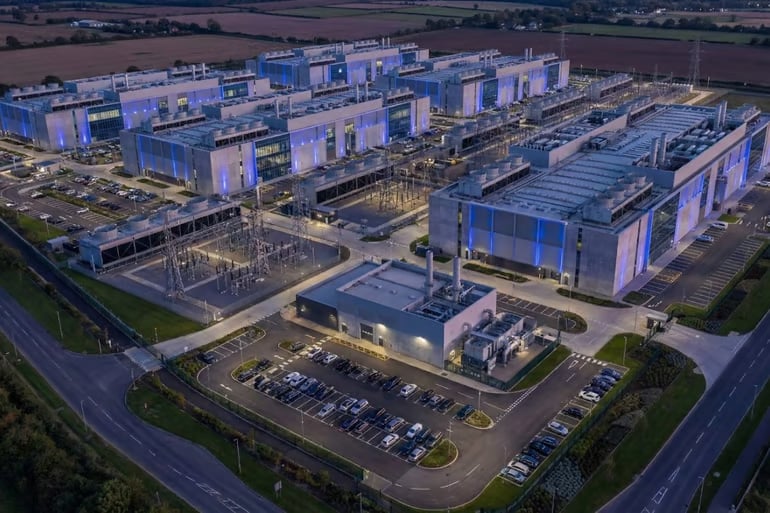
The company has 88 data center buildings under construction. All have already been leased.
The Omdia viewpoint is that the onward march of AI factories will continue despite the various issues faced – power, water, permitting, supply chain, and more.
“There is an unprecedented volume of data centers currently under construction or planned,” said Alan Howard, an analyst with Omdia. “Last year, some thought we had over-predicted AI and data center build out, yet this year we have had to revise our projection upward once again.”
Liquid cooling moves from niche to necessity
Just as the power market is being turned on its head, so too is cooling.
Wang said the volume of liquid-cooled chips will 5X between 2025 and 2030. The market is dominated by cold plates that provide limited cooling close to the chip. Omdia reported 8 million cold plate shipments in 2025. By 2030, it will surge to 356 million.
“Liquid-cooled cooling capacity equaled air cooling capacity in 2025,” said Wang. “By the end of 2026, it will double air cooling capacity.”
However, the rise of liquid cooling doesn’t mean the end of air cooling. Wang noted that even in the most advanced liquid-cooling setup, heat from power shelves, memory, SSDs, switches, motherboards, and busbars would still require air cooling.
As rack densities move from tens of kilowatts toward hundreds, operators are managing a new class of cooling challenges.
Scott Armul, chief product and technology Officer at Vertiv, said during a keynote that AI infrastructure needs to be planned holistically, with cooling, power, and compute integrated into modules and standardized building blocks that scale rapidly, rather than relying on separate vendors for each aspect of the infrastructure.
On the cooling side, this means defined interfaces between coolant distribution units (CDUs) and other facets of the cooling and thermal cycle.
“We can now simulate the whole environment, so we know that we need to adjust liquid cooling valves and alter CDU set points to optimize facility cooling and efficiency,” Said Armul. “This is vital as we are seeing liquid cooling deployed in GW campuses at a scale that we have never seen before.”
For more on the scale of AI data center expansion, read how Shark Tank’s Kevin O’Leary is backing massive new powered compute campuses across the US and Canada.
Read the full article here