



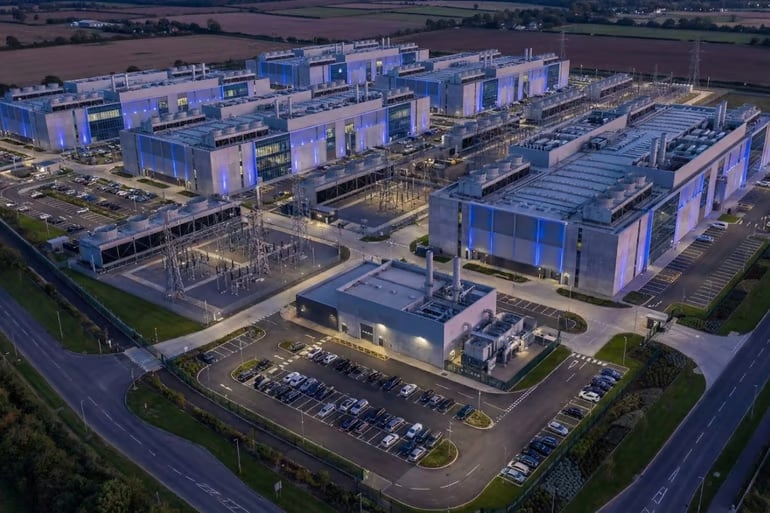

Australia’s data center buildout has hit new heights, turning server farms into one of the country’s strongest economic engines at a time when other parts of the economy are losing steam.
Private investment in Australia jumped 6.5% in the first three months of 2026, reaching its highest level in years and far exceeding economists’ expectations of around 1% growth, according to data from the Australian Bureau of Statistics (ABS).
A major driver behind the surge was spending on information, media, and telecommunications equipment, largely tied to data center infrastructure.
Companies spent about A$8.7 billion (around $6.2 billion) on building data centers and purchasing servers in the quarter, nearly doubling the level recorded in the previous period.
Data centers dominate capital spending
Data center-related investment accounted for nearly 17% of all private investment in the quarter, an unprecedented share in records going back nearly two decades.
ABS head of business statistics Tom Lay said the jump was driven by heavy spending on core infrastructure. “The lift in investment was the result of investment in data centre equipment, specifically server racks and processing equipment, significantly boosting overall investment figures,” he said.
Behind the spending wave lies the global artificial intelligence boom, reshaping how countries invest in infrastructure.
Hyperscale operators and tech giants are expanding aggressively in Australia, with major commitments from global cloud providers and local infrastructure firms. Industry reports point to multi-billion-dollar long-term plans from companies including Amazon Web Services and Microsoft, alongside rapid expansion by domestic operators such as NEXTDC, AirTrunk, and Canberra Data Centres.
The demand is driven by the need for high-capacity computing infrastructure to support AI workloads, which require far more power, cooling, and specialized hardware than traditional cloud systems.
A split economy emerges
While tech infrastructure investment is booming, household spending is moving in the opposite direction.
ABS data shows household consumption fell 1.1% in April after a rise the previous month, marking the steepest monthly decline since late 2023. The drop was largely driven by reduced discretionary spending on travel, services, and clothing. Economists say the contrast highlights a widening gap in the economy: strong capital investment in technology on one side, and weakening consumer demand on the other.
Economists expect the data center boom to continue supporting Australia’s GDP in upcoming reports, but caution that the broader economy may struggle to maintain momentum. Some analysts warn that the current growth model relies heavily on imported capital equipment and global tech demand, while domestic consumption softens under the pressure of higher interest rates.
The divergence reflects a broader shift already reshaping Australia’s workforce, as companies pour money into AI infrastructure while white-collar employees face growing pressure from automation and AI-driven restructuring.
Read the full article here