


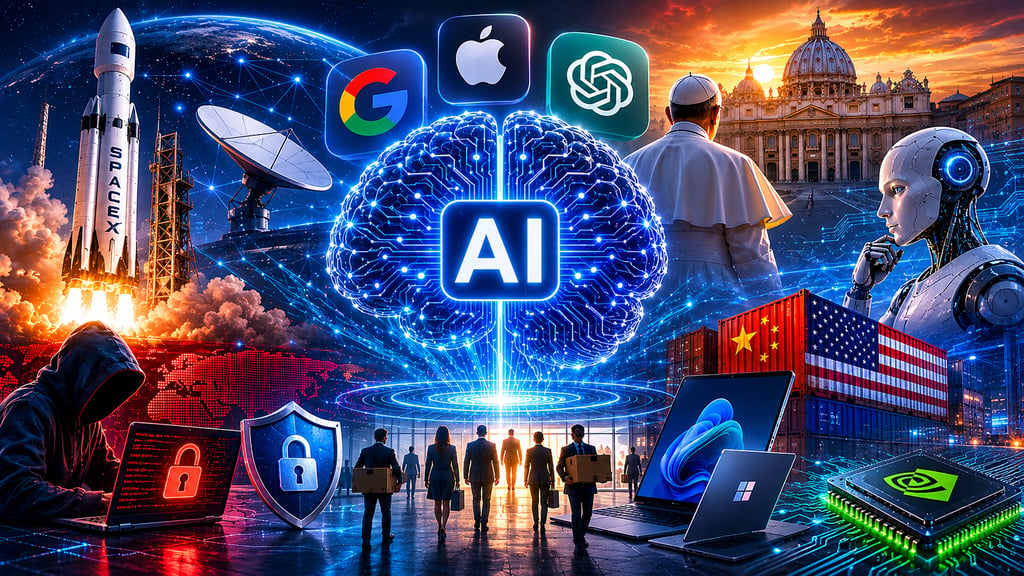

From SpaceX’s market-shaking IPO plans to AI product overhauls, security blowups, and another round of workforce reshuffling, this week showed how artificial intelligence is no longer just a tech trend — it is the engine behind the industry’s biggest bets, risks, and headaches.
Top news
SpaceX’s record-breaking IPO and expanding AI ambitions
SpaceX filed its S-1 for a record-setting IPO, seeking to raise up to $75 billion and targeting a valuation above $1.5 trillion under the ticker SPCX. Starlink now drives most of the company’s revenue and profit, though heavy AI investments have led to short-term losses. Elon Musk retains 85% voting control and could earn a massive bonus if ambitious goals are met.
AI in the spotlight: From Google to Apple
At Google I/O 2026, Sundar Pichai unveiled the “agentic Gemini era,” introducing Gemini 3.5 Flash, Gemini Omni, and Gemini Spark — new AI models designed to manage autonomous tasks across Google’s ecosystem. Meanwhile, Apple is preparing Siri’s biggest AI overhaul yet for WWDC 2026, adding AI writing tools, natural-language shortcuts, and privacy-focused controls to better compete with Google and Samsung.
Anthropic, OpenAI, and the Vatican enter the AI ethics arena
The Vatican is taking a bold step into AI ethics. Anthropic co-founder Christopher Olah joined Pope Leo XIV for the launch of an AI-focused encyclical exploring technology’s impact on human dignity and labor. The Vatican’s upcoming document, “Magnifica Humanitas,” will formally address AI’s societal and moral implications.
Elsewhere, Anthropic announced new monthly credit caps for its Claude Agent SDK, ending flat-rate compute pricing and sparking debate among developers. Meanwhile, OpenAI is reportedly considering legal action against Apple over ChatGPT’s integration into Apple Intelligence, citing disputes over visibility and revenue sharing.
AI shifts in industry and workforce
Detroit automakers are undergoing a massive transformation, cutting over 20,000 white-collar jobs as General Motors, Ford, and Stellantis pivot toward AI-driven operations. Simultaneously, Gen Z is pushing back against AI adoption, with protests and surveys showing nearly half of young people believe AI’s risks outweigh its benefits.
Hardware and geopolitics
Microsoft launched new Surface AI PCs for business, featuring Intel Core Ultra Series 3 chips and NPUs for local Copilot tasks. Meanwhile, the US government approved Nvidia H200 chip sales to select Chinese firms, including Alibaba and Tencent, underscoring ongoing geopolitical tensions in the AI supply chain.
Insider intel
Wall Street analysts are skeptical of AI-driven layoffs, noting that over half of companies announcing such cuts see their stock prices fall. Experts argue that augmenting workers with AI yields better returns than replacing them, suggesting that many corporate AI initiatives may be more about optics than true transformation.
Security alerts
Government and corporate breaches
A CISA contractor accidentally exposed AWS GovCloud admin tokens and passwords on GitHub for six months, prompting congressional scrutiny. In the healthcare sector, NYC Health and Hospitals suffered a breach exposing 1.8 million patient records, including biometric data. Separately, a ransomware attack on American Lending Center compromised data of 123,000 individuals.
Software vulnerabilities and exploits
Google accidentally published exploit code for an unpatched Chromium bug that allows malicious sites to keep JavaScript running after the browser closes. Meanwhile, Ivanti, Fortinet, SAP, VMware, and others issued emergency patches for 11 severe vulnerabilities enabling remote code execution and data theft. A malicious VS Code extension also compromised 3,800 GitHub repositories, underscoring the risks of tampered developer tools.
Emerging threats and malware
The KongTuke hacking group is exploiting Microsoft Teams chats to deploy ModeloRAT malware via fake IT messages. On macOS, the Reaper infostealer is spreading through fake WeChat and Miro installers, stealing credentials and crypto wallets. Meanwhile, Discord added end-to-end encryption for calls but left text chats unprotected, raising privacy concerns.
AI and cybersecurity trends
Verizon’s 2026 Data Breach Investigations Report revealed that AI-driven exploits have surpassed credential theft as the leading cause of data breaches, urging organizations to prioritize secure AI deployment and patch management.
Industry shakeups
Layoffs, lawsuits, and AI restructuring
Intuit announced 3,100 layoffs — about 17% of its workforce — to fund AI initiatives with OpenAI and Anthropic. Despite strong profits, shares fell over 20% amid investor skepticism. In the legal arena, Elon Musk lost his lawsuit against OpenAI, clearing the way for the company’s anticipated more than $1 trillion IPO and strengthening its partnership with Microsoft.
Corporate deals and labor negotiations
Google and Blackstone are forming a $5 billion joint venture to build a TPU-based cloud service for enterprises, aiming to expand AI compute access and challenge Nvidia’s dominance. Meanwhile, Samsung offered chip-division workers $26.6 billion in stock-based bonuses and a 6.2% wage increase to avert a strike — a move that could strain finances if the chip market cools.
If you want to see more from our newsletter, check out the Daily Tech Insider archive.
Read the full article here