







Since ChatGPT proved a consumer hit, a gold rush has set off for AI in Silicon Valley. Investors are intrigued by companies promising generative AI will transform the world, and companies seek workers with the skills to bring them into the future. The frenzy may be cooling down in 2026, but AI skills are still hot in the tech market.
Looking to join the AI industry? Which route into the profession is best for each individual learner will depend on that person’s current skill level and their target skill or job title.
The options below are organized by skill level and, within each category, alphabetically, making it easier to compare programs based on experience level. Because many providers offer several generative AI courses in different specialty areas, the best choice will depend on the learner’s objectives, role, and budget.
- Coursera’s AI for Everyone: Coursera
- AWS’s Building a Generative AI-Ready Organization via Coursera: Coursera
- DataCamp’s Understanding Artificial Intelligence: Datacamp
- Google Cloud’s Introduction to Generative AI Learning Path: Google Cloud
- IBM’s Introduction to Artificial Intelligence via Coursera: Coursera
- AWS Generative AI Developer Kit: AWS Skill Builder
- Harvard University Professional Certificate in Computer Science for Artificial Intelligence: edX
- MIT’s Professional Certificate Program in Machine Learning & Artificial Intelligence: MIT Professional Education
- Stanford Artificial Intelligence Professional Program: Stanford Online
- Udacity’s Artificial Intelligence Nanodegree program: Udacity
1
Robin by Atera
Employees per Company Size
Micro (0-49), Small (50-249), Medium (250-999), Large (1,000-4,999), Enterprise (5,000+)
Micro (0-49 Employees), Small (50-249 Employees), Medium (250-999 Employees), Large (1,000-4,999 Employees), Enterprise (5,000+ Employees)
Micro, Small, Medium, Large, Enterprise
Features
AI Copilot, Application Deployment, Asset Management, and more
2
Wrike
Employees per Company Size
Micro (0-49), Small (50-249), Medium (250-999), Large (1,000-4,999), Enterprise (5,000+)
Medium (250-999 Employees), Large (1,000-4,999 Employees), Enterprise (5,000+ Employees)
Medium, Large, Enterprise
Features
24/7 Customer Support, 360 Degree Feedback, Accounting, and more
Best AI courses: Comparison table
Coursera’s AI for Everyone
A name learners are likely to see on AI courses a lot is Andrew Ng; he is an adjunct professor at Stanford University, founder of DeepLearning.AI and cofounder of Coursera. Ng is one of the authors of a 2009 paper on using GPUs for deep learning, which NVIDIA and other companies are now doing to transform AI hardware. Ng is the instructor and driving force behind AI for Everyone, a popular, self-paced course — more than one million people have enrolled. AI for Everyone from Coursera contains four modules:
- What is AI?
- Building AI Projects
- Building AI in Your Company
- AI and Society
Pricing
For individuals, Coursera Plus provides unlimited access to 10,000+ courses, including AI for Everyone, for $239/year (less than $20/month) with a 7-day free trial. However, the AI for Everyone course can be audited for free; the subscription provides access to graded assignments and earning a certificate.
Duration
Coursera states the class takes six hours to complete.
Pros and cons
| Pros | Cons |
|---|---|
| Coursera is a popular course platform used widely. | The information is basic and generalized. |
| Instructor has proven excellence in the field. | The course videos have not been updated recently, so the latest information about generative AI is not included. |
| It is possible to complete the entire course within the 7-day free trial. | Coursera’s UI can be cluttered. |
| Coursera emphasizes gamified goals. |
Prerequisites
This course has no prerequisites.
AWS’s Building a Generative AI-Ready Organization via Coursera
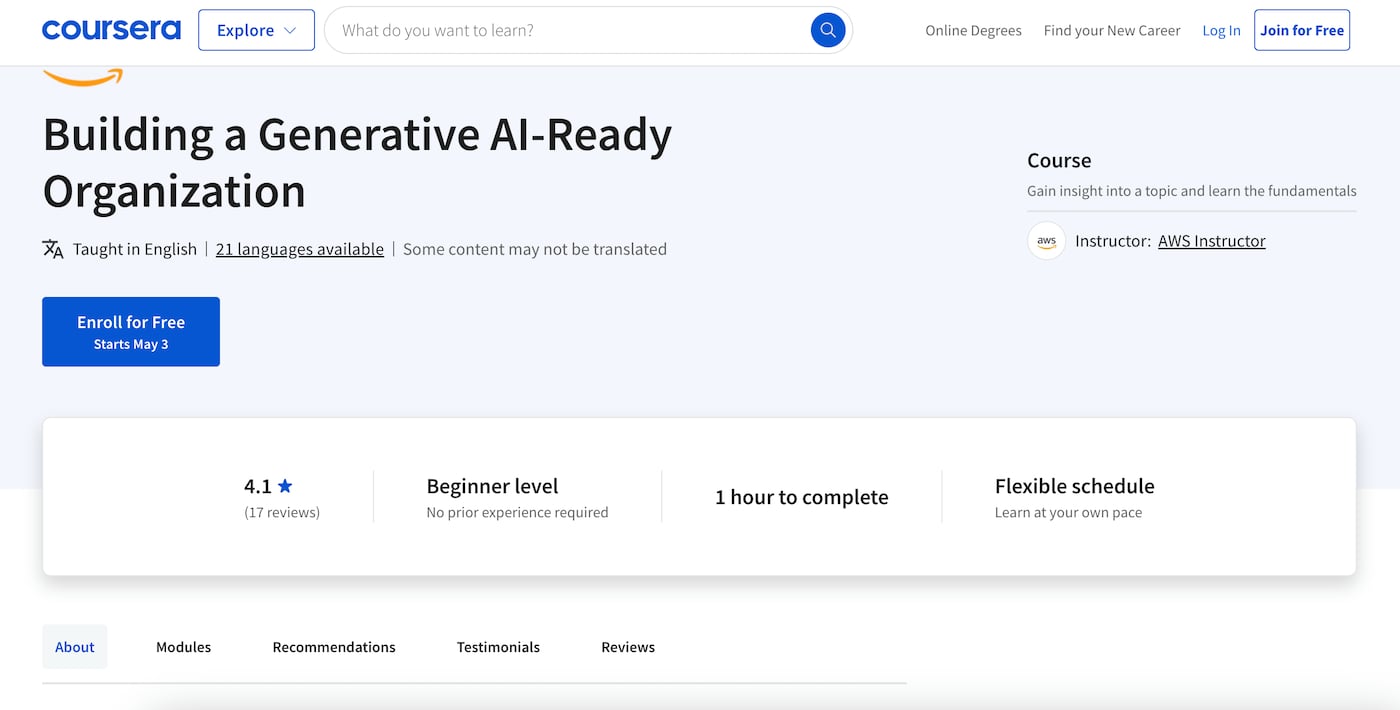
Are you a C-suite leader looking to shape your company’s vision for machine learning? If so, this non-technical course helps business leaders build a top-down philosophy around AI and machine learning projects. It could be useful for sparking conversation between business and technical leaders.
Pricing
Free to audit all materials. Full access with certificate via Coursera Plus at $239/year (less than $20/month) with a 7-day free trial.
Duration
This course takes about one hour.
Pros and cons
| Pros | Cons |
|---|---|
| Good overview for getting started with the topic. | While the title includes “generative AI,” this course is a reskinned initiative to promote machine learning. While many of the ideas are applicable to generative AI, they are not specific to generative AI. |
| Focuses on how to talk to stakeholders about AI and ML projects. | The course is brief, and information may be generalized. |
| Includes a quiz for self-assessment. | The course is hosted on an external AWS site, but requires the Coursera portal to access and complete the quiz. Moving between the two can be cumbersome. |
Prerequisites
There are no prerequisites for this course.
DataCamp’s Understanding Artificial Intelligence
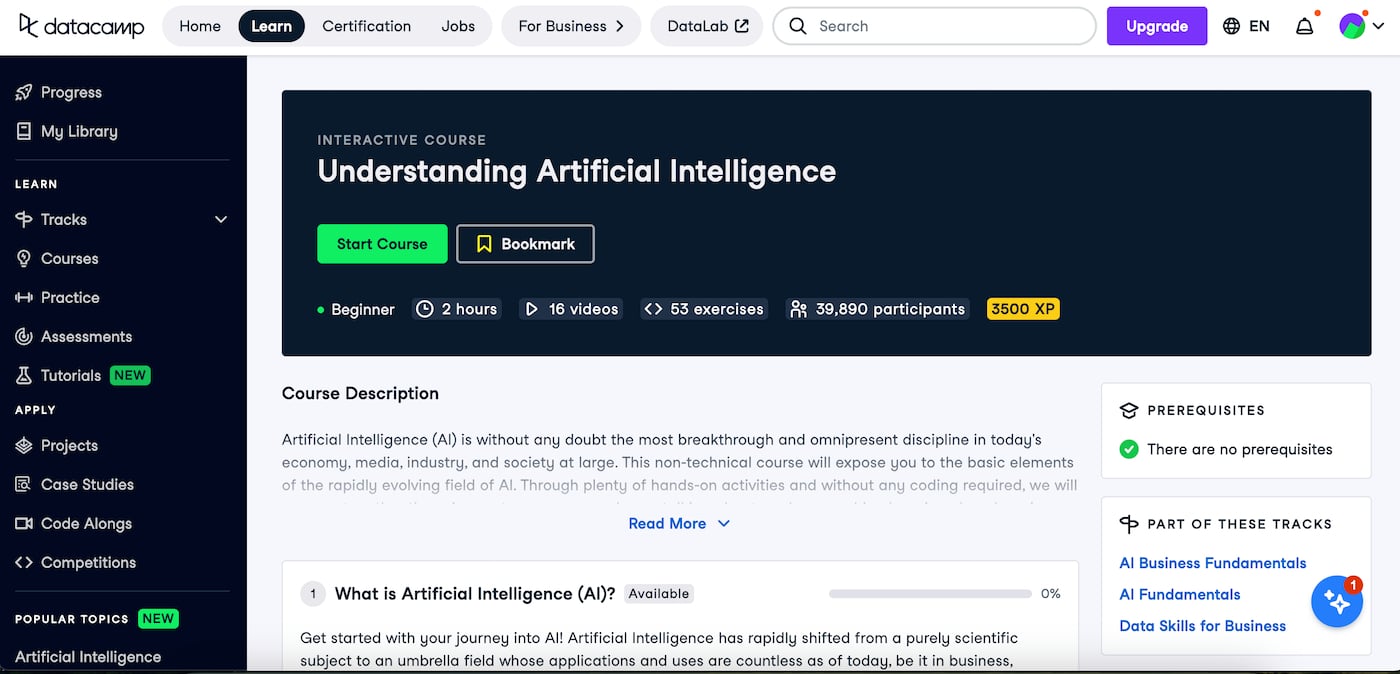
This is a well-reviewed beginner course that sets itself apart by approaching AI holistically, including its practical applications and potential social impact. It includes hands-on exercises but doesn’t require the learner to know how to code, making it a good mix of practical and beginner content. Datacamp’s Understanding Artificial Intelligence course is particularly interesting because it includes a section on business and enterprise. Business leaders looking for a non-technical explanation of infrastructure and skills they need to harness AI might be interested in this course.
Pricing
This course can be accessed with a DataCamp subscription, which costs $25 per person per month, billed annually. Educators can get a group subscription for free.
Duration
Including videos and exercises, this course lasts about two hours.
Pros and cons
| Pros | Cons |
|---|---|
| Like Coursera, DataCamp’s UI emphasizes gamified points systems and data-driven milestones. This may help some users break tasks into smaller chunks, concentrate on the task and complete the course faster. | DataCamp’s UI can be cluttered with pop-ups and promotions. If the gamification doesn’t help you focus, it could be distracting. |
| Includes real-world-like scenarios and practical use cases. | Some content can be very generalized and slow-paced. |
Prerequisites
This course has no prerequisites.
Google Cloud’s Introduction to Generative AI Learning Path
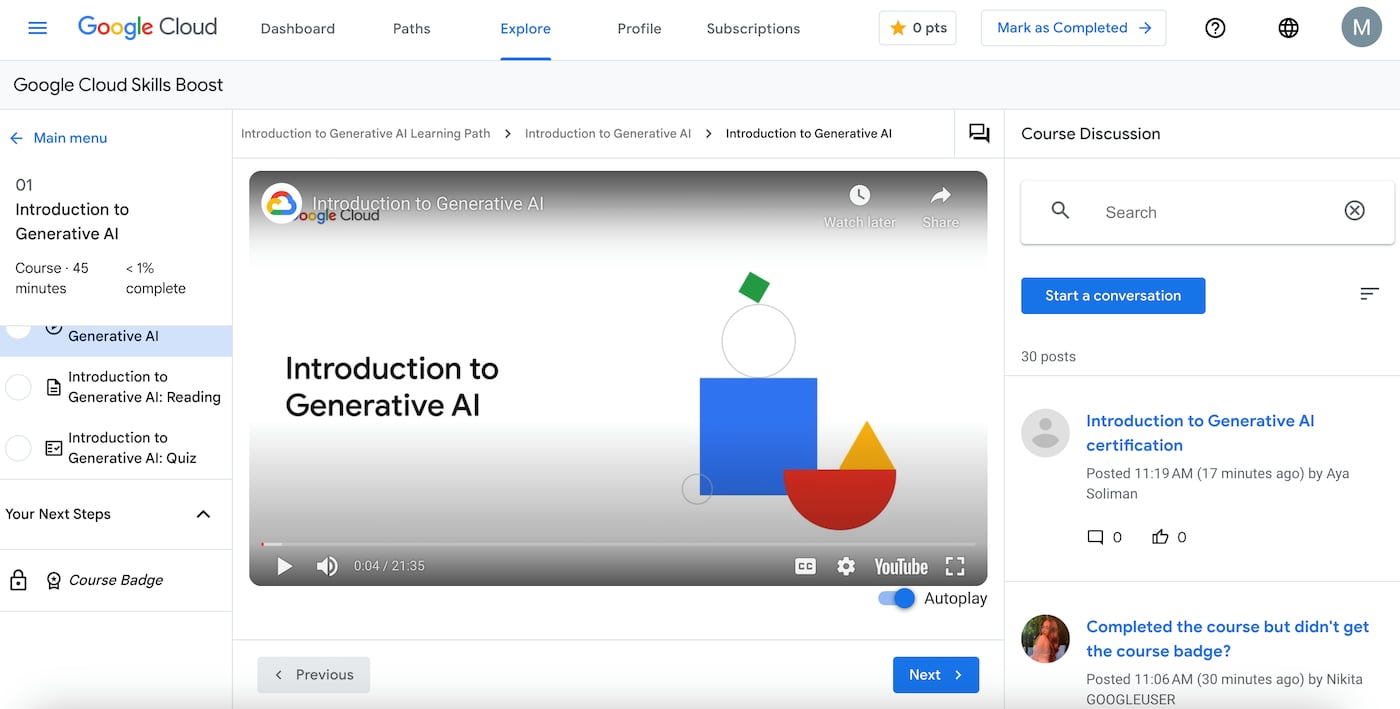
Google Cloud’s Introduction to Generative AI Learning Path covers what generative AI and large language models are for beginners. Since it’s from Google, it provides some specific Google applications used to build generative AI: Google Tools and Vertex AI. It includes a section on responsible AI, inviting the learner to consider ethical practices around the generative AI they may go on to create. Completing this learning path will award the Prompt Design in Vertex AI skill badge.
Another option from Google Cloud is the Generative AI for Developers Learning Path.
Pricing
This course is free.
Pros and cons
| Pros | Cons |
|---|---|
| Clean UI. | Focuses at times exclusively on Google products, which might not be an issue if you’re a Google admin. |
| Presentation is energetic and modern. | |
| Answers common, practical questions beginners may have about AI. |
Duration
The path technically contains 8 hours and 30 minutes of content, but some of that content is quizzes. The time it takes for each individual to complete the path may vary.
Prerequisites
The path has no prerequisites.
IBM’s Introduction to Artificial Intelligence via Coursera
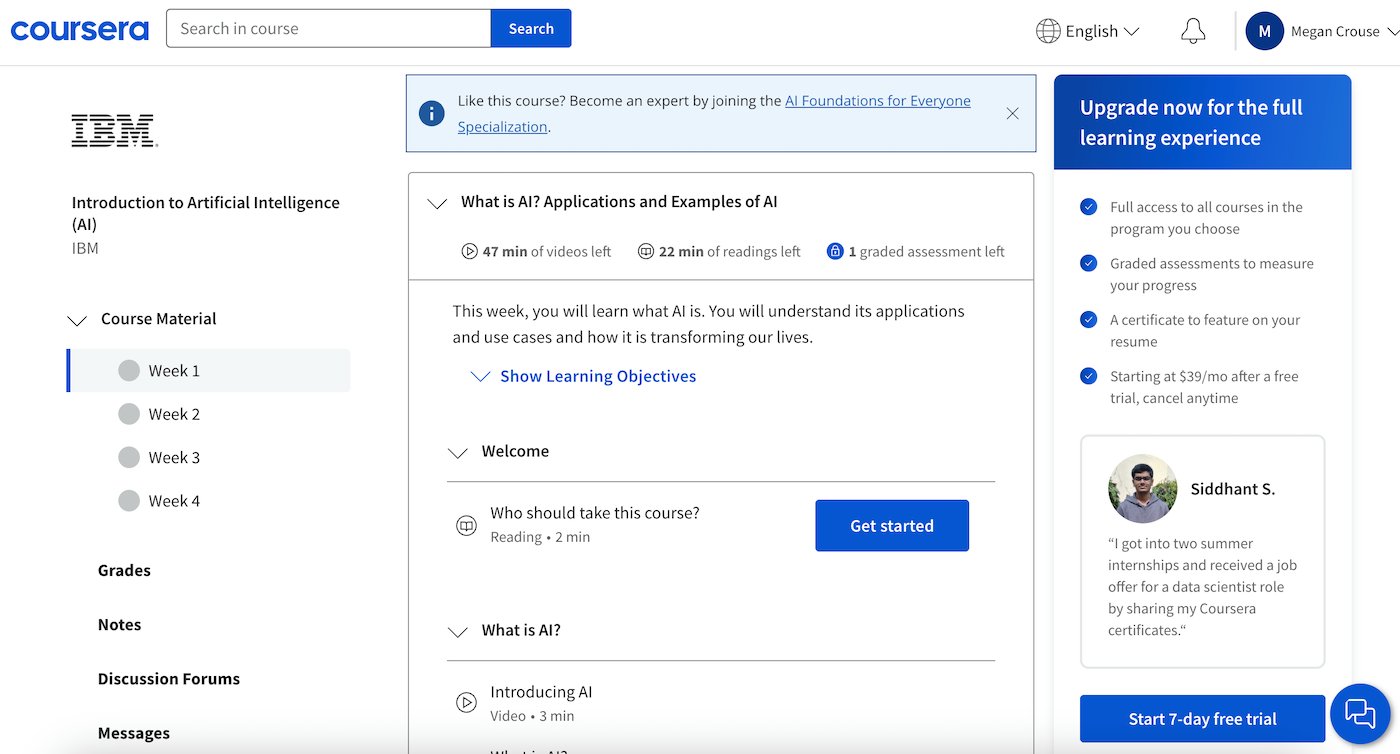
Since this course is taught by an IBM professional, it is likely to include, real-world insight into how generative AI and machine learning are used today. It is an eight-hour course that covers a wide range of topics around artificial intelligence, including ethical concerns. Introduction to Artificial Intelligence includes quizzes and can contribute to career certificates in a variety of programs from Coursera.
Pricing
Free to audit all materials, quizzes included. Full access with certificate via Coursera Plus at $239/year (less than $20/month) with a 7-day free trial. Financial aid available.
Duration
Coursera estimates this course will take about eight hours.
Pros and cons
| Pros | Cons |
|---|---|
| This course is part of multiple learning paths or certification tracks, so completing it can help learners start to pursue other interests on Coursera. | After selecting a certification track, Coursera will inform the user that some certifications require a subscription. |
| This course can be audited, meaning it can be taken for free, though doing so won’t contribute to certifications or include assessments. | Some people have reported bugs or trouble signing in to the IBM tools required to complete the course. |
| Some people noted that later parts of the course feature interviews with specialists, not practical use cases. These interviews aren’t necessarily a drawback, but some learners commented that the interviews were not as educational or practical as the course was advertised to be. |
Prerequisites
There are no prerequisites for this course.
AWS Generative AI Developer Kit
-
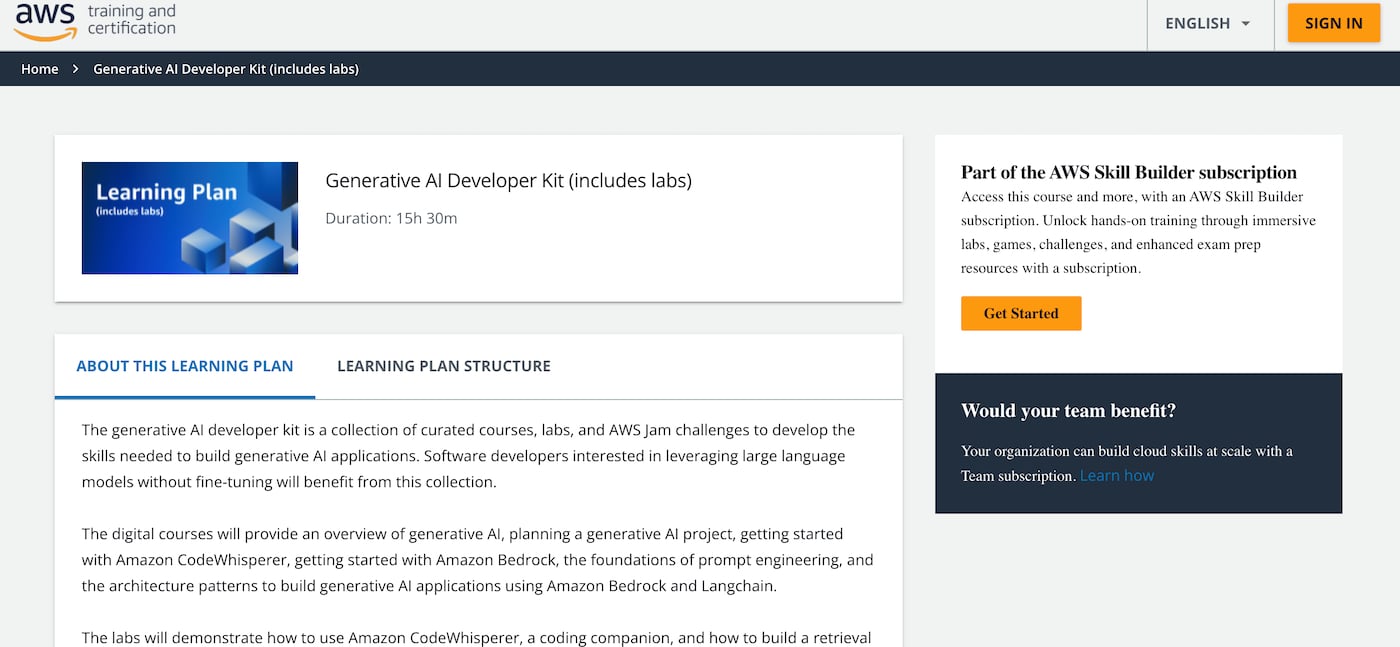
The AWS Generative AI Developer Kit course requires a subscription to AWS Skill Builder to complete. Image: AWS Skill Builder/Screenshot by TechRepublic
AWS offers a lot of AI-related courses and programs, but we chose this one because it combines fundamentals — the first two courses in the developer kit — with hands-on knowledge and training on specific AWS products. This could be very practical for someone whose organization already works with multiple AWS products but wants to expand into more generative AI products and services. This online, self-guided kit includes hands-on labs and AWS Jam challenges, which are gamified and AI-powered experiences.
Pricing
The AWS Generative AI Developer Kit is part of the AWS Skill Builder subscription. AWS Skill Builder is accessible with a 7-day trial, after which it costs $29 per month or $449 per year.
Duration
The courses take 16 hours and 30 minutes to complete.
Pros and cons
| Pros | Cons |
|---|---|
| Thorough exploration of the topic. | The content covered in the course may not be relevant outside of specific AWS products. |
| Good for gaining specific skills with AWS products. | Some learners found the course structure to be confusing. |
| Gain practice taking exams and certifications on AI development. |
Prerequisites
This course is appropriate for professionals who have not worked with generative AI before, but it would help to have worked within the AWS ecosystem. In particular, Amazon Bedrock is discussed at such a level that it would be beneficial to have completed the course AWS Technical Essentials or have comparable real-world experience.
Harvard University Professional Certificate in Computer Science for Artificial Intelligence
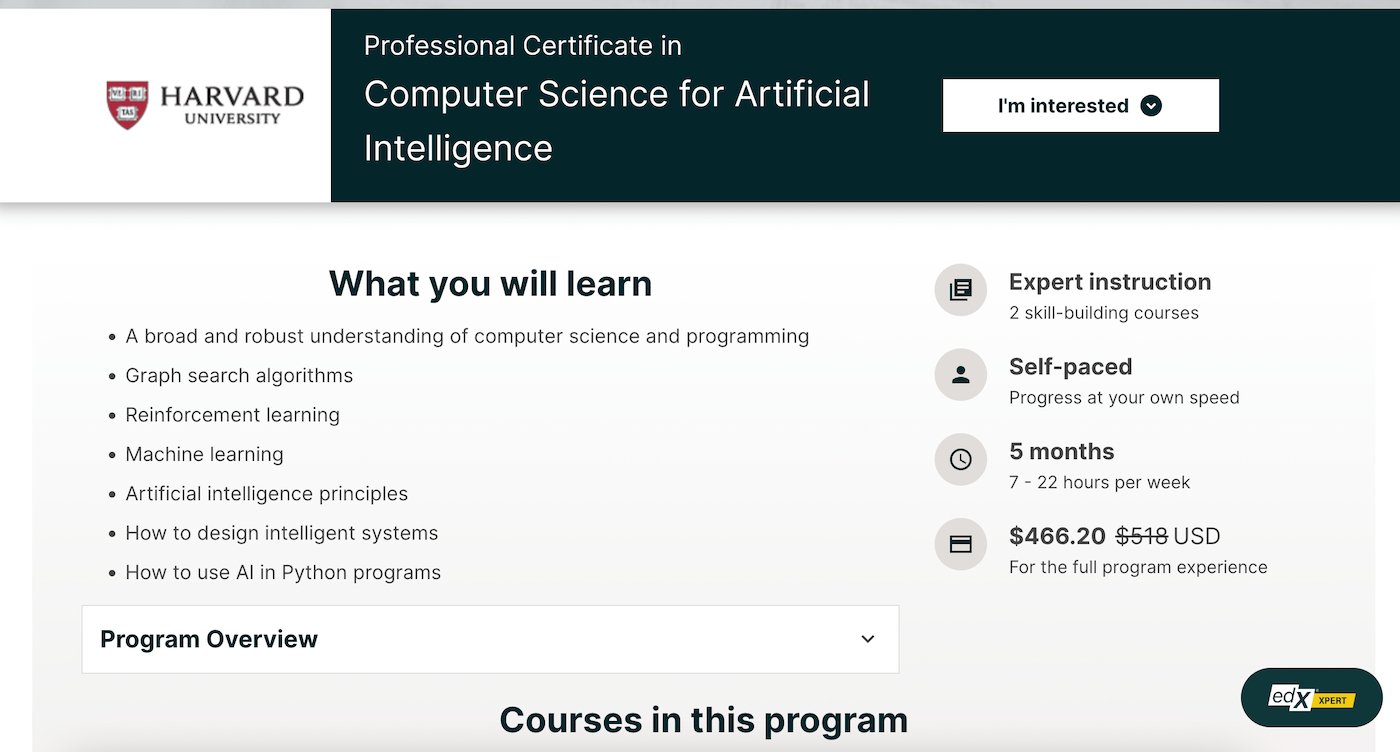
Harvard’s online professional certificate combines the venerable university’s Introduction to Computer Science course with another course tailored to careers in AI: Introduction to Artificial Intelligence with Python. This certification is suitable for people who want to become software developers with a focus on AI. This course is self-paced, and students will receive pre-recorded instruction from Harvard University faculty.
Pricing
Both courses together cost $466.20 as of the time of writing; this is a discounted price from the usual $518. Learners can take both courses in the certification for free, but the certification itself requires a fee.
Duration
These courses are self paced, but the estimated time for completion is five months at 7-22 hours per week.
Pros and cons
| Pros | Cons |
|---|---|
| Well-regarded educators and curriculum. | Relatively expensive. |
| Thorough. | Based on reviews, some material may be outdated. |
| Certifications affiliated with universities, particularly Harvard, could be beneficial in the job search or when pursuing further schooling. |
Prerequisites
There are no prerequisites required, although a high-school level of experience with programming basics would likely provide a solid foundation. The Introduction to Computer Science course covers algorithms and programming in C, Python, SQL and JavaScript, as well as CSS and HTML.
MIT’s Professional Certificate Program in Machine Learning & Artificial Intelligence
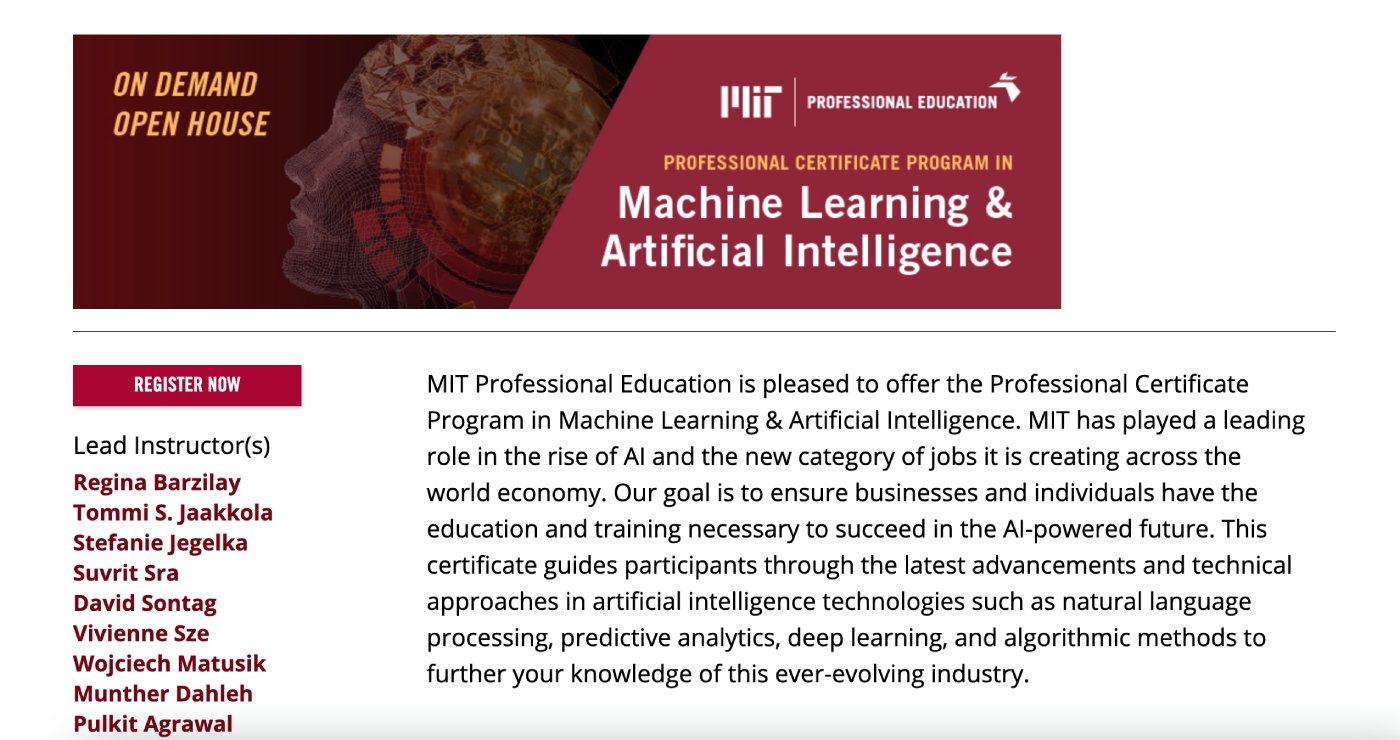
“MIT has played a leading role in the rise of AI and the new category of jobs it is creating across the world economy,” the description of the program states, summing up the educational legacy behind this course. MIT’s AI and machine learning certification course for professionals is taught by MIT faculty who are working at the cutting edge of the field.
This certification program is comparable to a traditional college course, and that level of commitment is reflected in the price.
If a learner completes at least 16 days of qualifying courses, they will be eligible to receive the certificate. Courses are typically taught June, July and August online or on MIT’s campus.
Pricing
There is an application fee of $325. The two mandatory courses are:
- Machine Learning for Big Data and Text Processing: Foundations, which costs $3,250 for two days.
- Machine Learning for Big Data and Text Processing: Advanced, which costs $3,975 for three days.
The remaining required 11 days can be composed of elective classes, which last between two and five days each and cost between $3,200 and $4,900 each.
Duration
16 days.
Pros and cons
| Pros | Cons |
|---|---|
| Provides access to the MIT Alumni Network for current and former students, providing further education and connections. | Less flexible than other online courses on this list, as it is held and paced like a traditional college course. |
| Network and learn together with peers. | Relatively expensive. |
Prerequisites
The Professional Certificate Program in Machine Learning & Artificial Intelligence is designed for technical professionals with at least three years of experience in computer science, statistics, physics or electrical engineering. In particular, MIT recommends this program for anyone whose work intersects with data analysis or for managers who need to learn more about predictive modeling.
Stanford Artificial Intelligence Professional Program
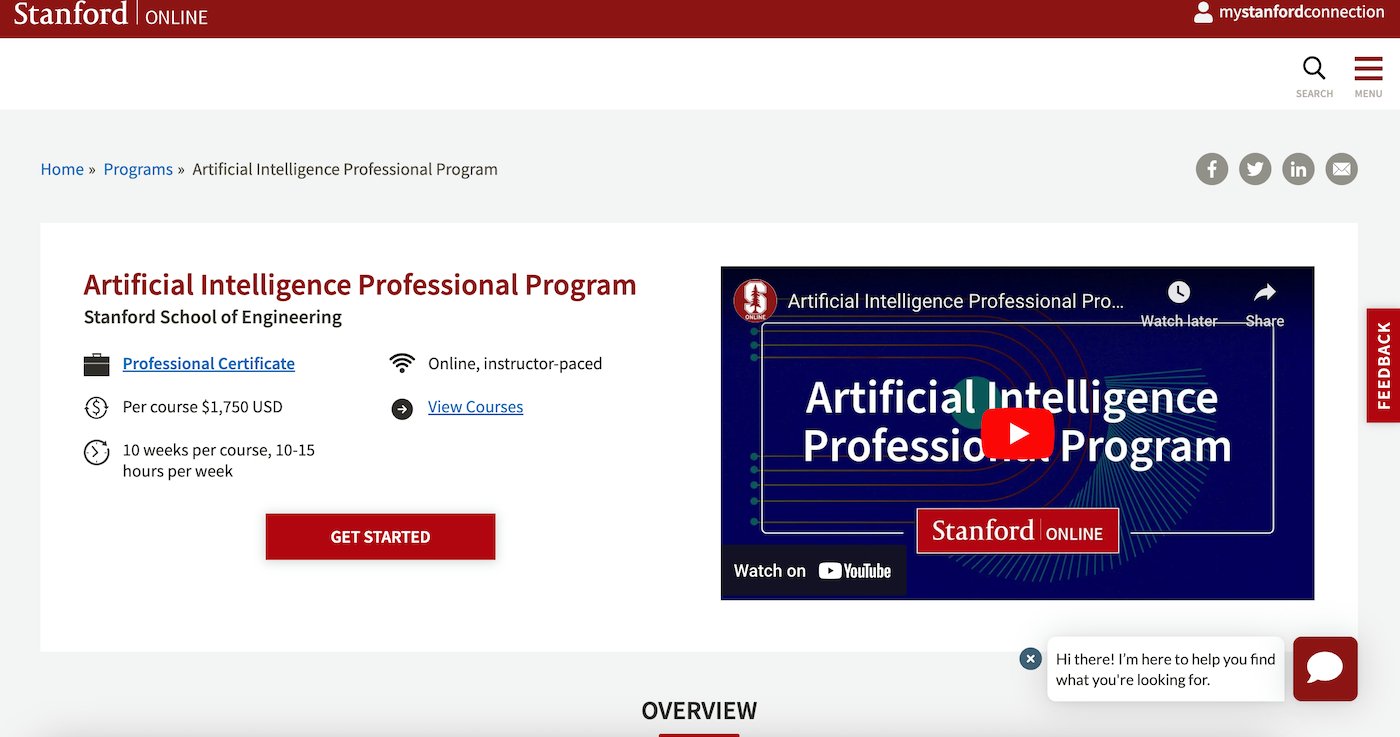
Completion of the academically rigorous Stanford Artificial Intelligence Professional Program will result in a certification. This program is suitable for professionals who want to learn how to build AI models from scratch and then fine-tune them for their businesses. In addition, it helps professionals understand research results and conduct their own research on AI. This program offers 1 to 1 time with professionals in the industry and some flexibility — learners can take all eight courses in the program or choose individual courses.
The individual courses are:
- Artificial Intelligence Principles and Techniques.
- Natural Language Processing with Deep Learning.
- Natural Language Understanding.
- Machine Learning.
- Reinforcement Learning.
- Machine Learning with Graphs.
- Deep Multi-Task and Meta Learning.
- Deep Generative Models.
Pricing
The Stanford Artificial Intelligence Professional Program costs $1,950 per course. Learners who complete three courses will earn a certificate.
Duration
Each course lasts 10 weeks at 10 to 15 hours per week. Courses are held on set dates.
Pros and cons
| Pros | Cons |
|---|---|
| Rigorous material and prestigious educators. | Relatively expensive and time-consuming, although the resulting education is proportionally thorough and practical. |
| May include research projects or other hands-on work that could be added to a professional portfolio. | |
| Opportunities to network with peers. |
Prerequisites
Interested professionals can submit an application; applicants are asked to prove competence in the following areas:
- Coding in Python.
- Basic Linux command line workflows.
- College calculus and linear algebra, including derivatives, matrix/vector notation and operations.
- Probability theory.
Udacity’s Artificial Intelligence Nanodegree program
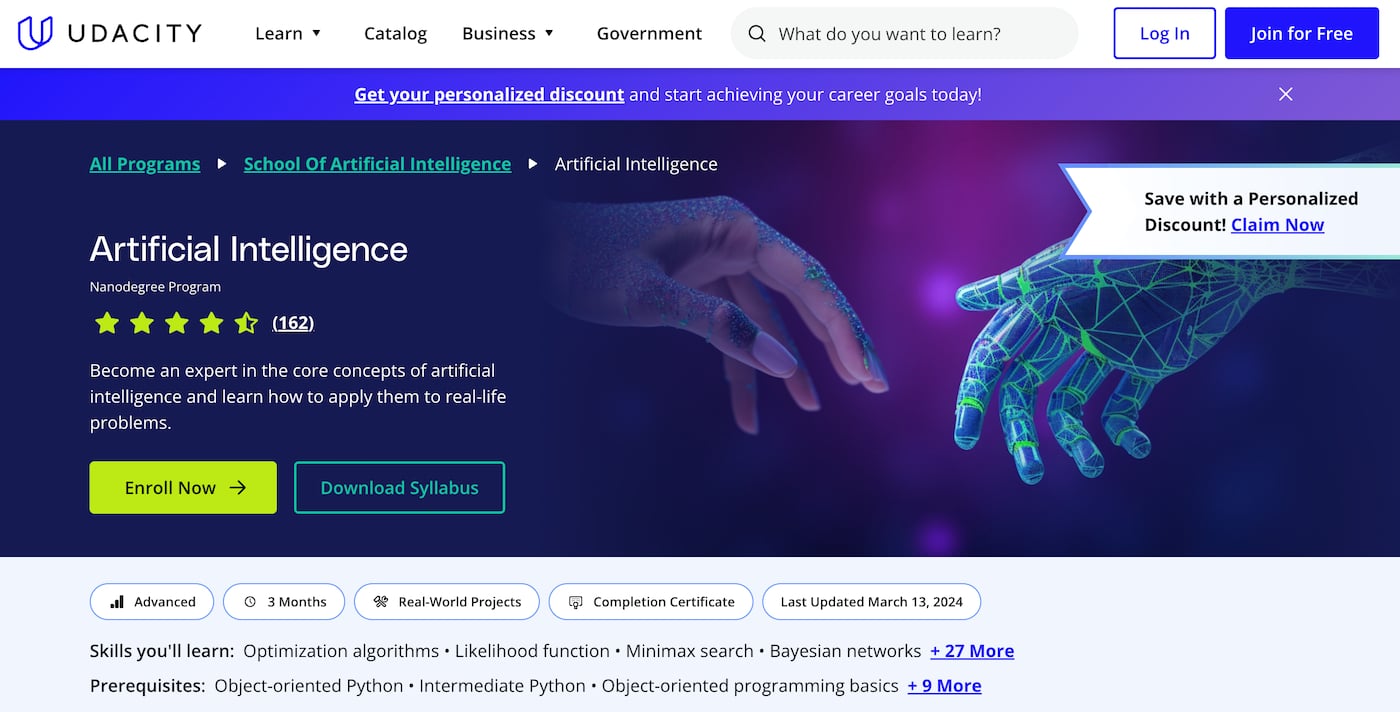
Udacity’s Artificial Intelligence Nanodegree program equips graduates with practical knowledge about how to solve mathematical problems using artificial intelligence. This class isn’t about generative AI models; instead, it teaches the underpinnings of traditional search algorithms, probabilistic graphical models, and planning and scheduling systems. Learners who complete this course will gain experience in working with the types of algorithms used in the real world for:
- Planning.
- Optimization.
- Problem solving.
- Automation.
- Logistics operations.
- Aerospace.
Pricing
This course costs $249 per month paid monthly or $846 for the first four months of the subscription, after which it will cost $249 per month.
Duration
This course lasts about three months.
Pros and cons
| Pros | Cons |
|---|---|
| Highly technical foundation for working with many types of AI. | Some reviews of Udacity-hosted courses indicated a decline in quality in recent years, or noted the courses moved too quickly over some subjects. |
| Includes real-world-style projects and exercises. | Based on reviews, some material may be outdated. |
Prerequisites
Learners in this course should have a background in programming and mathematics. The following skills are recommended:
- Object-oriented Python.
- Intermediate Python.
- Object-oriented programming basics.
- Basic data structures and algorithms.
- Basic descriptive statistics.
- Basic calculus.
- Command line interface basics.
- Differential calculus.
- Scripting.
- Linear algebra.
- Basic algorithms.
- Jupyter notebooks.
Frequently asked questions (FAQs)
Is it worth taking an AI course?
Whether it is worth taking an AI course depends on many factors: the course, the individual and the job market. For instance, getting an AI-focused certification might contribute to getting a salary increase or making a career change. AI courses could help someone learn AI skills that might be a good fit for their abilities, or could be the first step toward a lucrative and life-long career. Educating oneself in a contemporary topic can always have some benefits in terms of practicing new skills.
Can I learn AI without coding?
Some introductory AI courses do not require coding; however, AI is a relatively complex topic in computing, and practitioners will need some programming skills as they progress to more advanced courses and learn how to build and deploy AI models. Most likely, intermediate learners need to be comfortable working in Python.
Some of these courses and certifications include education in basic programming and computer science. More advanced courses and certifications will require learners to already have a college-level knowledge of calculus, linear algebra, probability and statistics, as well as coding.
Methodology
To build this list of the best AI courses for 2026, I focused on programs from providers with strong reputations, broad market recognition, and course offerings that reflect the skills learners are most likely to need now. My goal was to identify courses that not only cover relevant AI topics, but also offer practical value in terms of quality, accessibility, and time investment.
Each course was evaluated using consistent criteria, including provider credibility, topic depth, practical usefulness, cost, and course length. I looked at how established and trusted each provider is, the breadth and relevance of the material covered, how applicable the lessons are to real-world use, how much the course costs, and how much time learners can expect to commit.
These criteria helped identify AI courses that offer the best overall mix of quality, relevance, and value.
Read the full article here