





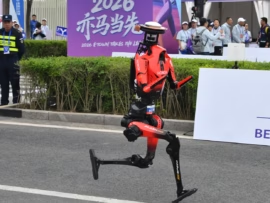

Beijing’s humanoid robot half marathon had everything a robot race should: one machine finishing in 50 minutes and 26 seconds, others wobbling into barriers, and a crowd watching to see whether the whole thing was a breakthrough or a gimmick.
It turned out to be a little of both. The race was messy in places, but it also produced something last year’s event did not: a clear jump in autonomous performance over a full 21-kilometer course.
This year’s race looked far more real
According to AP’s race coverage via Yahoo, the winning robot was built by Honor, and all three podium spots went to Honor machines. AP reported the winner finished in 50:26, while organizers said before the race that close to 40% of the robots were expected to navigate the course autonomously.
That is a very different picture from 2025. Last year, every robot in the field was remote-controlled, and the fastest finish took 2 hours, 40 minutes and 42 seconds. This time, autonomy was one of the main things the race was there to test.
The race was also public and hard to smooth over. Some robots held a steady gait and kept pace. Others stumbled, clipped barriers, or dropped out. That unevenness helped. A polished demo can hide problems. A 21-kilometer outdoor race cannot.
The progress was real, but it was still narrow
The biggest thing the marathon showed was movement. Some humanoids are getting faster, steadier, and better at staying upright over distance without constant human correction. That is a useful result because it can be compared year to year in a visible way.
It does not mean humanoid robots are suddenly ready for every real-world job. Running forward for 21 kilometers tests balance, endurance, cooling, and control. It does not settle larger questions about reliability, object handling, or how these machines perform outside a tightly defined task.
China’s role gives the event more weight than a one-day curiosity. The country is already pushing humanoid robotics as both an industrial priority and a public showcase, and the Beijing race turned that push into something easier to measure from one year to the next.
The half marathon did not prove that the humanoid robot industry is ready to deliver on every promise attached to it. It did show that one part of the technology, autonomous movement over distance, is improving fast enough to stand up in public, with mistakes and all.
Also read: Chinese humanoid robots dominated the opening day of the Canton Fair 2026, showing how fast the country is turning robotics into a national industrial showcase.
Read the full article here