



For the first time in over half a century, a human crew is officially on its way to the Moon.
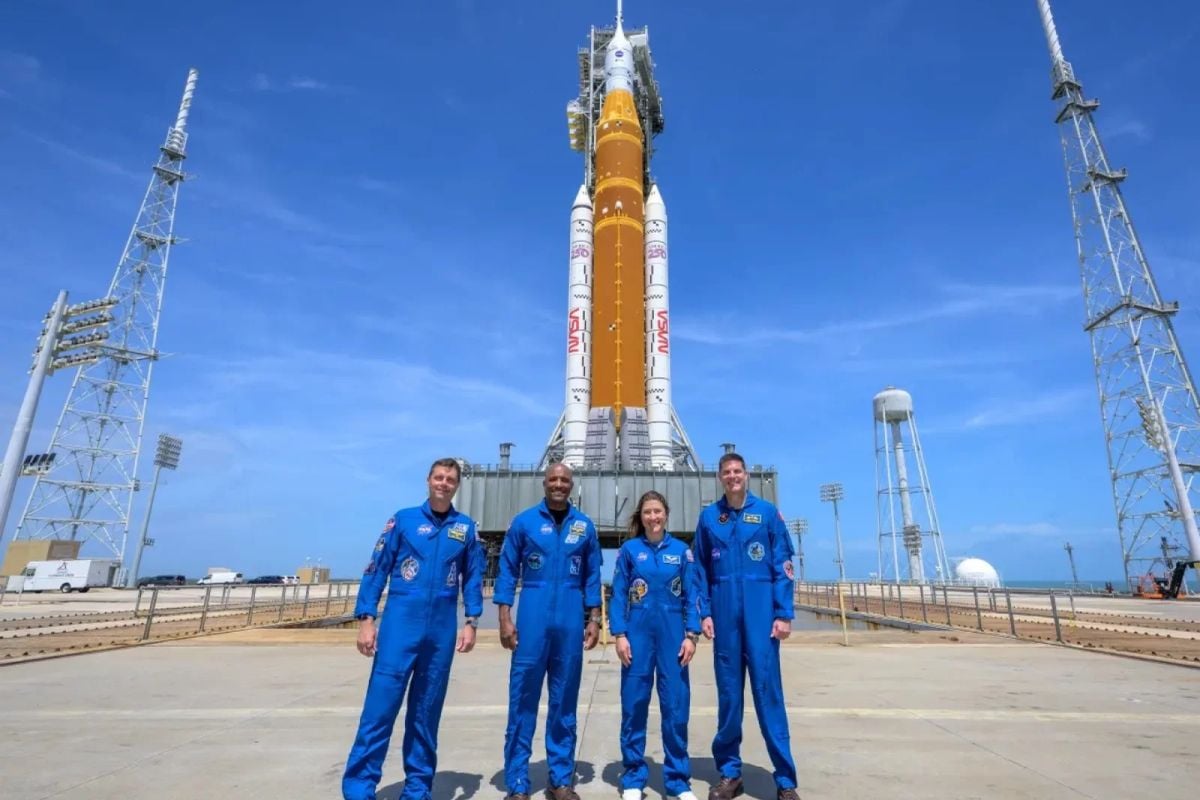
At 6:35 p.m. EDT on April 1, 2026, the silence at Kennedy Space Center’s Launch Complex 39B was shattered by 8.8 million pounds of thrust. NASA’s Space Launch System (SLS), the most powerful operational rocket on the planet, roared to life, carrying the Orion spacecraft, named Integrity, and four astronauts into the Florida evening sky.
The twin solid rocket boosters provided the bulk of that muscle, burning through 1,385,000 pounds of propellant in just two minutes, an average of 5.5 tons every single second, before peeling away to let the core stage take over.
Four travelers and a losing hand
Onboard are Commander Reid Wiseman, Pilot Victor Glover, and Mission Specialist Christina Koch from NASA, joined by Jeremy Hansen of the Canadian Space Agency. While the mission is a high-tech marvel, the morning of the launch was rooted in old-school tradition.
Before heading to the pad, the crew engaged in a card game. Per NASA, the rules are simple: the game doesn’t end until the commander loses.
“It is hoped that by losing, the commander burns off all his or her bad luck, thereby clearing the mission for only good luck.”
Wiseman eventually lost, the luck was cleared, and the crew boarded the capsule that would be their home for the next 10 days.
Spreading its wings
Once the rocket reached orbit and the core stage separated, the Orion spacecraft had to wake up. A major milestone occurred at 6:59 p.m. when the spacecraft successfully unfolded its four massive Solar Array Wings (SAWs).
These wings aren’t just for show; they give the spacecraft a 63-foot wingspan and are covered in 15,000 solar cells.
“The Orion spacecraft’s SAWs (solar arrays wings) have fully deployed, completing a key configuration step for the Artemis II mission,” NASA reported.
These arrays will pivot to track the sun, providing the constant electricity needed to keep the crew’s life-support systems running in the deep freeze of space.
Life inside a space-age mini-van
While the mission is a giant leap for exploration, the astronauts’ daily reality is a bit cramped. The habitable area of the Orion capsule is roughly 330 cubic feet, about the size of two mini-vans.
However, the room service is surprisingly varied. List Wire notes that there are “189 different menu items” available, ranging from breakfast sausage and vegetable quiche to barbecued beef brisket and shrimp cocktail. To keep spirits high, the crew even has a cassette player and tablets loaded with TV shows for any rare moments of downtime.
They aren’t just there for the food, though. Tucked away in the cabin is a piece of history: a one-inch square of fabric from the Wright Brothers’ original 1903 flyer, connecting the birth of flight to the future of lunar exploration.
What happens now and why it matters
Artemis II will not land on the Moon. The mission is explicitly a test flight.
The goal is to put people inside the Orion spacecraft and see how it performs in deep space. The crew will follow a figure-8 trajectory around the Moon, traveling as far as 250,000 miles from Earth. That would break the distance record set during Apollo 13’s 1970 emergency.
During the journey, the crew will lose contact with mission control for up to 50 minutes while the Moon blocks their radio signals. If anything goes wrong during that window, they handle it on their own. That is the reality of deep-space travel.
They will also be exposed to radiation beyond Earth’s magnetic field. NASA estimates up to 30 millisieverts per crew member, well within career safety limits, but a real consideration for future long-duration missions. Upon return, the Orion capsule will hit Earth’s atmosphere at 25,000 miles per hour, generating temperatures of over 3,000 degrees Fahrenheit on its heat shield, before slowing to a splashdown in the Pacific Ocean off California.
If all goes well, Artemis IV is tentatively planned for 2028, and it will land astronauts on the Moon’s surface for the first time since Apollo 17. Tuesday’s flight is the bridge to that moment.
Speaking of space: For a glimpse at how space and AI are converging beyond the Moon, check out how Nvidia is powering orbital data centers with next-gen chips.
Read the full article here