



Clicks started with a simple idea: bring the physical keyboard back to smartphones, and it ended up building something much more.
Ahead of its December launch, Clicks has upgraded the phone with 12GB of RAM, a larger battery, and Android 17 while keeping the physical keyboard at the center of the experience. It also adds on-device speech-to-text, regular Android apps and new services around the handset.
The result is less of a BlackBerry throwback and more of an attempt to rethink what a modern smartphone should prioritize: communication first, everything else second.
Clicks gets an upgrade
Clicks unveiled the Clicks Communicator in January at CES 2026. At the time, the device focused on bringing back the BlackBerry-era style to modern smartphones, a move the Minimal phone is also moving towards, suggesting strong back-to-basics demand.
However, months after that announcement, Clicks has gone back to the drawing board, incorporated feedback from enthusiastic users, and unveiled an upgraded version.
The final device will now ship with 12GB of RAM instead of the 8GB originally announced, while its battery has also grown from 4,000mAh to 4,350mAh.
The battery change is not just about capacity. Clicks has moved away from the silicon-carbon battery it originally planned to use and will ship the phone with a lithium-ion battery instead.
The operating system specification has changed too. Rather than launching on Android 16 as originally planned, the Communicator will arrive with Android 17, with Clicks committing to support through at least Android 20 and five years of security updates.
The keyboard is only part of the phone
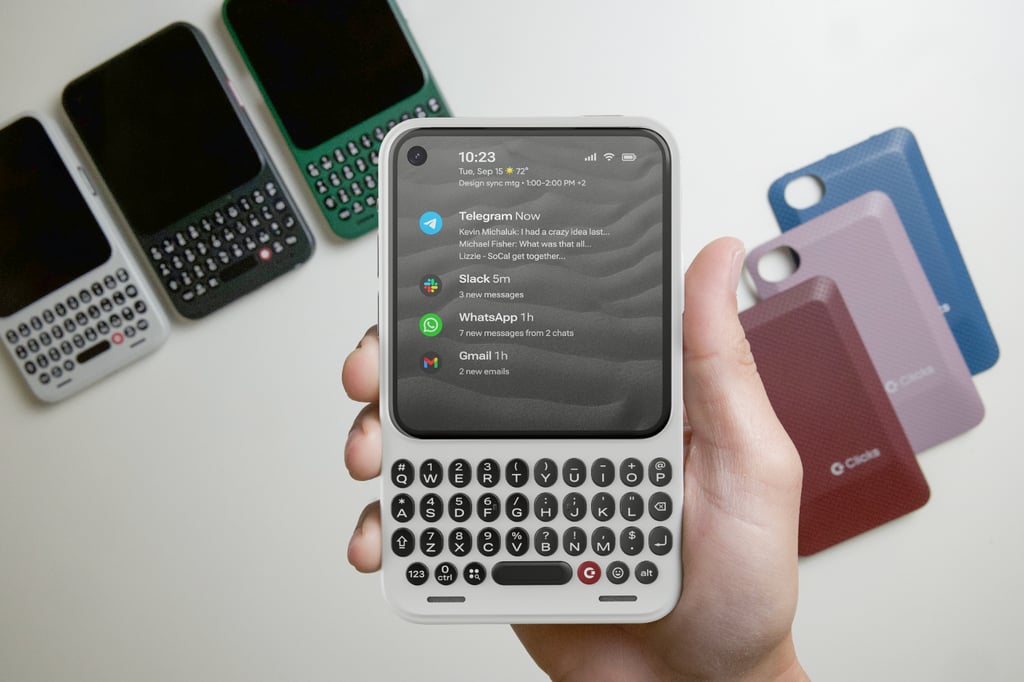
The physical keyboard is the Communicator’s defining feature, but Clicks has built several other functions around it.
Despite having a physical board, the keyboard is also touch-sensitive for scrolling and navigation. Its spacebar doubles as a fingerprint sensor, and a dedicated Prompt Key can trigger on-device speech-to-text or bring up Gemini.
The phone itself is also much closer to a conventional Android handset than its form factor might suggest. It runs on MediaTek’s Dimensity 8300, has a 4.03-inch AMOLED display, 256GB of storage with microSD expansion, a 50MP main camera and a 24MP front camera, and supports 5G, Wi-Fi 6, NFC, eSIM and a nano SIM slot, and a 3.5mm headphone jack
Another distinctive feature is the Communicator’s customizable side indicator. Clicks says users can assign different colors to different contacts or apps, giving them a quick way to identify notifications without immediately opening the phone.
A work message, for example, could trigger one color, while a family call could use another.
That combination separates the Communicator from a stripped-down handset: the keyboard changes how you interact with the phone, but it doesn’t require you to give up the apps, connectivity, or hardware of a regular touchscreen smartphone.
Availability, pricing, and added perks
Per an earlier 9to5Google report, when Clicks first unveiled the Communicator, it offered an early-bird price of $399, before setting the regular price at $499. The $499 launch price now runs through September 30, after which it rises to $649, according to Clicks’ latest information.
Existing reservation holders keep their original price and will receive the RAM and battery upgrades at no extra cost. The first units are expected to ship in December, with sales available across multiple regions, subject to regional factors and specific device configuration.
Optional extras cost more. In the U.S. and U.K., buyers can also get two months of free Clicks Mobile data and voice, while Clicks Care is offered in the US and Canada for $129.99 for two years, with a $49 replacement deductible, according to 9to5Google.
What does using a phone like the Clicks Communicator mean for users in this era
The modern smartphone has become a device for almost everything, but that has also made it remarkably easy to spend hours doing very little.
The Communicator promises a different approach: keep the underlying smartphone experience, but make typing and communication the easiest things to do, while putting a smaller screen between users and the endless stream of visual content that dominates most phones.
That could make the phone feel less like something you constantly check and more like something you pick up to accomplish a specific task. It does not stop users from opening social media, watching videos, or browsing the web — all of that is still there — but the physical keyboard and smaller display change which activities the device naturally encourages.
The bigger question is whether that difference is enough to change behavior. Clicks is betting that reshaping the form factor — rather than stripping away smartphone features — can make communication feel central again.
The phone has not launched yet, so the real test will come when buyers use it outside of demos and early previews. The upgrades suggest strong interest, but whether that translates into long-term satisfaction will depend on how well the unusual design works in everyday use.
Other news: Vocci’s $249 AI ring can record meetings without a nearby phone, generate transcripts and summaries, and let supported AI apps such as ChatGPT and Claude retrieve meeting context through a read-only MCP connection.
Read the full article here