




AI coding agents can write software surprisingly quickly. Keeping track of what they are doing is becoming the harder part.
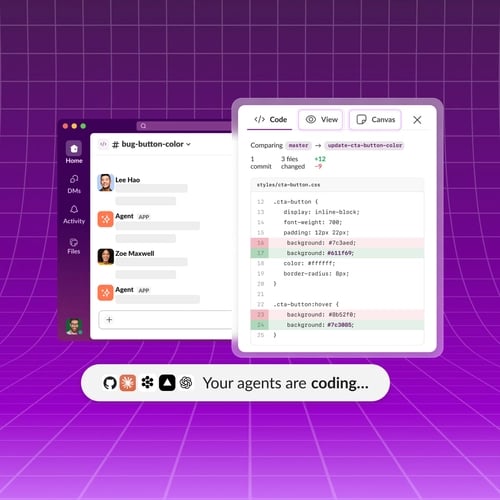
Slack has launched Slack Code, a new feature that gives AI coding agents dedicated project channels where developers and other team members can watch, guide, and review their work. The Salesforce-owned platform is effectively trying to pull agent-assisted development out of isolated terminals and browser tabs and into a workspace where teams can see changes before code ships.
Here’s how it works:
- Users can mention an agent in Slack, prompting it to create a code channel around a specific task and pull in relevant teammates.
- Those channels can display code changes, planning information, and live HTML previews.
- When the work is finished, the channel automatically archives, preserving a searchable record of the project.
Slack Code is available across Slack plans, although users must have access to the individual AI agents they want to use. The launch initially focuses on software development, with integrations involving Anthropic’s Claude Code, Cognition’s Devin, GitHub Copilot and Vercel. Slack said OpenAI’s ChatGPT integration is coming soon.
The company is also opening the experience to people who do not normally write code. In Slack’s example, a nontechnical employee can flag a problem, have an agent work on a fix and bring an engineer into the conversation to review the changes.
That could shorten the distance between spotting a problem and getting it fixed. Slack is betting that visibility will also help keep AI-generated code from becoming a quality-control headache.
Visibility becomes the safety net
Slack argues that if more people can see what an agent is doing, they have more opportunities to catch bad assumptions before those mistakes become production problems.
VentureBeat reported that Slack’s interim CEO Rob Seaman described the shift this way: “Ideas, taste, judgment, craft — those are the things that are the bottleneck, and you’ve effectively extended the population that can contribute ideas, taste, judgment, and craft to anybody that exists in your Slack.”
The approach still has limits. Making coding visible does not automatically make the resulting software good, and adding agents to team conversations could create more noise rather than less. Companies will also need to decide how much human review is appropriate as agents become capable of handling larger tasks.
Slack says agents inherit existing user permissions and administrative controls rather than receiving unrestricted access. High-stakes changes can still be routed to people for approval.
More must-read AI coverage
Slack’s bigger bet
The more important part of Slack Code may be what happens beyond software.
Slack said the same model could eventually support marketing campaigns, legal contract reviews and IT onboarding. The company is also introducing an Agents tab to manage agent conversations across Slack, along with agent DMs and tools to bring third-party agents into the platform.
That suggests Slack is positioning itself less as a place where employees simply discuss AI-generated work and more as the shared workspace where humans and AI actually produce it.
What Slack Code means for developers
For developers, Slack Code could change where AI-assisted coding actually happens. Instead of bouncing between a terminal, an agent interface, and team chat, developers can bring the agent’s work into a shared channel where teammates can follow changes, review decisions, and step in when needed.
That could make collaboration easier, especially when an agent is handling a task that touches multiple parts of a project. But developers will still need to treat AI-generated code like any other contribution: review it, test it and understand what changed before it reaches production.
The real value may be less about getting AI agents to write more code and more about making their work easier for developers to inspect, challenge and improve.
Also read: Slack’s push to bring AI agents into everyday work started before Slack Code, with Anthropic’s Claude Tag bringing shared AI agents directly into Slack.
Read the full article here