




Self-driving cars have a persistent problem. When a driver’s attention drifts to a phone or a laptop, how do you pull their eyes back to the road fast enough to catch a hazard? A new study from the University of Glasgow suggests the answer might not be another beep or flashing light. It could be a small animated character that looks and points toward danger, like a person would.
Adding a stronger cue closed the attention gap
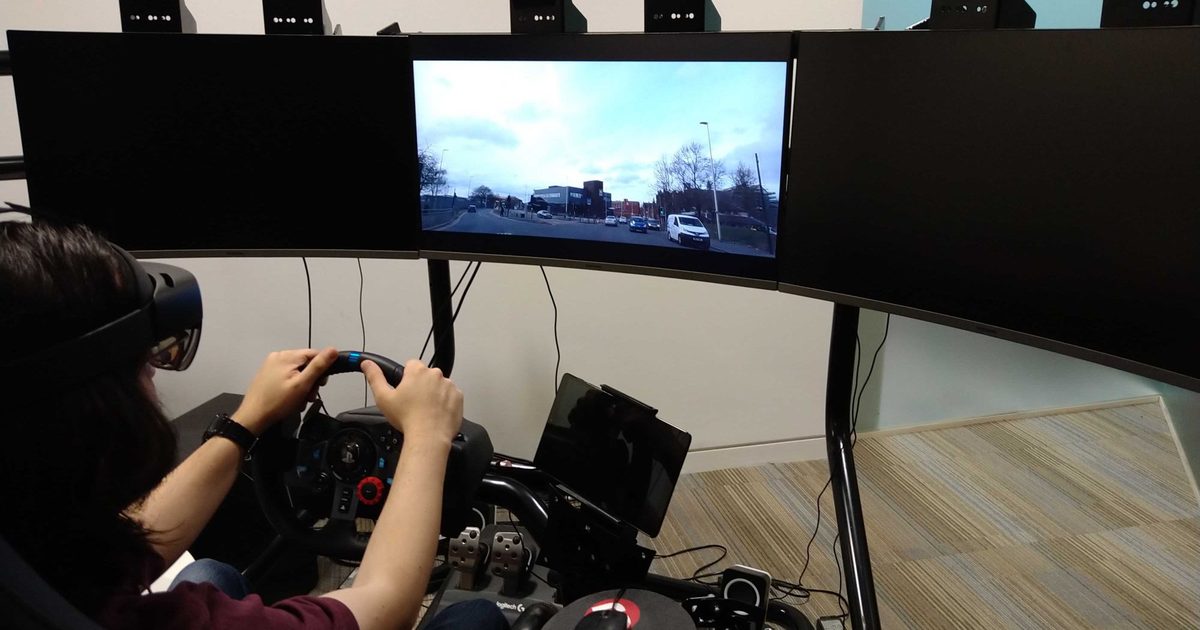
Researchers led by PhD candidate Thomas Goodge tested the idea using AR glasses on 48 volunteers seated in a driving simulator. Participants played a distracting mixed reality game while dashcam footage of real driving scenarios played in front of them, mimicking a driver absorbed in email or a game. A warning then flagged an oncoming hazard just before the video cut out, and researchers asked what the driver had seen.
In the first round, distracted participants missed hazards far more often than a control group that watched without playing the game, regardless of whether the warning was a colored bar or an animated robot head turning toward danger. Adding a second layer, a red highlight paired with the colored bar or head turn, closed that gap entirely. Both warning styles helped distracted drivers spot hazards correctly about 80 percent of the time, matching participants who weren’t distracted at all.
Too much personality backfired
The robot’s usefulness had a limit, though. When researchers gave it visible signs of stress, like trembling and sweating, participants got distracted trying to read its emotional state and missed more hazards. Professor Stephen Brewster, who co-authored the paper, also flagged a subtler risk. Some drivers leaned on the warning entirely instead of watching the road themselves, the same over-reliance problem that has shown up in systems like Cadillac’s Super Cruise, which tracks a driver’s eyes and pulls the car over if they stop responding.
The researchers now plan to add sound and conversation in the next phase to see how drivers respond to a warning system that talks back.
Read the full article here