




Is Amp Crash a guitar amp or a guitar pedal? Yes.
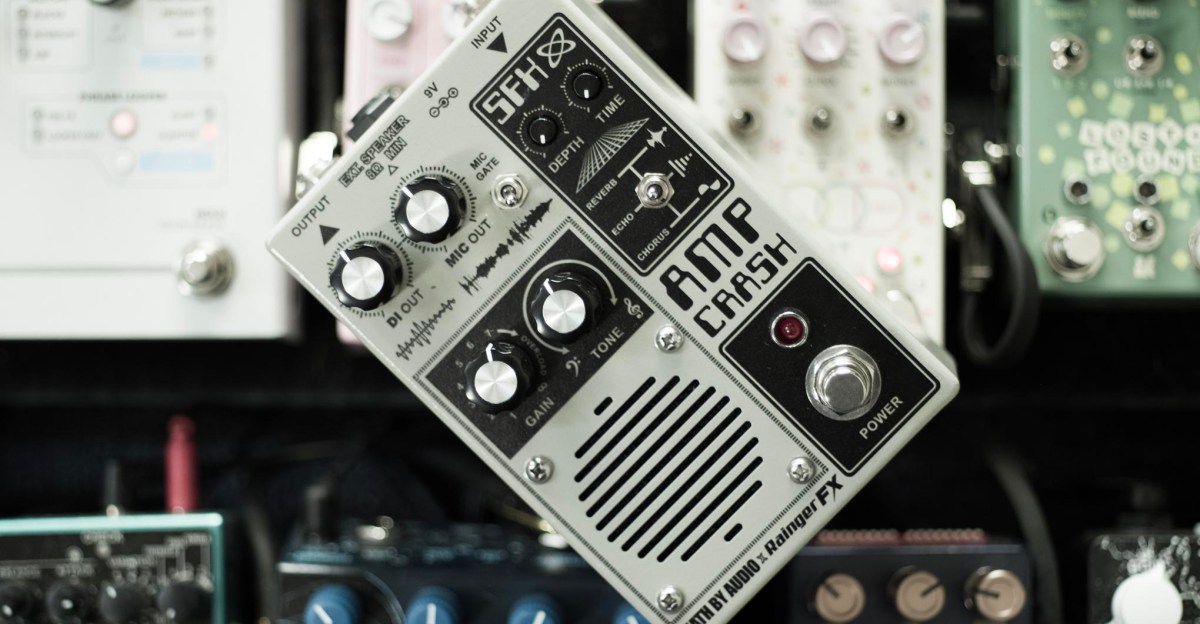
Death By Audio’s latest is, in fact, both. While it’s in a guitar pedal enclosure, Amp Crash is actually a tiny 3-watt amp hooked up to a 2-inch speaker. You can even connect an external speaker if you want. This isn’t a digital re-creation of a classic Fender or Marshall like you might get from a Universal Audio amp sim pedal or a Neural DSP Cortex. This is an actual amp with an original design that moves air.
The tone you get out of this tiny thing is, unsurprisingly, harsh and boxy. But that’s not a criticism. Guitarists like Josh Homme (Queens of the Stone Age), Jack White, and Dan Auerbach (The Black Keys) have famously used cheap solid-state practice amps to get their unique tones. Amp Crash lives firmly in that realm. It never truly cleans up, even with the gain turned all the way down, and the brittle edge-of-overdrive at those lower settings has a charming, amateurish vibe. It’s not going to replace my Yamaha THR10, but I can’t hate on it.
What makes Amp Crash special, though, is that, in addition to a speaker, it also has a microphone inside. You can then feed the signal from that microphone into your digital audio workstation (DAW) or another amp, and capture the real sound of a speaker in a room being pushed to its limits. There’s a subtle magic that happens when the microphone picks up actual vibrations in the air and the sound of a room, instead of just running your guitar straight into Guitar Rig 7 in Ableton. And this is where Amp Crash’s real value lies, not as an amp, but as the world’s most convoluted distortion pedal.
The way the mic and speaker interact creates some truly wild sounds when you start cranking the gain. Once you turn the gain knob past 12 o’clock, it goes from crunchy, if slightly two-dimensional overdrive, to explosive fuzz. The tone knob at these higher gain settings has a huge impact, going from buzzsaw at the top to sludgy and uneasy at the bottom as the tiny speaker struggles to handle the bass frequencies.
Past three o’clock on the gain knob, things get truly insane as the speaker basically gives up. It flubs and rattles in a way that tells you it was not designed to take this level of abuse. But the mic also can’t keep up. It introduces its own crackles and clipping as it struggles to absorb the onslaught from the speaker. The introduced natural, slightly unpredictable compression turns your guitar into a brick wall of noise where the edges of individual notes and chords all collapse in on themselves. The two also create natural feedback so you can get that real cranked amp howl, without disturbing the neighbors too much.
You can dial in a bit of the direct signal (no mic) to add a bit of definition to your tone. Or even disable the speaker entirely by connecting a cable (no speaker) or a ¼-inch headphone adapter to the speaker-out jack. But why would you want to do that?
Things get even more insane when you start playing with the small multi-effect module in the top right-hand corner of the pedal. You can choose between reverb, echo, or chorus. They’re all digital and quite lo-fi, with just two controls (depth and time) to play with. The chorus is rubbery and highly resonant, the echo crushed and self-oscillating, while the reverb is metallic and abrasive.
Add all these components together, and you get a little box that caters to the wildest of noisemakers. It’s no surprise that the companies that conceived of this thing are Death By Audio — the brainchild of Oliver Ackermann from noise rock mainstays A Place to Bury Strangers — and Rainger FX — a company that made a distortion pedal you fill with beer, soda, or even blood to change its tone. The Amp Crash is an appropriate addition to their legacy of musical chaos engines.
Read the full article here