





Toyota could eventually deploy about 400,000 robots across its manufacturing network — and it is teaching some of them the way it would train an apprentice.
Toyota estimates that modernizing its global manufacturing network could require about ¥1 trillion ($6.4 billion) annually starting in 2028, according to Nikkei Asia. The plan covers Toyota, group companies and major suppliers and could involve roughly 400,000 robots.
For technology and operations leaders, the larger challenge is building the data infrastructure, governance, and training systems needed to transfer specialized knowledge across a global manufacturing network.
The number is broader than humanoids. It includes conventional industrial and logistics machines, replacements for existing equipment and new installations. About 150,000 robots are expected at Toyota’s own plants, with approximately 250,000 more across group companies and other facilities covered by the initiative, according to Nikkei Asia.
Toyota operates about 60 factories worldwide and has around 18,000 veteran workers known as “takumi,” or master craftspeople. Their hands-on expertise is central to the company’s approach.
Meet ELEY
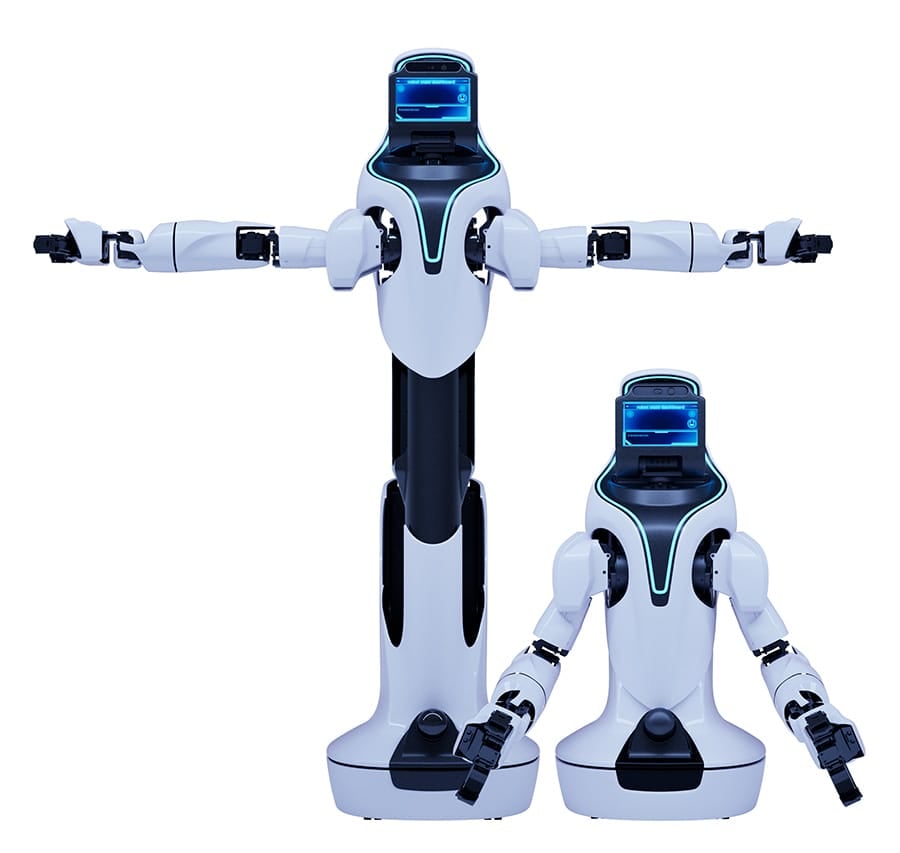
One of the more unusual pieces of the plan is ELEY, short for “Embodied Learning robot for Enhanced Yield.” The 50-kilogram robot has two-fingered hands, runs on batteries or a power cord, and moves on wheels rather than legs.
Instead of programming every movement manually, Toyota trains ELEY using demonstrations from workers. Employees wear finger-shaped jigs modeled on the robot’s hands, allowing the system to capture movements that ELEY can learn to reproduce.
At a September technology briefing in Europe, ELEY demonstrated that approach by folding T-shirts after approximately 1,500 training sessions over two weeks, achieving what Nikkei Asia described as near-perfect accuracy. Toyota also plans to share learned data across its factories, allowing a robot that masters a task at one site to help machines elsewhere learn it without starting from scratch.
More must-read AI coverage
Turning experience into data
The more significant part of Toyota’s strategy may not be the robot count itself. It is the attempt to turn years of human manufacturing experience into reusable digital knowledge.
A skilled worker can perform a task without being able to fully explain every movement involved. ELEY’s approach gives Toyota a way to capture those movements through observation and distribute what the system learns across its manufacturing network.
That could make factory expertise less dependent on having a particular veteran worker at a particular plant. It could also allow robots to help train new employees, creating a cycle in which humans teach machines and machines help teach people.
There are clear limits to how much can be concluded from a successful demonstration. ELEY folding T-shirts accurately after repeated training does not establish that the system can reliably handle every unpredictable situation on a production line.
Toyota’s March 2026 research identified challenges including long-duration reliability, precise end-effector positioning and the data infrastructure needed to operate learning systems across a huge global fleet.
Toyota’s ¥1 trillion figure is also an estimate, not a firm commitment, and the 400,000 robots would be introduced progressively alongside factory renovations rather than all at once.
What Toyota’s robot strategy means for workers and production
Toyota’s proposed framework emphasizes workforce collaboration rather than fully automated factories. Human craftspeople would provide guidance, evaluation, and expertise, while robotic systems assume physically intensive and repetitive assignments.
For Toyota and its customers, the practical test is whether the technology can improve consistency, quality, and productivity across factories — not whether the robots make for impressive demonstrations.
The initiative’s success will depend on whether Toyota can support hundreds of thousands of robots with reliable training data, common technical standards, human oversight, and infrastructure that works across facilities. If it succeeds, the most consequential result may be a repeatable system for preserving and distributing manufacturing expertise rather than the robot count alone.
Read more: Xiaomi is testing its CyberOne humanoid robot in vehicle production as manufacturers explore how robots could handle repetitive factory work.
Read the full article here