





A new study by Kapwing has says that a huge volume of videos circulating on YouTube are brainrot content and ‘AI slop’: a catch-all term for low-quality, AI-generated content designed to farm views rather than offer real value.
Kapwing’s researchers tested this by creating a new YouTube account and tracking the first 500 videos recommended by the platform. Out of those, 104 videos, roughly 21%, were classified as AI slop, while 165 videos, about 33%, fell into a broader “brainrot” category.
Brainrot includes repetitive, bizarre, or hypnotic clips that are easy to watch but lack substance. Together, the findings suggest that a significant chunk of what new users see is automated content rather than work made by human creators.
How much AI slop YouTube is actually serving
The scale of such content goes far beyond a few strange recommendations. Kapwing also analyzed trending YouTube channels across multiple countries and found 278 channels made entirely of AI slop, spread across the global top 100 rankings.
These channels are not small. Collectively, they have accumulated billions of views and millions of subscribers, translating into tens of millions of dollars in estimated annual ad revenue. Some regions stand out in particular. In Spain, AI slop channels have more than 20 million combined subscribers, higher than totals seen in the United States or Brazil.
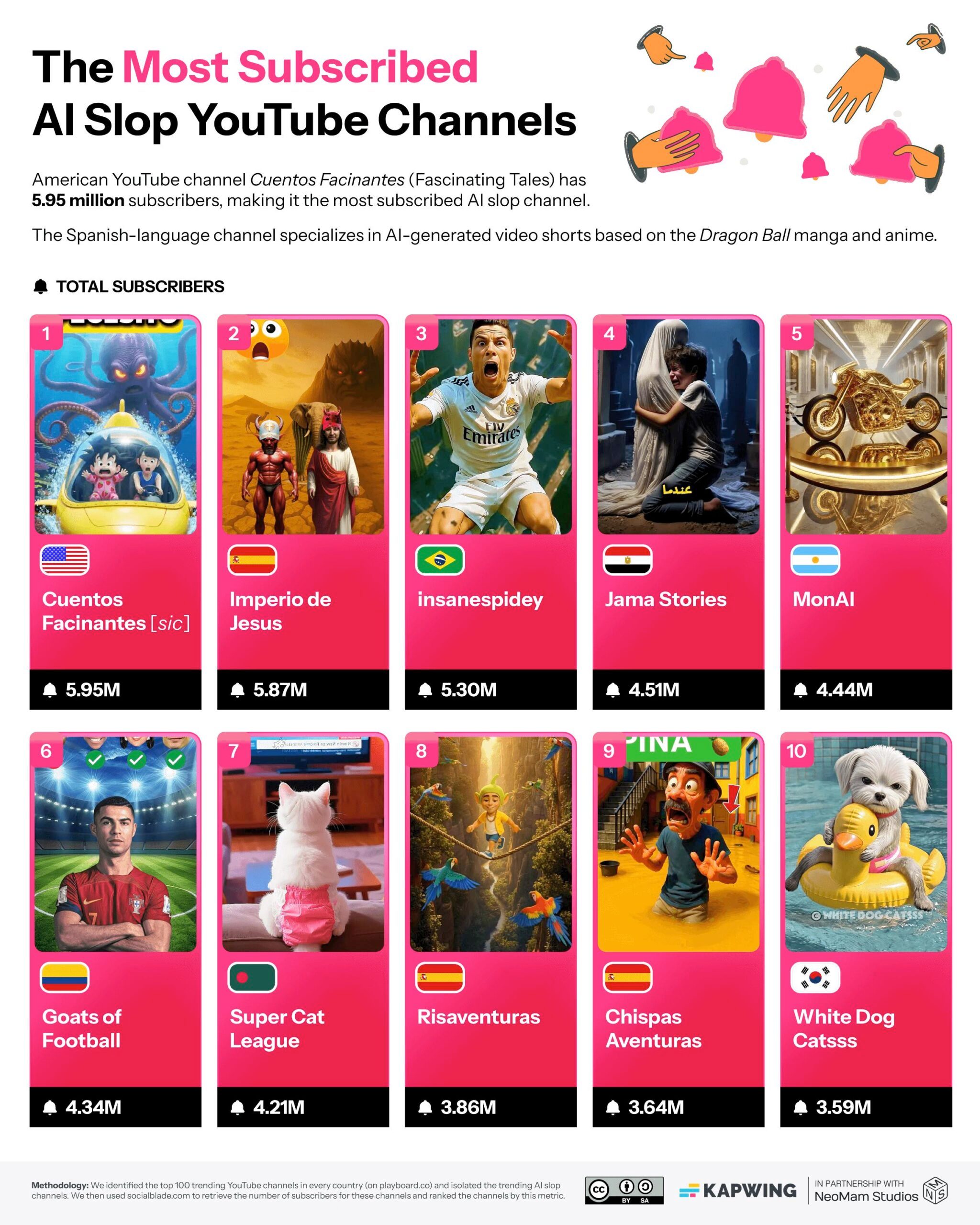
South Korea’s slop channels have generated over 8.45 billion total views, while India’s largest AI slop channel alone has surpassed 2 billion views. These rankings show that AI slop is not confined to one market, but is spreading globally.
Why is it spreading so fast?
The problem is less about individual creators and more about incentives baked into recommendation algorithms. AI-generated videos are cheap to produce, can be uploaded at a massive scale, and are often optimized to trigger curiosity or endless scrolling.
New users are especially vulnerable because the algorithm has no viewing history to guide recommendations. For YouTube, the findings raise uncomfortable questions. If a fifth of early recommendations are AI slop videos, it could reshape how users experience YouTube before they ever find creators they actually want to watch.
While YouTube has rolled out tools designed to curb deepfakes, I would like to see the platform offering better controls to limit AI-slop, much like TikTok already does. A report by Amazon Web Services (AWS) researchers claims that 57% of the internet may already be AI sludge.
This is why DuckDuckGo offers tools to filter low-quality AI content, while some tools like Slop Evader go even further by stripping the web back to how it looked before generative AI took over.
As AI tools make it easier to flood platforms with synthetic media, the challenge will be deciding whether engagement alone should keep driving what new viewers see first.
Read the full article here