

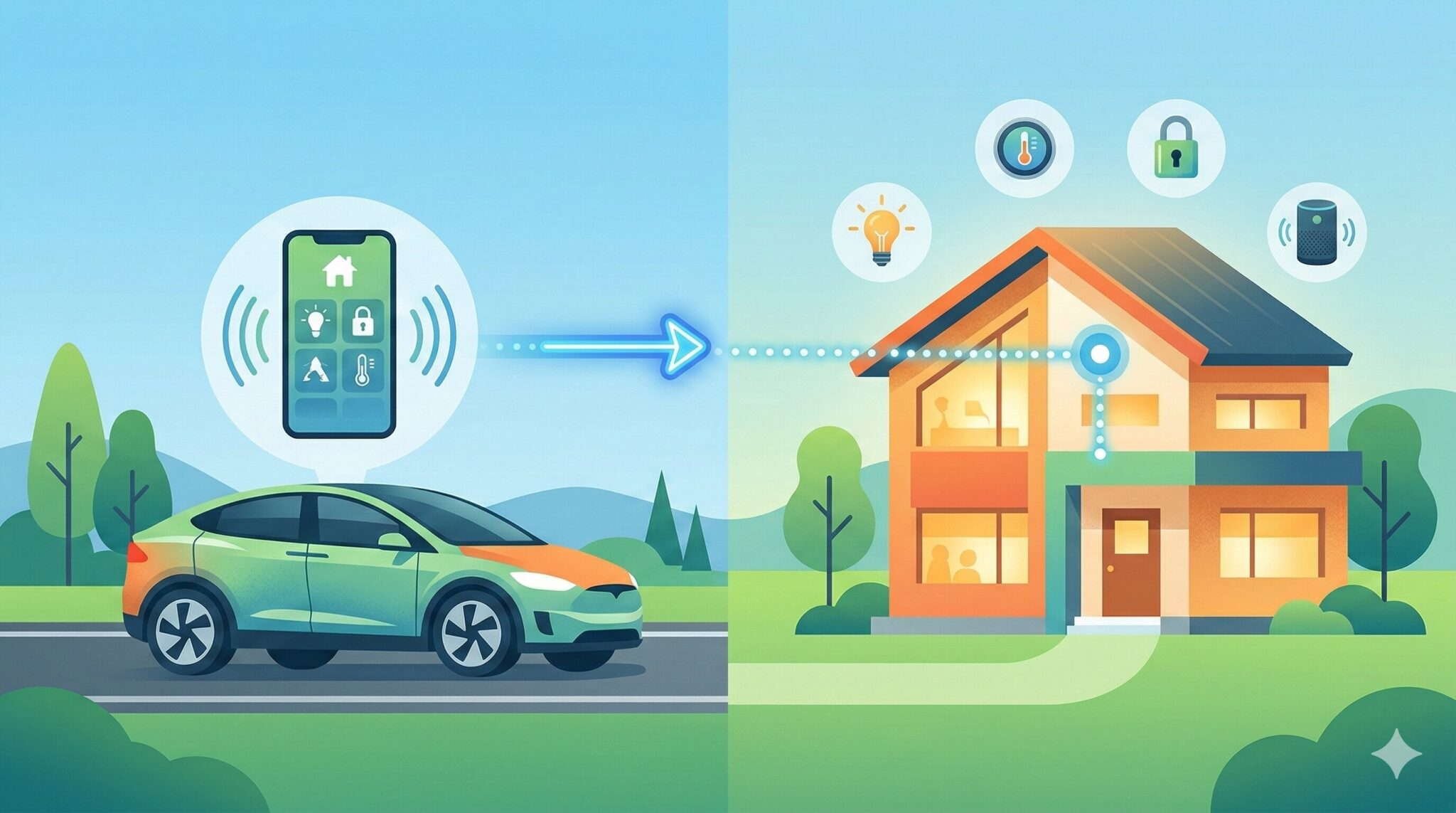

Samsung and Hyundai Motor Group have launched the SmartThings Car-to-Home service, giving some Hyundai and Kia drivers a way to control home devices from the car’s infotainment screen. The release turns a CES 2024 partnership into a shipping feature, with support starting on eligible vehicles built after November 2022 that use Hyundai Motor Group’s connected car navigation cockpit platform.
The launch also completes the two-way setup Samsung and Hyundai have been building toward. Home-to-Car, which lets users control some vehicle functions from home through SmartThings, rolled out last September. Car-to-Home now adds the reverse direction from the dashboard.
How it works in the car
The current version is built around preset routines rather than full device-by-device control. Drivers can trigger Home mode or Away mode from the infotainment screen to run multiple actions at once, such as turning on an air conditioner before arriving or powering down appliances and starting a robot vacuum before leaving. Yonhap’s launch coverage says the service currently works with Samsung air conditioners, air purifiers, and robot vacuum cleaners.
That keeps the in-car experience simple, but it also makes this first release narrower than the broader vision Samsung and Hyundai outlined in early 2024. At CES, the companies described Car-to-Home and Home-to-Car services that would connect SmartThings to Hyundai and Kia vehicles, including EVs, with control for home appliances such as TVs, air conditioners, and EV chargers, plus voice-command support while driving.
For now, the product is touchscreen-based, and current launch coverage does not confirm TVs, EV chargers, or voice controls as part of this release.
What’s still unclear
The biggest open question is eligibility. Samsung and Hyundai have said the service starts with Hyundai and Kia vehicles produced after November 2022 that support the connected car navigation cockpit platform, with broader support expected through software updates. A full model-by-model list has not been widely published in the launch materials reviewed.
Regional rollout is also still unclear. The original 2024 agreement said the companies planned to expand Car-to-Home and Home-to-Car services to overseas markets, according to Hyundai’s original announcement. The latest launch coverage does not clearly spell out where Car-to-Home is live first beyond Korea.
Privacy and account-linking details also remain thin in public launch materials. That is worth watching for any service that connects home controls, vehicle software, and user accounts in one chain. Recent connected-service incidents, including the Navia data breach that exposed the sensitive personal data of 2.7 million people, show how quickly trust can erode when those systems are not clearly explained.
Samsung and Hyundai now have a real Car-to-Home product in the market, not just a concept. The companies want the car to function as another SmartThings endpoint alongside phones and home devices. Other companies are pushing toward similar connected ecosystems, too.
Perplexity’s move to unify medical records and wearables through AI shows how widely the push to centralize device data is spreading, while Amazon is pursuing a similar connected ecosystem strategy with its AI-powered smartphone revival.
Also read: Google’s AI is reshaping search results and publisher content.
Read the full article here