



This is Lowpass by Janko Roettgers, a newsletter on the ever-evolving intersection of tech and entertainment, syndicated just for The Verge subscribers once a week.
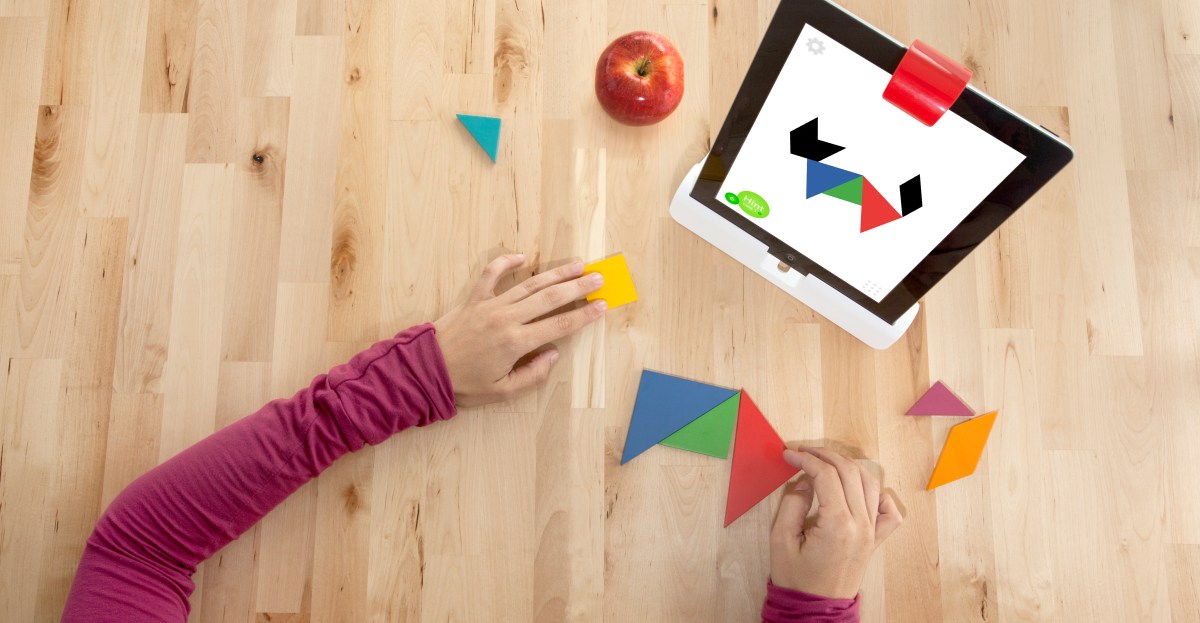
I still remember the first time I tried the kids edutainment system Osmo back in 2014: I was sitting in front of an iPad, placed vertically on a white iPad stand, that showed me pieces of a tangram puzzle, its squares and triangles arranged to make a shape.
In front of the iPad were matching wood puzzle pieces strewn across the table. I went to work to re-create the shape in question with those wood pieces. When I had managed to do so, the iPad played an animation and a sound, and showed me a new shape to crack.
This combination of digital and physical play felt like magic, especially because the physical side of it was so dead simple: In addition to the iPad and the custom white stand, Osmo only relied on analog objects — wood tangram pieces, as well as Scrabble-like letter and number tiles — forits various puzzles and other tasks. And all it took for Osmo’s apps to recognize these objects was a simple clip-on mirror that redirected the field of view of the iPad’s front-facing camera onto the table surface.
Osmo’s playful use of computer vision to bridge the physical and the digital world helped the company win over many millions of fans over the years, and ultimately led to a $120 million acquisition by India’s edutech giant Byju’s in 2019. Then, Byju’s imploded amid fraud accusations — and Osmo went down with the mothership, forced to shutter operations in 2024.
Now, a small group of former Omso employees is trying to bring its magic back: Together, they acquired Osmo’s IP and other assets for just $825,000 out of bankruptcy in December. Since then, they have been quietly restoring some of Osmo’s existing apps, and even started selling remaining hardware — all while brainstorming ways to take Osmo’s technology to the next level.
Two key members of the new Osmo team are Felix Hu and Ariel Zekelman, who met working on Osmo’s coding app, and have since married and become parents themselves. “Having kids just made us realize how special Osmo is and how there is nothing quite like it on the market,” Hu says. “We put so much love and energy into those products. We still want to see them thrive.”
“You don’t want to create these problematic play patterns. You don’t want to create addictive garbage.”
As parents, Zekelman and Hu also realized that the problems Osmo was trying to solve in 2014 — kids zoning out with screens and ignoring the world around them — have only gotten worse over the years. “I really want to create healthy relationships with the digital space,” Zekelman says. “I don’t want parents to feel like they can’t introduce technology to children. I think that we just need to be more responsible about it.”
At the same time, Zekelman acknowledges that kids themselves have changed. They start using technology much earlier, and consume vastly different forms of media. “Ten years ago, the world was a very, very different place,” she says. “Kids were in a different mindset. We had a different relationship to technology.”
Zekelman and Hu didn’t want to talk too much about upcoming products just yet. Hu said the company is initially focused on regaining trust with its existing customers, including the thousands of schools that once used Osmo.
But the couple suggested AI could play a big role in Osmo’s future. In the company’s early days, its computer vision was often limited to recognizing a very small set of physical objects. Basically, whenever Osmo wanted to build a new iPad app, it also had to ship new play pieces to put in front of the iPad’s camera.
“We were limited by the technologies that were available at the time,” Hu says. “Now that you have large language models, there’s a lot more opportunities [to] put anything in front of [the iPad] and interact with it in a meaningful way.”
At the same time, AI could also be a godsend for a small, largely self-funded team. “We can dream much bigger and we can do much more exciting things to bring kids out of this digital world and into the physical world,” Zekelman says.
This combination of digital and physical play has been something many companies have tried to crack over the years. Amazon’s Glow — a projection mapping device for children and their caregivers — was clearly inspired by Osmo, down to the physical tangram puzzle (Zekelman briefly worked on Glow after leaving Osmo in 2022). The Nex Playground is using a Kinect-like approach to tackle the same problem in the living room. One could even argue that Pokémon Go, and the way it uses the physical world as a playground, falls into the same category.
It’s also something that’s a lot harder to pull off than building apps or games confined to phone screens. Case in point: Amazon killed its Glow product just over a year after its launch. Osmo is likely going to face challenges as well, starting with distribution. In its prior iteration, the company had a number of retail partnerships, including with Target and the Apple Store. Striking those kinds of deals requires significant capital.
Hu didn’t want to comment on future distribution plans yet, but Zekelman suggested that the new Osmo may focus on slow, sustainable growth. “You can’t be held to VC growth standards, and you shouldn’t be,” says Zekelman about kids hardware like Osmo that isn’t optimized for constant engagement and growth. “You don’t want to create these problematic play patterns. You don’t want to create addictive garbage.”
Zekelman and Hu tell me that they’re clear-eyed about the challenges ahead, which include reminding the world that Omso even exists and staying clear of the temptation to chase hyper-growth. “We have an idea of what we’re getting into,” Zekelman says. “We can’t be stupid. I think that’s it. We can’t sell out.”
Read the full article here