


The NVIDIA Agent Toolkit is Jensen Huang’s answer to the question enterprises keep asking: how do we put AI agents to work without losing control of our data, our systems, and our liability?
Announced at GTC 2026 in San Jose on March 16, the NVIDIA Agent Toolkit is an open source software stack designed to help enterprises and developers build autonomous AI agents–ones that can perceive, reason, and act on their own, across internal systems, without needing a human to babysit every step.
The timing makes sense. The agent conversation has moved well past the pilot phase. What’s stalling broader deployment isn’t capability–it’s trust. Agents that can take action inside enterprise systems need guardrails, and until now, those have been hard to standardise at scale.
OpenShell and the safety problem
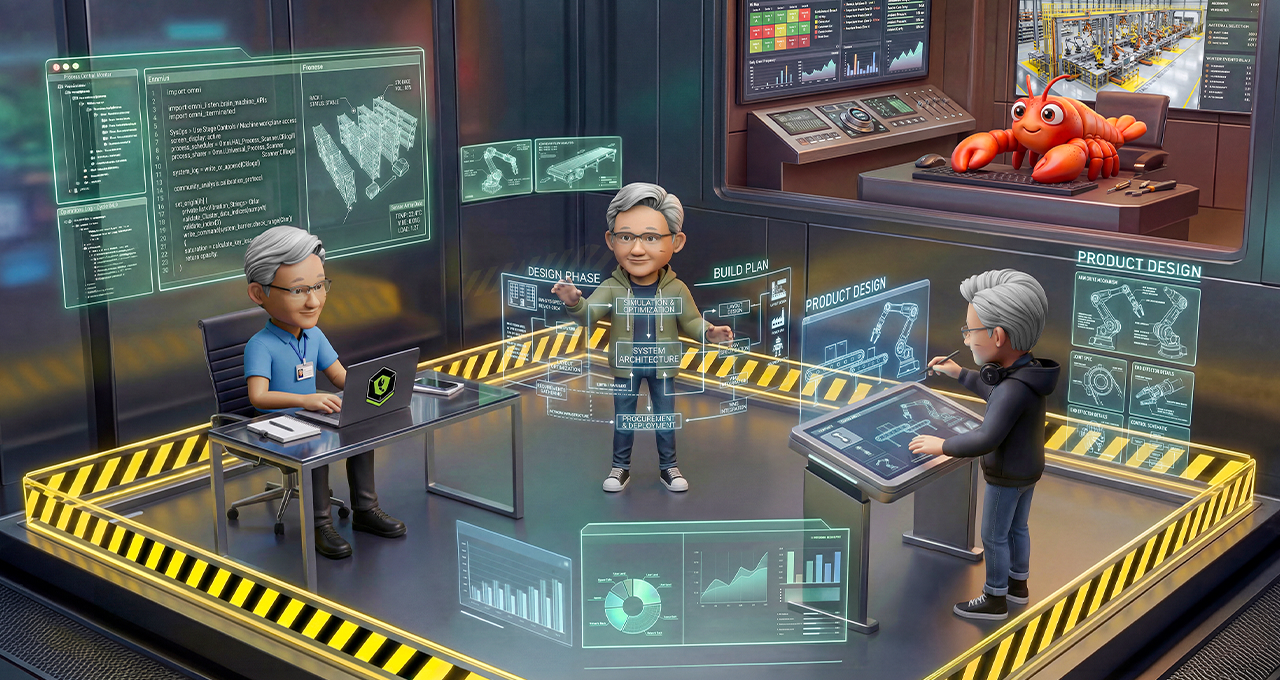
The centrepiece of the toolkit is NVIDIA OpenShell, an open source runtime that enforces policy-based security, network, and privacy guardrails for autonomous agents. In NVIDIA’s terminology, individual agents are called “claws”, and OpenShell is what keeps them in check.
Huang framed the stakes plainly at GTC: “Claude Code and OpenClaw have sparked the agent inflexion point–extending AI beyond generation and reasoning into action. Employees will be supercharged by teams of frontier, specialised, and custom-built agents they deploy and manage.”
That last part is the pitch. The ambition isn’t a single AI assistant; it’s a workforce of specialised agents, each handling a domain, coordinated at scale. OpenShell is the layer that’s supposed to make that deployable without IT teams having heart attacks.
NVIDIA is working with Cisco, CrowdStrike, Google, Microsoft Security, and TrendAI to build OpenShell compatibility into their respective security tools, which signals that this isn’t being positioned as a standalone product, but as infrastructure others build on top of.
The research and cost angle
Also inside the toolkit is NVIDIA AI-Q, an agentic search blueprint built with LangChain. It uses a hybrid architecture–frontier models handle orchestration while NVIDIA’s open Nemotron models do the research-heavy lifting. According to NVIDIA, this approach can cut query costs by more than 50% while still producing accuracy that tops the DeepResearch Bench and DeepResearch Bench II leaderboards.
That cost figure will matter to enterprise buyers who’ve been burned by consumption-based AI pricing that looked manageable in pilots and became a budget problem at scale.
Who’s already on board?
The partner list at GTC was extensive. Adobe, Atlassian, SAP, Salesforce, ServiceNow, Siemens, Cisco, CrowdStrike, Red Hat, Box, Cadence, Cohesity, Dassault Systèmes, IQVIA, and Synopsys are all advancing enterprise AI agents using the NVIDIA Agent Toolkit.
A few specifics stand out. Salesforce is building a reference architecture where employees use Slack as the orchestration layer for Agentforce agents–pulling from data in both on-premises and cloud environments–powered by NVIDIA infrastructure. Atlassian is integrating Agent Toolkit into its Rovo AI strategy across Jira and Confluence. ServiceNow’s “Autonomous Workforce of AI Specialists” is built on the toolkit alongside NVIDIA AI-Q.
And Siemens launched the Fuse EDA AI Agent, which uses NVIDIA Nemotron to autonomously orchestrate workflows across its electronic design automation portfolio, from design conception through manufacturing sign-off.
IQVIA’s deployment numbers offer a real-world data point: the company has already deployed more than 150 agents across internal teams and client environments, including 19 of the top 20 pharma companies.
The bigger shift
What NVIDIA is really doing here is positioning itself not just as the hardware backbone of AI, but as the software infrastructure layer for enterprise agentic deployment. The Agent Toolkit, OpenShell, Nemotron models, AI-Q-these are components of a stack that NVIDIA wants sitting underneath an enormous swath of enterprise software.
Whether that bet pays off depends on how quickly enterprises move from agent experimentation to agent operations. The toolkit is available now on build.nvidia.com, with support across AWS, Google Cloud, Microsoft Azure, and Oracle Cloud Infrastructure.
See also: AI Expo 2026 Day 1: Governance and data readiness enable the agentic enterprise
Want to learn more about AI and big data from industry leaders? Check outAI & Big Data Expo taking place in Amsterdam, California, and London. The comprehensive event is part of TechEx and is co-located with other leading technology events, click here for more information.
AI News is powered by TechForge Media. Explore other upcoming enterprise technology events and webinars here.
Read the full article here