



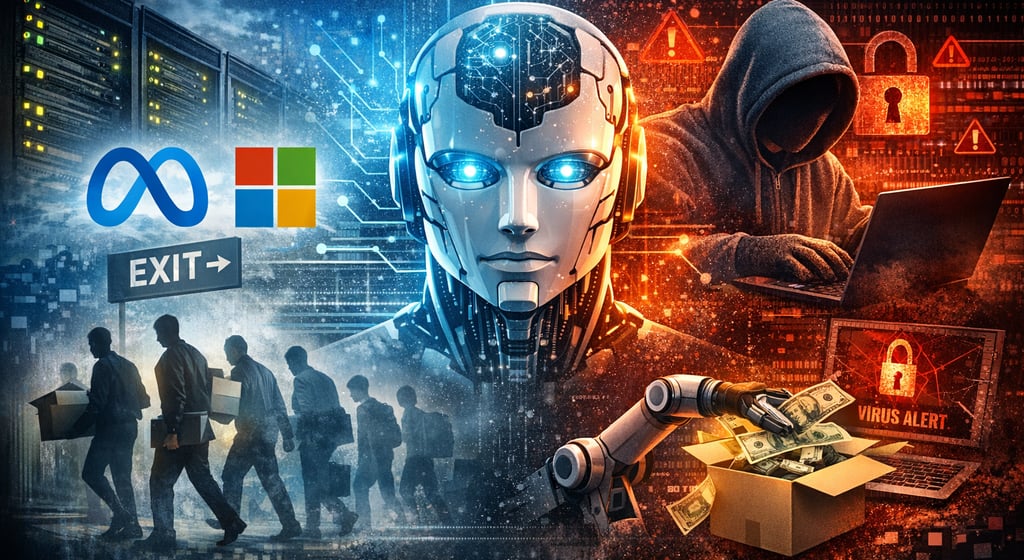

From multimodal AI launches and trillion-dollar infrastructure bets to critical zero-days and a fresh wave of tech layoffs, this week’s headlines expose the uneasy dance between breakneck innovation and mounting instability across the industry.
Top news
AI tools and platforms take center stage
Google introduced a new Notebooks feature for Gemini, merging chats, documents, and web content into a unified workspace synced with NotebookLM. The update allows users to organize projects, assign per-notebook instructions, and access advanced features under the AI Ultra plan.
Meta unveiled Muse Spark, a multimodal AI system developed by Meta Superintelligence Labs. The model powers Meta AI apps and will expand to Facebook, Instagram, Messenger, WhatsApp, and Ray-Ban devices. Meta claims benchmark wins over OpenAI and Google while using less compute, though the model remains closed and accessible only via private API preview.
Microsoft announced plans to release proprietary large AI models by 2027, reducing reliance on OpenAI. The company’s Superintelligence team is developing models across text, image, and audio while expanding Nvidia GB200 infrastructure to strengthen margins and investor confidence after a weak stock quarter.
OpenAI proposed a sweeping economic reset, suggesting a “robot tax” on automated labor, a 32-hour workweek, and an AI-funded public wealth fund to prepare for AI-driven disruption. The company also called for infrastructure expansion to support the emerging AI economy.
Tech giants push boundaries in hardware and software
Tesla is reportedly developing a smaller, more affordable compact SUV positioned below the Model Y. Expected to be produced in Shanghai, the vehicle revives the concept of a $25,000 Tesla but faces US market challenges due to tariffs.
Google Chrome added a long-awaited vertical tab sidebar, letting users view full tab titles and manage groups more efficiently. The update also includes a revamped Reading Mode for distraction-free browsing, a move accelerated by competition from browsers like Arc and Edge.
Samsung announced it will discontinue its Messages app in July 2026, directing Galaxy users to switch to Google Messages. The decision aligns with Apple’s testing of end-to-end encrypted RCS, signaling a more unified and secure cross-platform texting future.
AI meets media and security
Anthropic launched Project Glasswing, a coalition including Apple, Google, Microsoft, and others, to use AI for detecting zero-day vulnerabilities. The initiative leverages Anthropic’s unreleased Claude Mythos model, which has already identified thousands of flaws across major platforms.
Netflix and Sofia University unveiled VOID, an open-source AI model capable of removing and replacing objects in video scenes while maintaining realistic motion. Built on CogVideoX and enhanced by Gemini and SAM2, VOID could revolutionize video editing and VFX workflows.
Cloudflare introduced EmDash, a TypeScript-based, serverless CMS built on Astro that isolates plugins for improved security and includes AI-driven features. While WordPress cofounder Matt Mullenweg criticized the “successor” label, analysts see potential for future CMS innovation.
OpenAI confirmed its acquisition of the Technology Business Programming Network (TBPN), a popular Silicon Valley livestream, reportedly for hundreds of millions. The move folds TBPN into OpenAI’s strategy division under Chris Lehane, promising editorial independence while critics call it a pre-IPO reputation hedge.
Insider intel
Massive AI infrastructure deals
Meta extended its AI cloud partnership with CoreWeave through 2032 in a $21 billion deal, adding to last year’s $14.2 billion commitment. The agreement secures GPU capacity for Meta’s AI models and reduces CoreWeave’s reliance on Microsoft.
Anthropic signed a 3.5 GW TPU compute deal with Google and Broadcom to power its AI models. The agreement expands US AI infrastructure and underscores Broadcom’s growing role in the AI chip supply chain.
Security alerts
Critical vulnerabilities and exploits
Adobe Acrobat Reader users face a critical zero-day vulnerability exploited since November 2025. The flaw allows malicious PDFs to execute JavaScript and steal local files. Adobe has not yet released a patch, and users are urged to disable JavaScript and sandbox suspicious documents.
BlueHammer, a Windows zero-day exploit, was leaked by a researcher after a dispute with Microsoft. The flaw enables privilege escalation via Defender’s update process, with no patch available yet. Users should monitor Defender directories and disable unused admin accounts.
Fortinet issued emergency fixes for a FortiClient EMS zero-day (CVE‑2026‑35616) under active attack. The flaw allows remote command execution on management servers. CISA added it to its KEV catalog and ordered agencies to patch by April 9.
Google Chrome released emergency updates to patch CVE‑2026‑5281, a use-after-free vulnerability in the WebGPU layer actively exploited in the wild. The flaw affects all Chromium-based browsers, with CISA mandating federal agencies patch by April 15.
Cyber espionage and data breaches
Russia’s APT28 hijacked over 18,000 MikroTik and TP-Link routers worldwide, altering DNS settings to steal credentials and tokens. Microsoft and the FBI confirmed the campaign, urging users to update firmware, reset DNS, and enable multifactor authentication.
LiteLLM suffered a supply chain attack by hacking group TeamPCP, which infiltrated Mercor’s systems and prompted Meta to suspend collaboration. The breach exposed up to 4 TB of sensitive data, with Lapsus$ reportedly auctioning stolen information.
China-linked hackers breached an FBI network used for metadata collection in February, compromising surveillance data and personal information from active cases. The incident, classified as a major breach, reportedly exploited an ISP vendor’s infrastructure.
Scams and social engineering
Apple Pay users are being targeted by a widespread scam involving fake fraud alerts that trick victims into calling fraudulent support lines. Attackers impersonate Apple or law enforcement to steal two-factor codes or money transfers. Apple advises users to ignore such messages and report phishing attempts.
QR code smishing scams are spreading through fake court notices that redirect victims to fraudulent DMV-style sites demanding small payments. The campaign steals personal and financial data, and users are urged not to scan unknown QR codes.
Industry shakeups
Economic and workforce shifts
Goldman Sachs data shows AI automation is eliminating about 25,000 US jobs per month while creating only 9,000 new ones, resulting in a net loss of 16,000 jobs monthly. Entry-level and administrative roles are hit hardest, though demand for AI-skilled workers continues to rise.
Tech layoffs surged across the US in Q1 2026, with over 52,000 jobs cut — the worst first quarter since 2023. Companies including Oracle, Meta, and Amazon are reducing staff while investing heavily in AI infrastructure, prompting economists to call for rapid reskilling initiatives.
Policy and funding changes
President Trump’s FY 2027 budget proposal slashes $707 million from CISA, cutting several programs and nearly 870 staff positions. Analysts warn the cuts could delay cyber threat alerts, urging organizations to bolster their own defenses.
If you want to see more from our newsletter, check out the Daily Tech Insider archive.
Read the full article here