




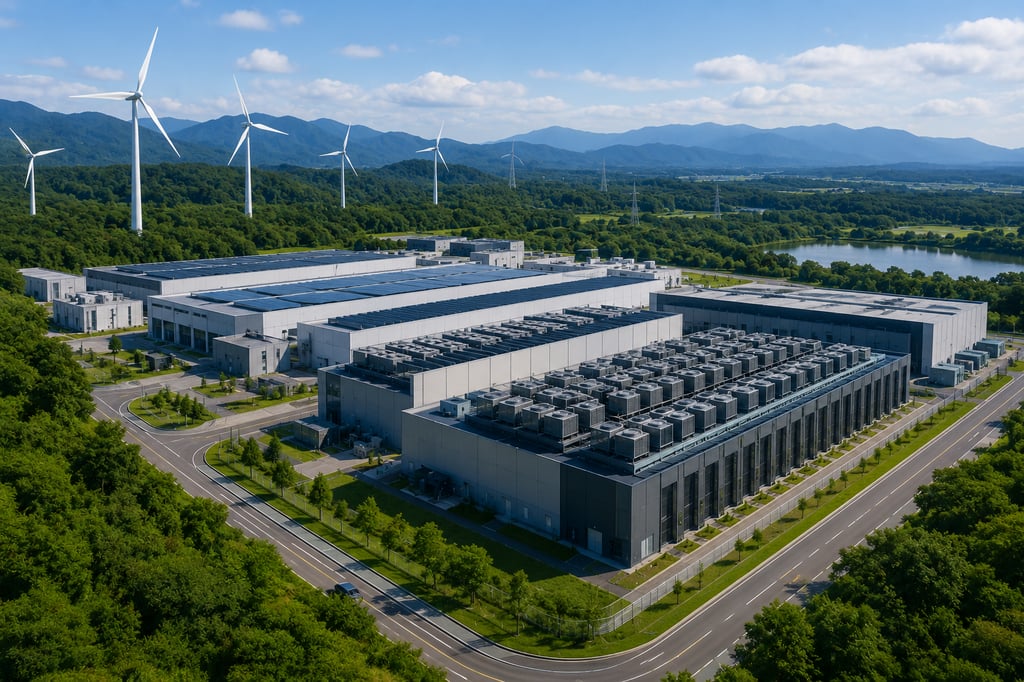

Japan could gain one of its largest AI data centers under a project in Akita now expected to cost more than ¥2 trillion, or roughly $12.6 billion, with Abu Dhabi sovereign investor Mubadala considering an investment.
If completed, the 300–500 MW project would add substantial AI compute capacity outside Japan’s established data center hubs.
For enterprises planning future Japan-based workloads, however, the useful capacity will depend on whether organizers can secure financing, grid connections, and enough deliverable power to support the proposed scale.
A ¥2 trillion project could expand Japan’s AI capacity map
Japan Today reported that expected construction costs now exceed ¥2 trillion and that Mubadala Investment Co. is considering backing the project. No final investment commitment has been announced.
The financial scope being discussed is considerably larger than earlier figures. JETRO reported in November 2025 that planned investment could reach ¥400 billion.
The figures are not directly comparable because the earlier number described expected investment while the new figure is reported as construction cost. Still, the latest estimate establishes Akita as a much larger infrastructure project than its initial public outline suggested.
Akita City signed a cooperation agreement with S2 and Bitgrit in October 2025. Organizers say they have secured 50 hectares in a renewable-energy industrial park in northern Akita City and are targeting full operation around 2033.
That scale could broaden where enterprises source Japan-based AI infrastructure. Most current capacity remains concentrated around established markets, although providers are expanding, including Alibaba Cloud with its fifth Japan data center.
Akita would offer a different proposition: large-scale AI infrastructure built around access to regional renewable generation rather than proximity to an existing metropolitan data center cluster.
Power and financing will decide how much capacity arrives
The project’s official site describes 300–500 MW of renewable-energy potential, including offshore wind. That does not mean the data center has already secured 500 MW of usable IT load or the grid connections required to deliver it.
That distinction directly affects future customers. A planned 500 MW campus does not create 500 MW of bookable compute capacity if electricity connections, substations, or generation cannot arrive on the same timetable.
Similar constraints are already affecting data center expansion elsewhere. US grid capacity constraints are slowing some proposed projects, while Australia is preparing for additional pressure from AI data center demand.
Akita therefore remains a long-term capacity prospect rather than infrastructure enterprises can include in near-term deployment plans. A Mubadala investment could strengthen the financing side, but customers will also need evidence of grid interconnection, construction milestones, operating partners, and committed capacity before the project becomes a realistic sourcing option.
Also read: Uptime Institute found 57% of major data center outages now cost more than $100,000, even as overall outage frequency declines.
Read the full article here