


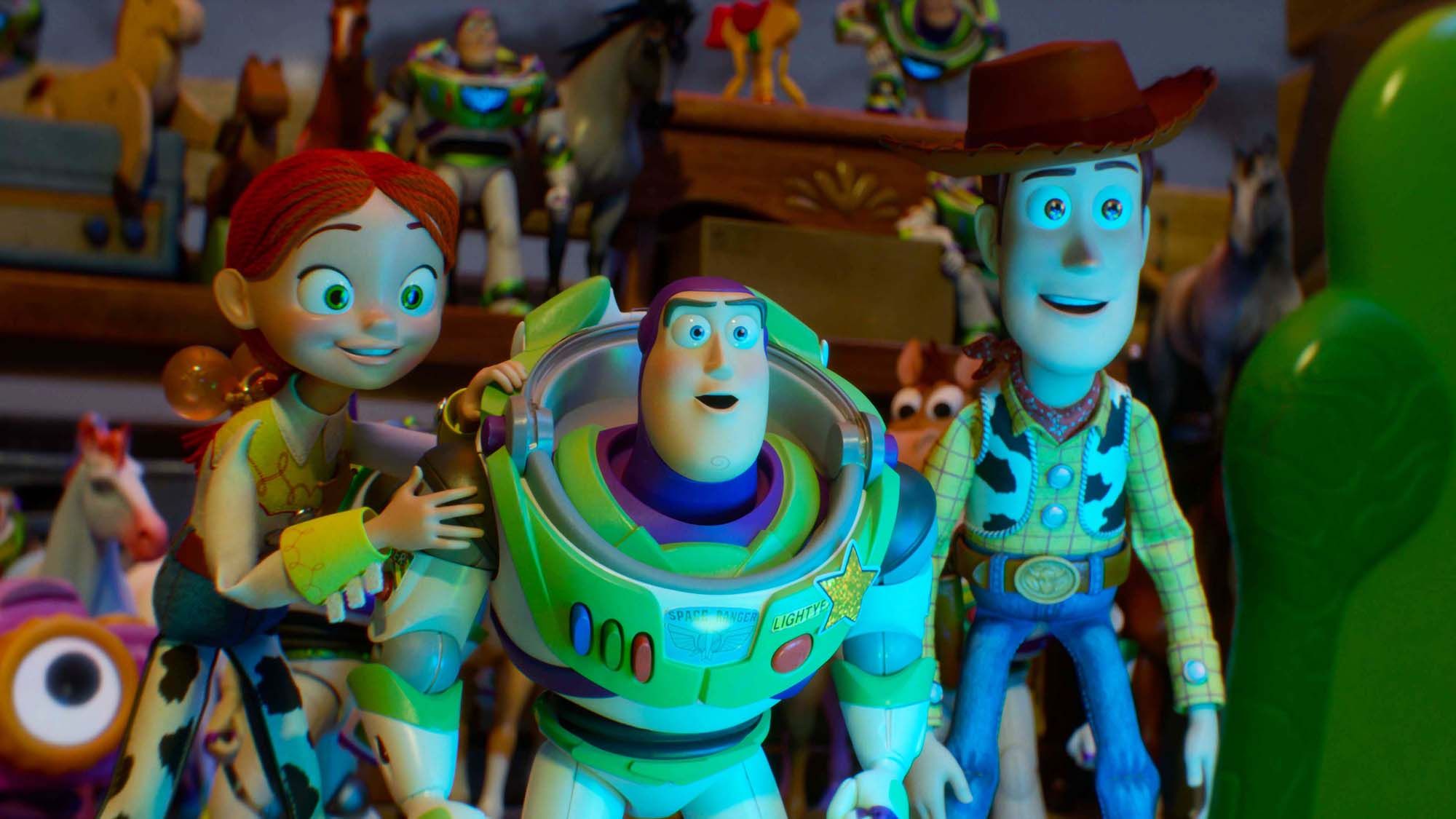

Full spoilers follow for Toy Story 5. You have been warned.
Thomas Jordan has seen a lot in his Hollywood career. The Pixar veteran, who began his career at the acclaimed animation studio in 1997 as a production intern on A Bug’s Life, has had a front-row seat to the company’s many highs and occasional lows, and the rapidly changing face of the entertainment business itself.
Hoppers, the first of two new movies from Pixar this year, launched to critical acclaim, grossing almost $400 million globally, and the Disney subsidiary is aiming for another box office success with its next feature.

Step forward Toy Story 5, the latest installment in Pixar’s long-running, incredibly popular, and money-spinning film franchise. Despite a mixed critical reception — read my Toy Story 5 review to see what I thought — it’s anticipated that the movie series’ fifth entry will be a huge hit, financially, with some analysts predicting a $150 million windfall during its opening weekend in North America alone.
As the film’s visual effects (VFX) supervisor — a role he filled for the very first time on Toy Story‘s fifth chapter — and with almost 30 years of experience under his belt, Jordan knew how big an undertaking this movie would be. After all, as he tells me, on a sunny Friday afternoon in London ahead of the family-friendly flick’s June 19 worldwide release: “Toy Story is very precious. It started it all. It’s our crown jewel. It’s why Pixar is still here.”
That’s just one of many measured and insightful remarks Jordan gave in our exclusive interview. From developing innovative new technologies and crafting Bonnie’s imagination-based art style to the challenges of animating the film’s antagonistic tablet device Lilypad and Pixar’s experiment with artificial intelligence (AI), here’s everything we discussed in our chat.
(NB: this interview has been condensed and edited for clarity).
Bridging the animation tech divide
TechRadar: Each new Toy Story film — and Pixar project for the matter — gives you the opportunity to improve upon the last. What technologies, programs, and tools did you invent or refine to craft specific parts of this film?
Thomas Jordan: Well, to animate the realistic-looking horse — she’s called Daffodil — we have in this movie, we needed to figure out a new rigging system. Without it, we couldn’t have her in as many shots, because it would have been too laborious to animate her. This new system is more realistic in terms of horse motion and easier for the animators [to use], so we can have her in as many shots as we want.
The other example that comes to mind is the long, black, curly hair on the [human] character Blaze. We strive to create movies that represent the audience, and if we can’t represent a certain part of the population, we feel like we’re not doing our jobs properly. We put extra effort into solving the problem instead of changing the hairstyle because we wanted to finally solve this problem once and for all, and we knew it would not just benefit our film but any Pixar production.
TR: When you implement new tools, what are some of the challenges of making them work in tandem with established Pixar programs?
TJ: There’s an expectation with every Pixar movie to push the envelope and innovate, so sequels are particularly appealing as testing grounds. But, early on, I did think about the danger of adopting too many new tools at once, so we were very careful about which current programs we combined them with.
There were instances where our new tools didn’t overlap with pre-existing ones. For example, for Daffodil, the new rigging technology we used to animate her doesn’t use our recent lighting tool Luna, nor our new rendering tool Renderman XPU.
We took a similar approach with Blaze’s curly hair tool. We only used it alongside Renderman XPU for one sequence and with Luna in two to minimize the risk because, you know, the movie has a release date. No matter what we do, we can’t jeopardize that.
What makes a toy?
TR: Let’s talk about the new toys you introduce in this film, starting with Smarty Pants, Atlas, and Snappy. What was most challenging about bringing them to life and ensuring they moved in visually unique ways?
TJ: The first thing is they’re all solid objects. None of them have hands or legs, and they either have screens or a sticker for eyes, so initially we had to work out how they’d move.
The next challenge was they all needed to feel like they were from different eras. We wanted Smarty Pants to be the oldest one, so his technology looks older because he’s from when Blaze was a little girl, and his screen doesn’t refresh as quick as the others. The next one she got was Atlas, and so we did a lot of research on what technology and screens looked like in the ’80s, ’90s and 2000s. After that came Snappy, who’s the most advanced with her eyeball camera lens, and so things needed to feel unrefined.
There’s an expectation with every Pixar movie to push the envelope and innovate
Thomas Jordan, Toy Story 5 VFX supervisor
On top of that, they all have screens, which have to be animated separately from the characters themselves. The problem was that when the animation team worked on Snappy, Smarty Pants, and Atlas, their screens were blank, which isn’t very useful or inspiring for the animator who’s trying to make them emote. So, we gave them a tool — it’s like a virtual pencil they can animate with — that allowed them to mock up what shows up on the toys’ screens.
Once their animation was approved by the director with these temporary sketches, we have an art team that creates what we call “motion graphics”, which are these graphic design images but animated. So that’s what we added to the screens, in the form of these chunky and old-fashioned pixels, after the rest of the characters were animated.
TR: I imagine you applied a similar process to Lilypad. As a modern toy with a touchscreen that Bonnie and other characters can swipe on, though, how did animating Lilypad differ from the others?
TJ: There was an extra complicated step. Like the other toys’ screens, if the animator was, say, animating Bonnie’s finger swiping on Lilypad’s screen, we hadn’t actually figured out what Bonnie would be swiping, so the animator was essentially swiping at nothing.
When the eventual screen images are designed, not only do they need to support the rest of Bonnie’s animation, they also need to be synchronized with her swiping motion. So, while it was another use case for the virtual pencil sketch tool, it became a timing guide for the artists who were making the graphics for Lilypad’s screen, and ensuring they lined up with when Bonnie is touching it and moving it.
As for Lilypad’s screen, it has the highest resolution [of the new toy devices], but you’ll notice that her eyes are still pixelated. The reason for that is our director, Andrew Stanton, really wanted to make sure the audience always remembered she wasn’t just a toy, but a tech device. Because her screen is so high-tech, if we did that for her eyes, she might just feel like an actual frog toy as opposed to a device. So it was a deliberate decision we made, even though it makes her feel a little bit more retro.
Building Bonnie’s imagination scene — and Toy Story 5’s most intricate sequence
TR: A lot of positive things have been said about the art form used to represent Bonnie’s imagination since Toy Story 5‘s official trailer came out. How many styles did you explore before settling on those visuals?
TJ: I’d say all of them! *laughs* That was a very long process where we were challenged to create something that the audience has never seen before, but we don’t know what it is or what they want.
And so, on a weekly basis, we’d bring in our own toys, drawings from our kids, and examples of different painting styles, and get together in a meeting room to look at all of these little bits and pieces. As we started honing in on what the directors liked, it became clear they liked things that were reminiscent of Bonnie’s crafts-oriented personality, so we extended that into what her imagination looks like.
We were also inspired by the early pastel lighting studies done by Toy Story 1‘s original production designer Ralph Eggleston. That was his style for showing what the lighting would look like for the entire film, so he would do sketches — we’d call it a color script — using pastel chalk to demonstrate it.
It was a very deliberate choice to show Bonnie and Blaze had similar imagination styles
Thomas Jordan, Toy Story 5 VFX chief
TR: Later in the movie, when Blaze is seen playing with Jessie and Bullseye, her imagination is stylized in the same way as Bonnie’s. Was that used to telegraph to audiences how compatible she and Bonnie were as individuals and, as the film’s final sequence reveals, friends?
TJ: Yes, it was a very deliberate choice to show Bonnie and Blaze had similar imagination styles — and Jessie sees it, too, because Jessie is part of that imaginary sequence, which helps her realize these kids are very similar, and they would make great friends someday.
That said, Blaze’s imagination has a different color palette and some fun, different themes to it, as well. So, at the end of playtime, where Bonnie and Blaze are playing together, we purposefully combined the two art styles to show how compatible their personalities are. It was one of the most rewarding things to work on and see come together at the end.
TR: What was the hardest or most intricate sequence to realize, from initial concept to the final product?
TJ: When I read an early draft of the script, there was an “oh no” moment when I reached the scene where Jessie and Bullseye, along with Woody, the 51 Buzzes, and all the toy horses, are trying to rescue Lilypad from a moving truck on the highway. That meant we needed to figure out how to animate well over 100 characters individually, because they all have their own personalities and unique animation, and it all had to be coordinated so they arrived at the truck at the same time.
I thought, ‘How the heck are we going to do that in this exterior environment? We’re outside, racing through the countryside on a dirt road, and then all of a sudden we’re on the highway, and there are other cars, we see shops and stores, and there are clouds in the sky!’.
It was by far the most complicated scene and required months of planning, so we decided to start working on it very early, because we didn’t want to leave it to the last minute.
One eye on Easter eggs, the other on AI
TR: It’s an understatement to say AI is a hot topic right now. What are your feelings on its use in the entertainment industry? And is it something you’ve tentatively or actively researched to improve any aspects of your work?
TJ: We’ve experimented with it at Pixar, but only to see how AI could be used, and very quickly we learned that it wasn’t ready for our level of filmmaking. So, we’ve started to approach it more from the angle of wanting to improve the artist’s experience, not replace it.
My personal philosophy is if there are steps to, say, helping set up a scene so you can actually get to animating it faster, that sounds extremely useful.
More importantly, it still puts the artist first, because I think the secret sauce of Pixar animation is the way that we animate. It’s not meant to be based on the real world — it’s artistic license and caricatured. We’re trying to support the story and emotion, but in a way that allows us to put our creativity into the characters you see on screen, and I think that’s something we would never want to change.
TR: No Pixar movie is complete without its Easter eggs. Do you have a favorite that you snuck in? And should viewers keep an eye out for the Pizza Planet truck?
TJ: Yes, the Pizza Planet truck is there. It’s in all but one of our movies, so it’s tradition to include it. As for another specific reference, I challenge the audience — and this is another of my favorite Pixar traditions — to find the Easter egg related to our next film.
Every Pixar movie has an Easter egg for the one that comes after, and the fun thing is that you don’t know what to look for until you’ve seen the most recent film. So, there was a Toy Story 5 secret in Hoppers, which was Atlas the GPS hippo device.
And so, for Gatto, the film we’re releasing in 2027, there’s an Easter egg for that in Toy Story 5. I’ll give you a hint: it’s not the titular black cat himself. Let me know if you find it!
Toy Story 5 is out now in theaters worldwide.
Follow TechRadar on Google News and add us as a preferred source to get our expert news, reviews, and opinion in your feeds.
Read the full article here