





Apple used to question whether generative AI-powered editing features were worth the risk of distorting our perceptions of the world. Now it seems Apple no longer believes that photos should accurately capture reality. At WWDC 2026, the company announced a host of new AI-powered photo editing tools. They give users effortless powers of manipulating images that Apple still refers to as “photos.”
Two years ago, Apple launched Clean Up — an AI-powered object removal tool in Apple’s Photo app that’s similar to the Magic Eraser feature in Google Photos. At the time, Apple software chief Craig Federighi said that it was important for the company to “purvey accurate information, not fantasy.” The company seemed hesitant to provide more extensive AI editing tools, while Google and Samsung charged ahead with editing suites that allow you to add almost anything to photographs by just describing it — including explosions, drug paraphernalia, and other potentially harmful inclusions.
Now, Apple is launching its own tools for manipulating photographs using prompt descriptions. An updated version of Image Playground, Apple’s AI app for generating and editing images, notably introduces the ability to generate images in a photorealistic style. Apple says this “offers new powerful ways for users to bring their imagination to life.”
Image Playground allows you to modify images by describing complex changes in natural language, or by tapping, circling, or brushing over specific objects to simply move or resize them. In Apple’s keynote demonstration, we saw Image Playground being used to generate an image of a woman holding a birthday cake, using a real photograph of the person as a reference. The manipulated image doesn’t just add the cake, it also entirely replaces the original background. Until now, Apple avoided photorealistic AI generation. Image Playground previously focused on cartoon-like styles that don’t believably deepfake real people. So why did Apple change its mind?
The answer, seemingly, is SynthID: Google’s near-invisible watermarking system that tags content generated by its own AI tools. Apple says any photos adjusted with Apple Intelligence will be embedded with SynthID to make them easier to identify as AI manipulated. Apple was already labeling the metadata of images that were edited using Clean Up or generated through Image Playground, but using its own “forensics” feature that, to my knowledge, isn’t used by any other major tech platform.
SynthID watermarks will be applied to photos that are edited using Clean Up, Extend, and Spatial Reframing — the trio of Apple Intelligence-powered tools for Apple’s Photos app. The updated Clean Up tool has been given a “major upgrade” according to Apple, allowing you to remove “distractions” with “better quality and more realistic infill, even when the scene is complex.”
The new Extend tool lets you expand an image beyond its current dimensions, using generative AI to fill in the blank spaces — just like Adobe’s Generative Expand feature in Photoshop. You can use it to turn a portrait image into a landscape one, so long as you don’t mind the fact that the manipulated background isn’t actually real.
Spatial Reframing lets you adjust the perspective of images like a 3D scene. You can select part of a photograph and drag it around with your finger to make it look like it was taken at a different angle. Apple says that Spatial Reframing builds on the understanding of spatial models that it developed for the Vision Pro headset and that it only generates new content where the perspective has been adjusted, “ensuring the reframed photo stays consistent with the original scene.”
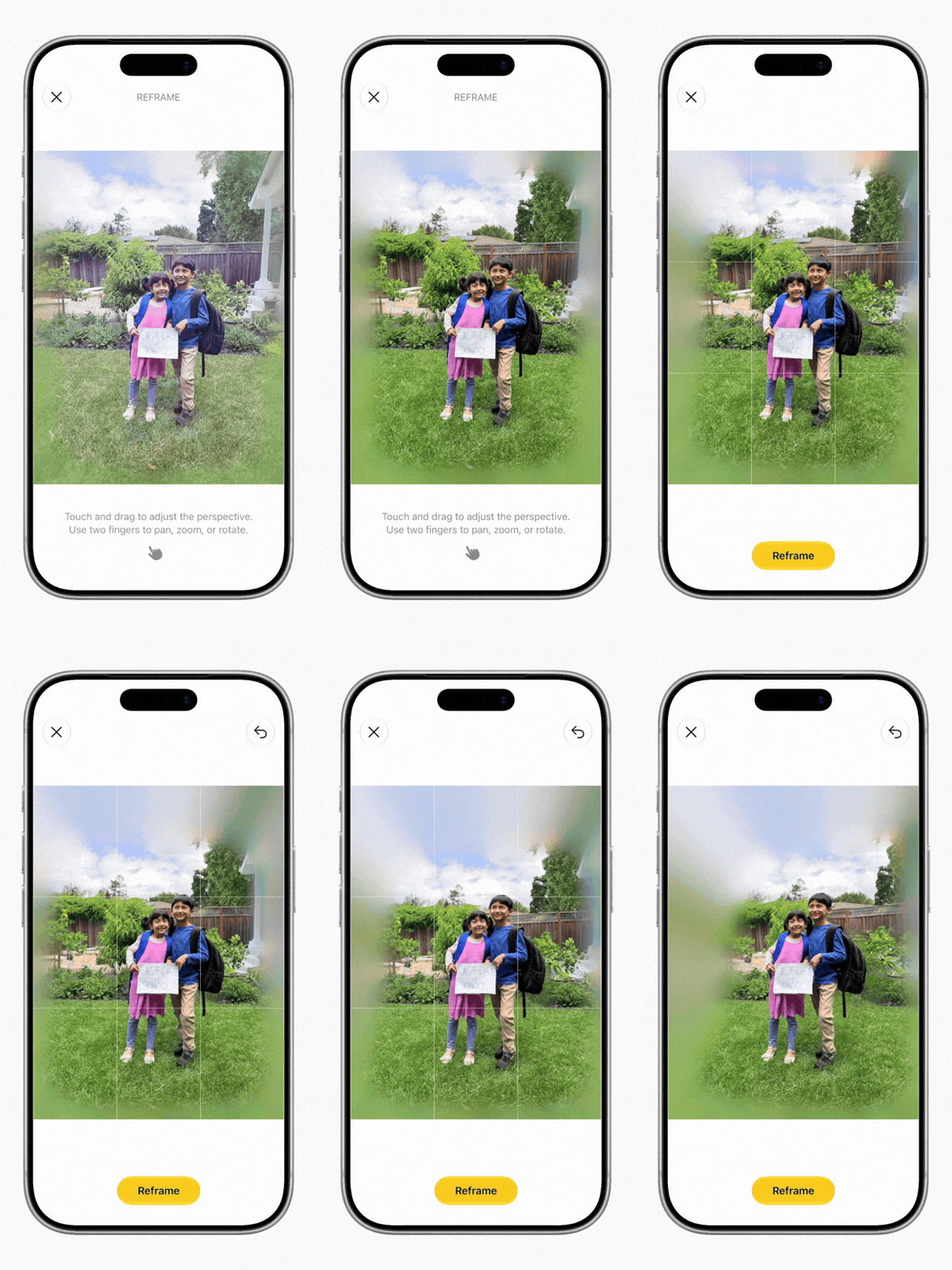
But consistency doesn’t mean authenticity. Any image edited using Apple’s tools will be flagged with AI watermarks, and if portions of the images are synthetically generated, is it really a true reflection of reality anymore? We’ve debated this subject at length at The Verge, and Apple itself has weighed in. When Apple Intelligence was announced in 2024, Federighi said Apple was “concerned” that AI could impact how “people view photographic content as something they can rely on as indicative of reality.”
AI labels are supposed to aid with this, by providing a way for online users to distinguish between real photographs and misleading AI manipulations. Support for SynthID is expanding across the industry, having recently been adopted by OpenAI. You can check images for SynthID data by uploading them into Gemini or Google’s AI-powered Search chatbot and asking if they carry the watermark. This is not exactly intuitive, but it gives users some control over checking the authenticity of images. Online platforms are also making efforts to automatically label content that carries SynthID data so that AI manipulated images can be quickly identified wherever they’re posted.
Those efforts are in the early stages, however, and much of the deepfake and synthetically generated imagery online is still unlabeled. Still, it’s notable that Apple is placing its trust in SynthID given the concerns it previously expressed about AI’s ability to easily distort real moments in time. If SynthID adoption pans out for Apple, the company may feel that’s enough to prevent people from being misled, which would allow it to develop more expansive generative AI editing features.
Apple has frequently communicated that photography’s ability to reliably capture real memories is worth preserving. But it seems like that’s no longer the emphasis here. The company encourages users to manipulate personal photos in unprecedented ways with the convenience of their phones — all for the sake of… what? A photo more “perfect” than reality? And while Apple doesn’t exactly want to contribute to the avalanche of manipulated content online, it’s betting it all on SynthID to stop that from happening. That’s a big pivot from saying that photography should represent “a personal celebration of something that really, actually happened.”
Read the full article here