



The ceremony was scheduled. The CEOs were on the guest list. And then it wasn’t happening.
On Thursday, US President Donald Trump scrapped a planned AI executive order, which had already been delayed multiple times, citing concerns that it might erode America’s competitive edge over China.
“We’re leading China, we’re leading everybody, and I don’t want to do anything that’s going to get in the way of that lead,” Trump told reporters in the Oval Office. What he did not say was that the order had been effectively killed by the very industry it was meant to oversee.
Lobbied out in one night
According to Semafor, which first reported the backstory, the White House’s plans were halted after Elon Musk of xAI, Meta CEO Mark Zuckerberg, and venture capitalist David Sacks, who, until recently, was Trump’s AI and cryptocurrency tsar, all spoke directly with Trump between Wednesday night and Thursday morning.
The argument that landed, according to US media, citing sources, was an appeal to the “accelerationist” faction in the administration, including officials at the National Economic Council and staffers in the Vice President’s office.
The order itself was not a sweeping regulatory framework. It would have established a voluntary mechanism for AI developers to engage with federal agencies and submit advanced models for security review up to 90 days before their public release. No licensing regime. No mandatory hold periods. Voluntary.
That was apparently still too much. Trump said he postponed it “because I didn’t like certain aspects of it,” declining to specify which ones. He added that he worried it “could have been a blocker,” a telling phrase from a president who has otherwise positioned AI as a jobs and national security priority.
A vacuum with consequences
The US has yet to pass comprehensive AI legislation. What governance architecture exists has been assembled piecemeal, through executive orders, agency guidance, and voluntary agreements. Earlier this month, the federal Centre for AI Standards and Innovation announced evaluation agreements with Google DeepMind, Microsoft, and xAI, allowing the government to assess models before public availability. That programme continues regardless of Thursday’s non-signing.
But the broader picture is one of regulatory drift. In early March, the Trump administration released a National AI Legislative Framework urging Congress to preempt state-level AI laws that “impose undue burdens,” arguing for a single national standard over what it called “fifty discordant ones.” Congress has not acted on it.
The contrast with China is sharp and increasingly difficult to ignore. Beijing’s State Council issued a 2026 legislative work plan in May outlining plans to accelerate comprehensive AI legislation, deploying language on AI governance in formal planning documents for the first time. The National People’s Congress has listed AI legislation for review for the third consecutive year.
In April, Beijing issued new rules requiring AI companies to establish internal ethics review committees. China is writing rules. Washington is cancelling ceremonies.
Who shapes US AI policy
Thursday’s episode clarified something implicit for months: in the current administration, the effective veto on AI regulation sits with a small group of industry principals who have direct access to the president.
Musk, whose xAI is a direct competitor to OpenAI and Anthropic, has a structural interest in keeping the regulatory field open. Zuckerberg’s Meta has similarly positioned itself as a champion of open-source AI development. Sacks, despite having formally left his White House advisory role in March, evidently retains enough influence to shape executive action.
Separately, Semafor reports that OpenAI has secured White House backing for a parallel effort to push AI regulations at the state level, an interesting manoeuvre given that Trump’s earlier executive order threatened states that enacted AI laws the administration disliked. That the administration appears to be simultaneously discouraging state regulation and endorsing OpenAI’s state-level strategy suggests the policy coherence problem runs deeper than one postponed signing.
The China frame does real work, but in both directions
Trump’s stated reason for pulling back, protecting the US lead over China, is the same logic that has driven every major AI policy decision since he returned to office, from the H200 export licence framework to the Stargate infrastructure programme. It is also the logic that China is watching closely.
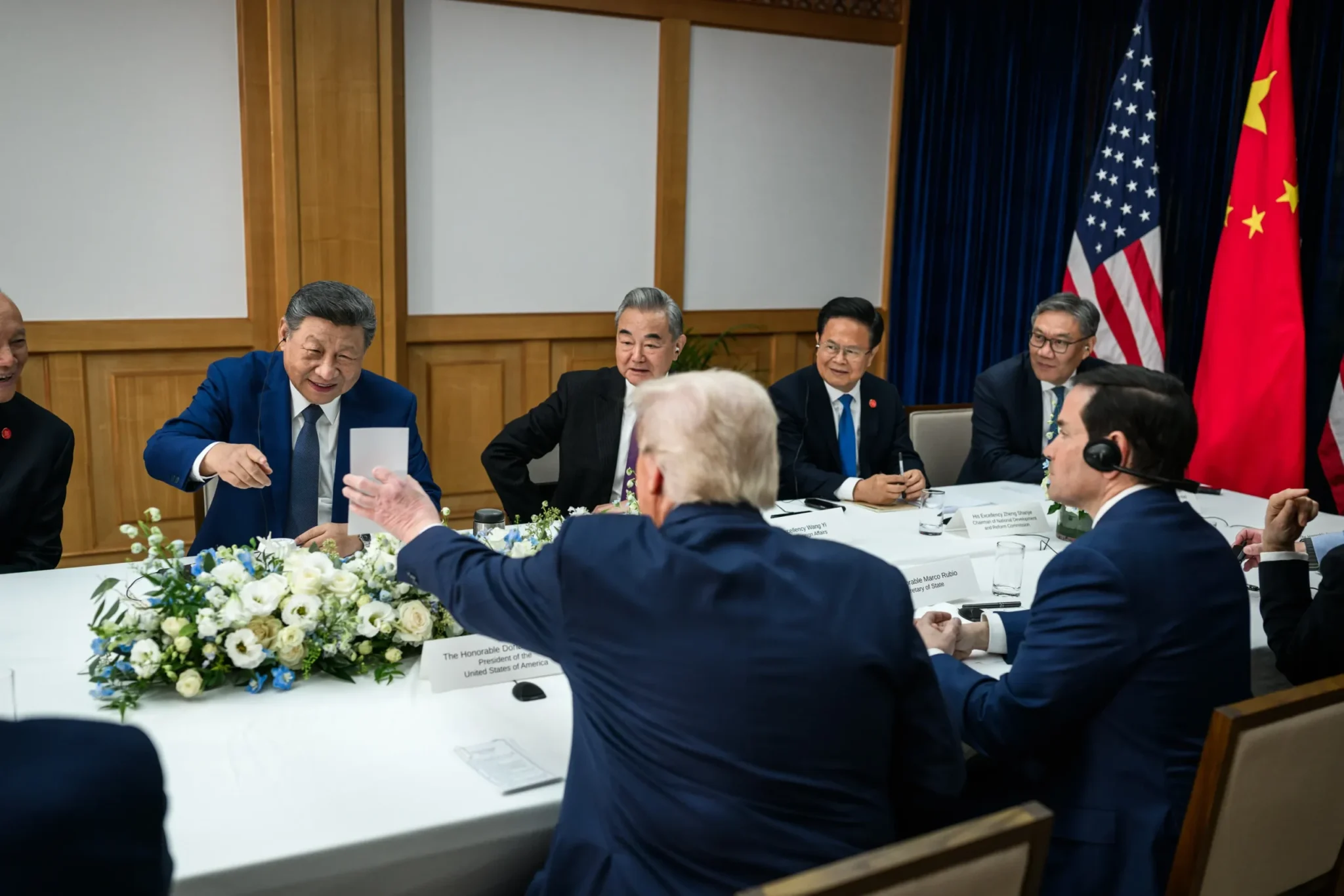
At the Trump-Xi summit in Beijing earlier this month, the two leaders agreed to launch an intergovernmental dialogue on AI, according to the Chinese Foreign Ministry. Beijing will have noted that Washington’s internal debate about even voluntary AI oversight was resolved not by policymakers, but by the companies that stand to profit most from the absence of guardrails.
In a report by the South China Morning Post, Lizzi C. Lee, a fellow at the Asia Society Policy Institute’s Centre for China Analysis, noted that both the US and China are grappling with the same underlying question: where should the regulatory frontier sit for frontier AI, particularly as models become more capable of autonomous action and more relevant to cybersecurity.
“I think a separate, potentially more important race is on governance and safety: not about who has the most advanced models, but who can govern powerful AI without choking off innovation,” she said.
The same report highlighted what Kyle Chan at the Brookings Institution put it more simply: “AI safety and regulation can be done in a way that doesn’t compromise innovation.”
Neither argument was enough on Thursday. Whether it becomes enough next time, assuming there is a next time, remains unclear.
(Photo by White House)
See also: The US-China AI gap closes amid responsible AI concerns
Want to learn more about AI and big data from industry leaders? Check out AI & Big Data Expo taking place in Amsterdam, California, and London. The comprehensive event is part of TechEx and is co-located with other leading technology events, click here for more information.
AI News is powered by TechForge Media. Explore other upcoming enterprise technology events and webinars here.
Read the full article here