



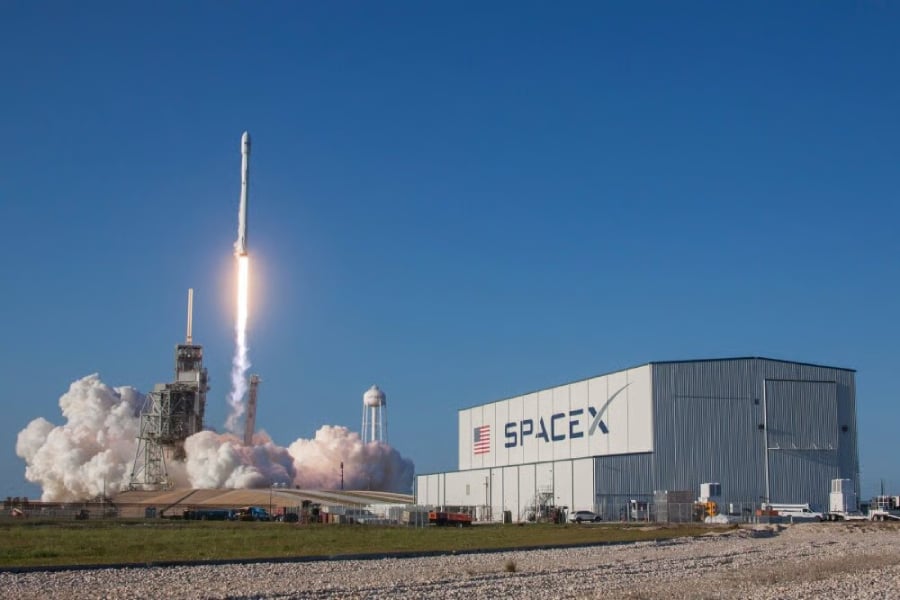

After years of secrecy, SpaceX has finally opened its books.
SpaceX has officially filed for its long-awaited stock market debut, setting the stage for what could become the largest IPO in Wall Street history and potentially making Elon Musk a trillionaire.
The filing described a company that has evolved far beyond reusable rockets. While SpaceX still frames its long-term mission around making humanity “multi-planetary,” the business now spans satellite internet, artificial intelligence, social media, and future in-orbit computing infrastructure. The company plans to trade on the Nasdaq under the ticker “SPCX.”
According to the filing, SpaceX generated roughly $18.6 billion to $18.7 billion in revenue in 2025 but posted losses of nearly $5 billion during the same period. The numbers offered investors their clearest look yet at the company’s finances after years of operating privately.
Starlink is carrying the business
The biggest revenue engine inside SpaceX is no longer rocket launches.
Starlink, the company’s satellite internet business, accounted for more than half of overall revenue last year and nearly two-thirds of sales in the first quarter of 2026, according to reports. The service now has more than 10 million subscribers globally and continues expanding outside North America.
The filing also showed that Starlink is expected to become even more important in the coming years, with projections suggesting it could generate more than 70% of the company’s revenue by 2026. That growth comes as SpaceX pushes deeper into rural broadband markets and international telecom partnerships, areas where the company already has a significant lead over rivals.
AI is becoming central to SpaceX
One of the biggest surprises in the filing was just how aggressively SpaceX is leaning into artificial intelligence. The company revealed that more than half of its capital spending last year went toward AI infrastructure tied to xAI, Musk’s artificial intelligence business behind the Grok chatbot.
TechCrunch reported that SpaceX directed around $20 billion toward AI-related spending in 2025 alone. Despite that investment, the AI division reportedly lost billions and grew more slowly than some competing AI firms.
Still, SpaceX appears convinced AI will eventually become one of its largest businesses. The filing claimed the company had identified “the largest actionable total addressable market (‘TAM’) in human history” valued at $28.5 trillion, with enterprise AI applications making up the bulk of that opportunity.
The company also confirmed plans to fully absorb xAI into SpaceX operations. “AI accelerates SpaceX’s mission to make life multiplanetary, to understand the true nature of the universe, and to extend the light of consciousness to the stars,” the filing stated.
Starship remains the company’s biggest gamble
Even with AI ambitions growing rapidly, much of SpaceX’s future still depends on Starship, the giant reusable rocket system Musk believes will eventually carry humans to Mars. The filing showed SpaceX spent billions developing the vehicle, including roughly $3 billion on Starship research and development in 2025 alone.
SpaceX expects Starship to begin orbital payload deliveries in the second half of 2026. If successful, the rocket would eventually carry next-generation Starlink satellites, support lunar and Mars missions, and potentially launch space-based AI data centers.
The company claims Starship could reduce the cost of reaching orbit by “99% or more” compared with historic launch systems. The filing also revived several futuristic ideas Musk has promoted for years, including point-to-point travel on Earth using Starship rockets, orbital manufacturing facilities, space tourism, and even asteroid mining operations.
“We aim to establish in-space manufacturing facilities that leverage the unique microgravity conditions of space to produce materials, pharmaceuticals, and advanced components that are difficult or impossible to manufacture on Earth,” the filing said.
More must-read AI coverage
Musk tightens his grip
The IPO filing makes clear that Musk will remain firmly in control of SpaceX after the company goes public.
He is expected to continue serving as chief executive officer, chief technology officer, and chairman of the board. Reports indicate he will retain majority voting control through the company’s dual-class share structure.
The filing also revealed an extraordinary compensation package tied to ambitious milestones, including increasing SpaceX’s valuation to $7.5 trillion and establishing “a permanent human colony on Mars with at least one million inhabitants.” Bloomberg reported that Musk’s bonus structure could eventually award him billions of additional shares if those goals are met.
Risks, lawsuits, and political baggage
SpaceX disclosed hundreds of millions of dollars in expected legal costs tied to lawsuits and regulatory investigations involving xAI, Grok, copyright claims, data privacy disputes, and allegations involving deepfake imagery.
The company also acknowledged that investor sentiment around Musk himself could become a factor in the IPO. Over the last two years, Musk’s political activity, alliance with US President Donald Trump, and controversies surrounding X and Tesla have increasingly drawn scrutiny from investors and regulators alike.
At the same time, SpaceX remains one of the few Musk-led companies still widely viewed as operationally dominant. Its launch business, Starlink network, and government contracts with agencies including NASA and the US Defense Department continue to give it a commanding position in the aerospace industry.
Wall Street analysts are already treating the SpaceX debut as the opening act in a new era of massive AI and tech listings, with rivals including OpenAI and Anthropic also preparing potential public offerings later this year.
The filing also raises a broader question about Musk’s next infrastructure frontier: his proposed $119 billion Texas “Terafab” chip plant, which could reshape the AI, robotics, and semiconductor supply chain.
Read the full article here