

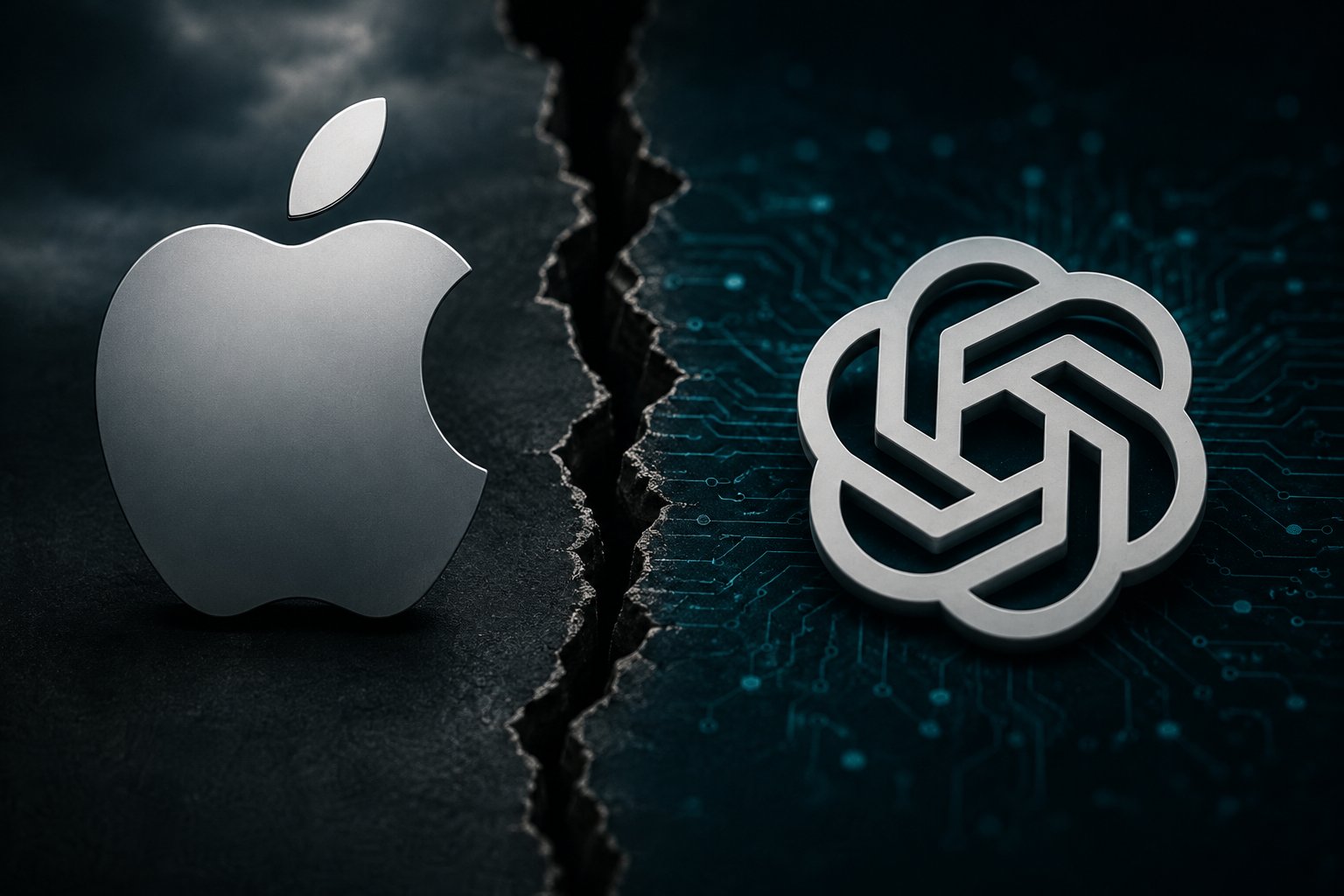

Apple and OpenAI’s AI partnership may be entering its awkward breakup era.
It has been just under two years since Apple announced the integration of ChatGPT into iOS, with users able to see results within Siri and analyze photos through Visual Intelligence in the camera app. At the time, ChatGPT had a commanding lead in the AI chatbot market, and Apple was playing catch-up by integrating a third-party tool instead of launching its own.
The relationship has fractured on OpenAI’s end due to Apple’s lack of interest in further integration and its poor performance in getting more users to sign up for ChatGPT. According to Bloomberg, the AI research lab is reportedly considering legal action against Apple, may stop short of filing a lawsuit, and instead claim Apple breached the contract.
This would only happen after the conclusion of OpenAI’s trial with Elon Musk, which, if it goes in Musk’s favor, could lead to a complete leadership change at the research lab.
Apple’s frustrations with OpenAI
On Apple’s side, OpenAI has been encroaching on its territory, reportedly annoying executives. It was announced in early 2025 that OpenAI and longtime Apple designer Jony Ive were working on an AI device, and then in June that year, OpenAI acquired the AI hardware startup io for $6.5 billion.
This device was originally expected to be a pendant, a non-threatening device that would not compete with Apple’s current portfolio. But rumors suggest OpenAI may be looking at launching an AI agent phone instead, which would be a much more competitive device. Other rumors say it could be a smart speaker or earphones.
How Apple could turn Siri into an AI bidding war
Apple seems to have switched from treating OpenAI as its primary AI provider to auctioning off the position. Google won the contract to work on the next version of Siri, expected to launch at WWDC in June, but it is unclear whether Google will be involved in the virtual assistant’s future development.
The iPhone maker may even look to open up Siri and other iOS features to multiple AI models, with one cost included and a potential additional cost for the default option. This might be a step too far in some regions, however, as Apple has already been in hot water for charging Google up to $20 billion a year to be the default search engine on iOS.
It is far behind others in AI model sophistication, with some reports even suggesting it has given up attempting to build a model at the leading edge. Instead, it may use its iOS moat to maintain control over the AI market, pitting model developers against one another for access.
Why OpenAI’s Big Tech partnerships keep getting complicated
It would not be the first of the “Magnificent Seven” that OpenAI has upset. Its partnership with Microsoft took a sour turn, with OpenAI executives claiming the exclusive commercial agreement was holding them back. That led to a renegotiation that opened the door for OpenAI to be added to Microsoft rival AWS.
This came after Microsoft propped up the fledgling startup with a $10 billion investment alongside preferential access to Azure servers, the cost of which has reportedly surpassed $100 billion.
Apple and OpenAI may be entering a more complicated phase, but the partnership still reflects how much both companies stand to gain from each other. Apple needs stronger AI experiences across iOS, while OpenAI benefits from access to one of the world’s most valuable consumer platforms.
Whether the relationship deepens or becomes more transactional, the next version of Siri could show how Apple plans to balance outside AI partnerships with control of its own ecosystem.
Related reading: For more on Apple’s shifting chip strategy, read TechRepublic’s coverage of its reported Intel manufacturing deal.
Read the full article here