






Asana and monday.com are two popular software providers in the realm of project management. Both have built large user bases, thanks to their broad feature offerings, intuitive interfaces, and flexibility to accommodate a wide range of use cases and team sizes. If you are still torn between the two, I have spent considerable time working with both tools, and I am here to share my experience to help you decide whether Asana vs monday best fits your needs and budget.
- Asana: Best for managing complex projects with multiple layers of tasks
- monday.com: Best for visual task management with custom workflows
1
ClickUp
Employees per Company Size
Micro (0-49), Small (50-249), Medium (250-999), Large (1,000-4,999), Enterprise (5,000+)
Any Company Size
Any Company Size
Features
Agile Development, Budget / Expense Tracking, Document Management / Sharing, and more
2
Wrike
Employees per Company Size
Micro (0-49), Small (50-249), Medium (250-999), Large (1,000-4,999), Enterprise (5,000+)
Medium (250-999 Employees), Large (1,000-4,999 Employees), Enterprise (5,000+ Employees)
Medium, Large, Enterprise
Features
Agile Development, Analytics / Reports, API, and more
3
Miro
Employees per Company Size
Micro (0-49), Small (50-249), Medium (250-999), Large (1,000-4,999), Enterprise (5,000+)
Micro (0-49 Employees), Small (50-249 Employees), Medium (250-999 Employees), Large (1,000-4,999 Employees)
Micro, Small, Medium, Large
Features
Kanban, Project & Portfolio Management
Why you can trust Project-management.com
Over the past four years as a project management writer, I have personally tested nearly 20 PM platforms, and several of them have become part of my own workflow. I have written dozens of buyer’s guides covering a wide range of use cases and company sizes, which allowed me to understand what project professionals need from these tools. Beyond hands-on testing, I design custom scoring rubrics for each evaluation to make sure every platform is assessed accurately and on equal footing, not ranked on gut feel or vendor claims.
My methodology
I evaluated Monday.com and Asana using a weighted scoring rubric across key categories like pricing, features, automation, support, and ease of use. I assigned scores based on standardized benchmarks, applied weighted percentages to prioritize critical areas, and used a curved scoring adjustment to produce a final ranking that reflects both feature depth and usability.
monday vs Asana compared
| My rating | ||
| Monthly starting price | ||
| Standout features |
|
|
| AI capabilities |
|
|
| Integrations | ||
| Support | ||
| Ease of use | ||
|
|
Affordability
Winner: monday.com
| Free plan | ||
| Annual starting price | ||
| Monthly starting price | ||
| User minimum |
When it comes to paid plans, monday has the edge in affordability. Its per-user pricing runs about $2 less than Asana’s, and it offers more paid tiers overall, giving teams greater flexibility to match a plan to their specific needs and budget. For users who want the full feature set, Asana’s top-tier plan comes in at $24.99 per user per month, compared to Monday’s maximum of only $19 per user per month.
Both Monday and Asana offer free plans capped at two seats. However, Asana’s free tier is notably more generous, including access to multiple project views, over 100 integrations, unlimited storage, and a full suite of core task management tools.
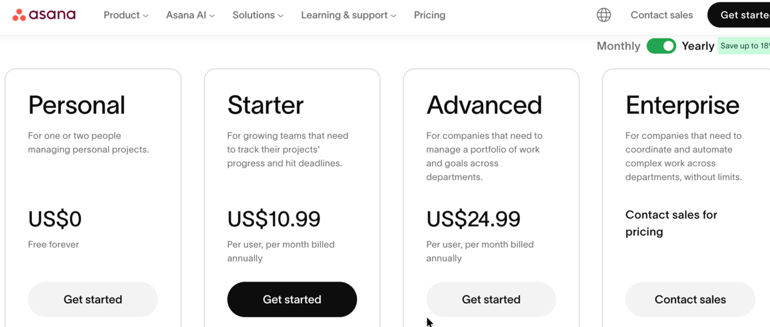
One important pricing quirk shared by both platforms is their bucket pricing model. Rather than charging strictly per seat, both tools sell subscriptions in fixed seat blocks. monday’s plans start at a minimum of three seats and increase in multiples of five, so a team of four would need to purchase the five-seat tier. Asana follows a similar structure, offering plans in blocks of three, four, or five seats. Teams should keep this in mind, as the block purchasing structure can result in paying for unused “ghost seats.”
Project management features
Winner: monday.com
If you’re evaluating monday Asana from a project management perspective, both providers share pretty much the same core capabilities, from task tracking, workflow management, reporting, and integrations.
Task management is the foundation of both tools, where users can create tasks and subtasks, create rule-based automations, and collaborate with other users through @mentions and file sharing. However, their differences come down to structures, with monday.com prioritizing visual flexibility and deep customization, while Asana favors a more standardized, task-first approach for consistency across teams.
Task management
When it comes to task management, I found that monday and Asana take noticeably different approaches to structuring task hierarchies.
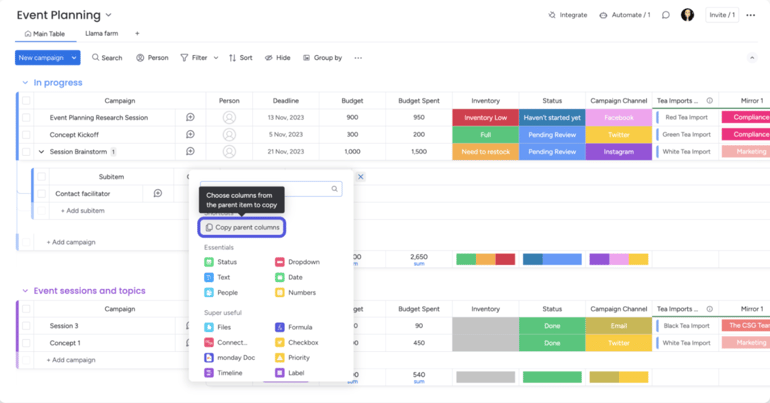
monday is built around grid-style boards with a highly visual, database-like appearance. It is extremely flexible in terms of what data you can track, as each task can carry dozens of customizable columns, such as status, text, numbers, files, formulas, and people tags. I particularly liked that you can add a Location column with an embedded map, a Formula column for budget tracking, or a Time Tracking column on the board.
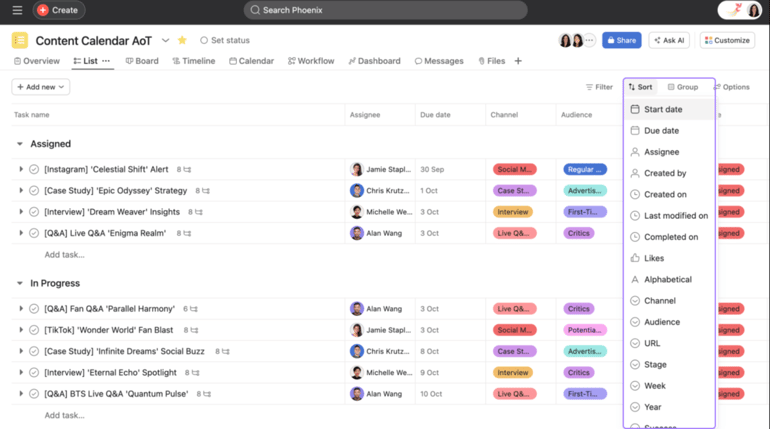
Asana, on the other hand, takes a more standardized approach by treating the individual task as its primary unit. It uses Sections to divide lists and boards, giving it a more traditional project management structure compared to Monday’s group-based layout.
One of Asana’s standout features is the ability for a single task to live in multiple projects. Any changes made to that task, whether a comment or due date, sync across all projects automatically. This eliminates duplication and allows different teams to track the same work within their own workflows. Asana also supports custom fields for tagging and filtering, though its interface is more rigid to maintain consistency across projects and teams.
Both platforms, however, have their limitations. I found that Asana does not support multiple assignees on a single task, which can be a drawback for collaborative work. monday, meanwhile, structures subtasks separately from their parent items on the board, which in my experience can make it harder to see the full picture at a glance and may lead to confusion for some teams.
Collaboration
| Communication features | Task comments, @mentions, and update feed | Task comments, @mentions, and Inbox |
| Document collaboration | ||
| Digital whiteboard |
When it comes to collaborative tools, I found that monday.com leans into built-in creative tools, while Asana focuses more on messaging.
Starting with their similarities, both platforms allow teams to comment on a specific task or item, @mention teammates to bring them into a conversation, and attach files (e.g., images and PDFs) within those threads. Both are powered by AI tools for summarizing comment threads, which is particularly useful for helping team members quickly catch up on long discussions.
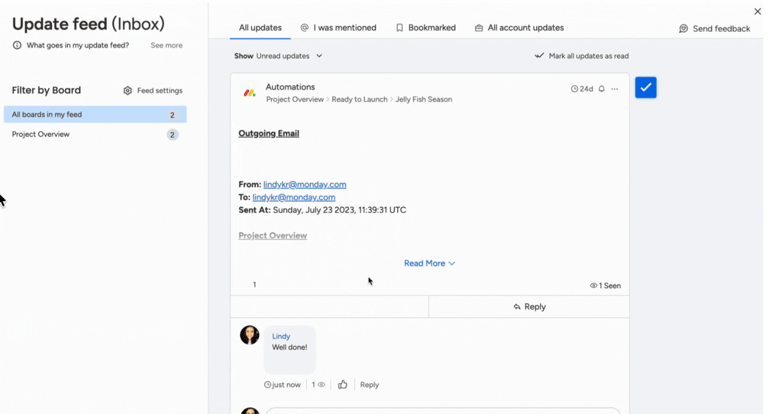
Each platform also has a dedicated space for tracking updates. Asana has its Inbox, while monday.com has an Updates Feed alongside a notification bell. On the guest collaboration front, both providers allow you to invite external stakeholders as Guests to specific projects or boards.
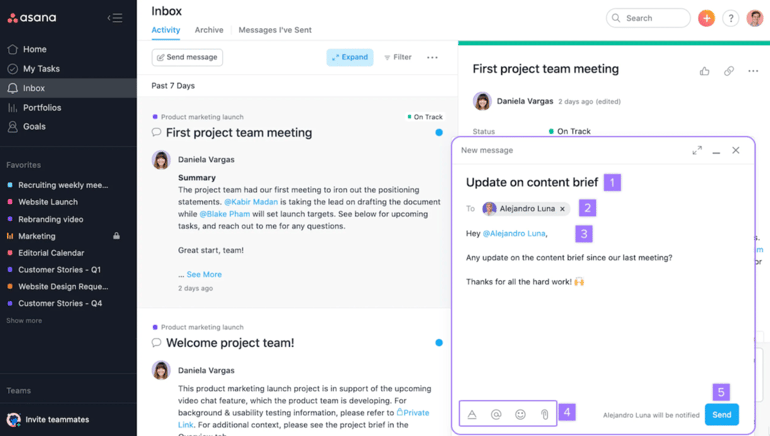
Where the two platforms diverge, however, is in real-time collaboration. Asana lacks native real-time tools like document co-editing and a digital whiteboard for brainstorming. Instead, it leans into asynchronous communication, with a dedicated Inbox for team discussions and status updates for conveying project health.
Reporting
| Primary Structure | ||
| Maximum Sources | ||
| Unique Visuals | ||
| Interactivity | ||
| Delivery |
Both platforms use visual dashboards to turn project data into actionable insights, and I found that both do a solid job of helping project managers monitor progress, though they differ significantly in how those dashboards are presented.
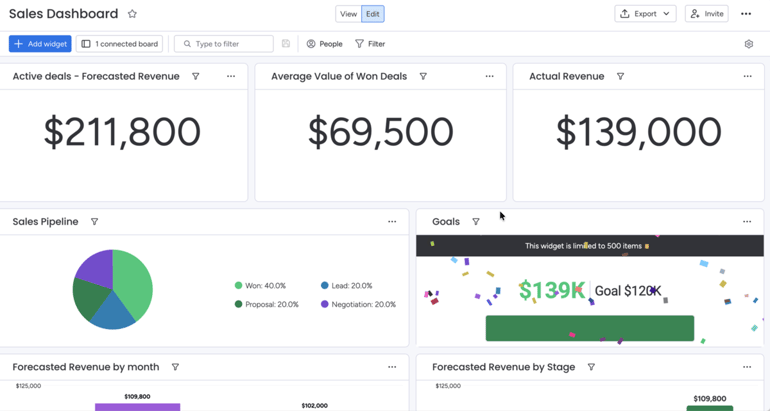
monday’s reporting is built around Widgets. I liked that you can drag and drop specific tools onto a dashboard, such as a Battery widget that displays an overall progress bar across all tasks, or a Numbers widget for calculating total budgets or logged hours.
Asana, on the other hand, takes a more guided approach through its Chart Builder. You select a data source, such as a specific project or an entire team, and then define the X and Y axes based on task attributes like assignee, priority, or custom fields.
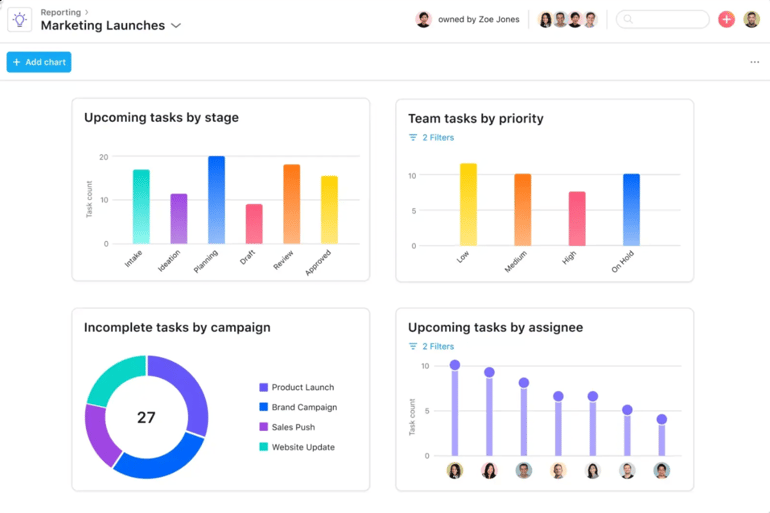
One of Asana’s reporting capabilities that stood out to me is the ability to click into any data point on a chart. Selecting a bar in a graph instantly surfaces the exact tasks behind that data, making it easy to take immediate action on blockers.
monday, meanwhile, emphasizes high-level executive summaries. Its dashboards function more as control centers, combining project data with widgets such as team announcements, quotes, and embedded content.
For resource management, both platforms also include Workload views within their reporting suites, which I found useful for visualizing team capacity and identifying who may be over- or under-assigned.
AI & automation
| Primary AI Helper | ||
| Autonomy Level | ||
| Workflow Build | ||
| Cost Model |
What impressed me about both platforms is how far they’ve evolved beyond basic “if-then” automation into intelligent workflows. Their differences lie in their approach to building those automations. monday uses AI Blocks, where you drag and drop specific AI capabilities, such as sentiment analysis, data extraction, or language detection, into a visual workflow builder to create custom automations.
Asana, on the other hand, takes an optimization-first approach. Its AI audits the Work Graph, which is essentially a historical record of how your team operates, to identify bottlenecks and handoff gaps. It then proactively suggests and builds the specific automations needed to address those friction points.
When it comes to AI assistants, both platforms have introduced dedicated AI suites to help teams summarize comment threads, flag potential risks, draft project plans, and generate executive summaries from existing data.
monday’s offering centers on Sidekick, a chat-based AI assistant that analyzes data across all your boards and documents. I also liked monday’s AI Agents for performing independent tasks like making follow-up calls or sending SMS messages. Asana counters with AI Teammates, which function as intelligent agents embedded in your workflows, alongside AI Studio, a dedicated environment for admins who need to build high-volume workflows where AI handles decision-making at scale.
Integrations
Winner: Asana
Both platforms boast large libraries of app integrations, spanning categories like AI, connectors, HR, development, marketing, sales, time tracking, and communication. In terms of volume, monday comes out ahead with over 850 integrations compared to Asana’s 200+.
When I looked beyond the numbers, I found Asana to be the clear winner in this category. Asana grants access to over 100 integrations on its free plan, with no credit limits on integration runs. monday, by contrast, requires users to upgrade to its second-tier paid plan just to unlock integration access, and even then, runs are capped at 250, which I found to be quite restrictive. To expand that limit to 250,000 integration credits, users would need to upgrade all the way to monday’s Pro plan.
So while Monday technically offers a broader integration library, Asana delivers significantly better value when it comes to accessibility and flexibility, especially for smaller teams or those just getting started.
Ease of use
Winner: Asana
Both platforms maintain high ratings for accessibility, but after looking closely at each, I’d give the edge to Asana for its clean, standardized interface that excels in individual task prioritization. monday, while visually impressive and highly customizable, tends to introduce complexity as teams and workflows scale.
On the Asana side, what stood out to me most is its clean and user-friendly interface. I particularly liked the My Tasks feature, a one-stop shop for managing individual work, so I can prioritize specific items without getting lost in the project view.
monday, on the other hand, draws users in with its visually appealing design. I found that features like the Battery widget and color-coded status columns offer strong at-a-glance visibility. That said, I noticed that performing mass updates can feel tedious when working with large datasets, which is worth keeping in mind for larger teams.
When it comes to onboarding, Asana has the advantage. New users generally encounter a learning curve only when using more advanced features like rules and reporting, but the overall experience remains approachable throughout. With monday, while the initial setup is relatively hassle-free, I found that the learning curve increases once users move into automation and customization.
Customer support
Winner: monday
Between Asana vs monday.com, both platforms offer a wide range of self-service support options. Each offers its own Academy featuring certifications, courses, webinars, and live training, and I found both community forums to be highly active, with users regularly exchanging troubleshooting tips and posting feature requests.
When it comes to real-time support, however, monday has the advantage. It offers a 24/7 live chatbot that can easily escalate your inquiry from AI to a human agent. Asana’s AI chatbot, by contrast, requires you to submit a support ticket before a human gets involved, which I feel adds unnecessary friction when you need quick help.
| Support channels | ||
| Training courses |
|
|
| Community forum |
Alternatives worth considering
If the capabilities of either tool are not appealing to you, consider other monday.com alternatives or see some of our top alternatives to Asana.
| Best for | |||
| Monthly starting price | |||
| Key features |
|
|
|
| Learn more |
|
|
|
Should you use Asana or monday.com?
When deciding between monday.com vs Asana for your business, consider your team’s requirements, the complexity of your projects, and your budget. Both tools offer powerful task management and collaboration features, but they cater to different needs and levels of sophistication. So, which is better between the two?
Based on my assessment, you should choose Asana if:
- You need robust project-planning tools with an intuitive interface.
- Your workflow demands high-level integrations.
- You are managing complex projects with many stakeholders.
Choose monday.com if:
- Customization and flexibility are crucial to your team.
- You value extensive automation capabilities
- Your projects involve creative processes or prioritize visual project management.
FAQs
Is Asana better than Monday.com?
The answer depends on team size and workflow needs. Asana is the stronger choice for small teams that prioritize ease of use and prefer a traditional project management structure. monday.com is the better choice for visual users and mid-size organizations seeking a customizable platform for both simple and complex workflows.
What is the main difference between Asana and monday.com?
Asana focuses on task management with a clean interface ideal for individual productivity. monday is a highly visual, database-style platform built for flexibility and customization. Asana suits traditional project workflows, while monday works better for teams needing custom data tracking.
Which has better AI features, Asana or monday.com?
I find monday slightly ahead, thanks to its AI Blocks and autonomous AI Agents. Asana’s AI Teammates and AI Studio are strong for workflow optimization, but monday offers more customizable AI capabilities across boards and documents.
Read the full article here